
Political Analysis
European Defence Industrial Capacity in Times of War
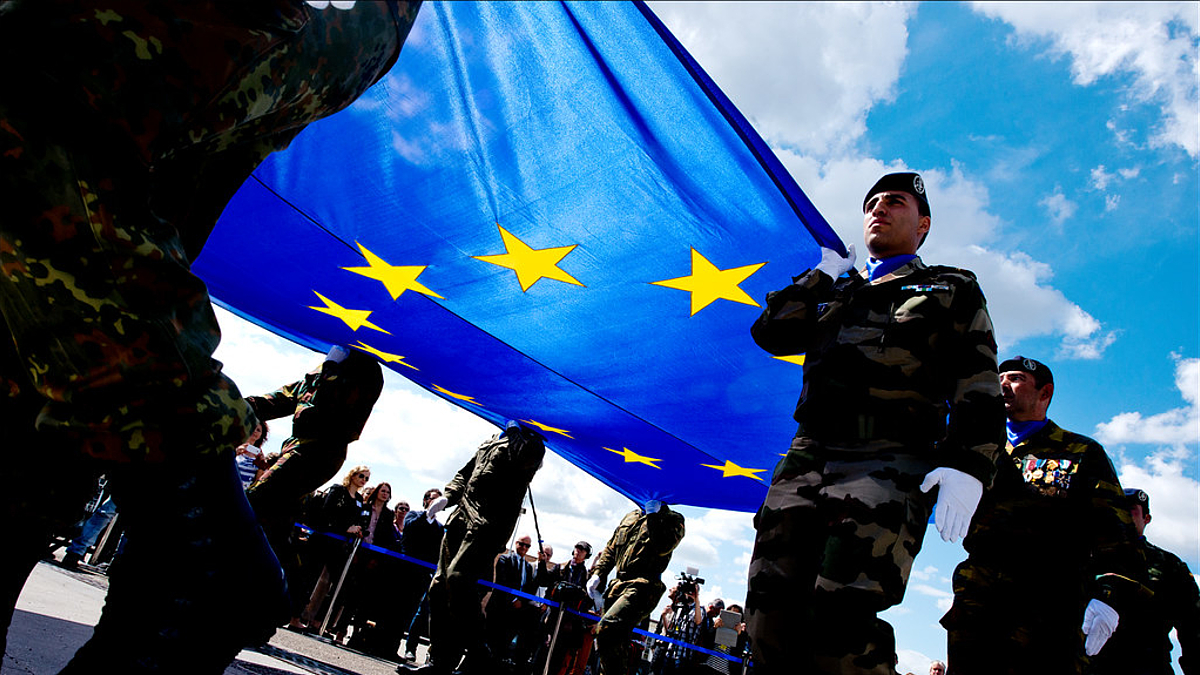
© European Union 2014 - European Parliament; https://www.flickr.com/photos/european_parliament/14521113746
The casual observer might be forgiven to think that Europe is currently losing an arms race with Russia. European governments are spending more money, but industry seems unable to ramp up production fast enough to deliver more military assistance to support Ukraine against Russian aggression and provide, at pace, urgently needed equipment to replenish the depleted and hollowed out inventories that plague most EU and NATO member states. Russia, directly supported by Iran and North Korea, on the other hand seems to be able to fill its sizeable battlefield losses in Ukraine, even if it does so with equipment of lesser quality.
Russia has placed its economy on a war footing with clear costs for other sectors and government services. Europeans, while increasing defence spending, have not done the same. Nearly a third of all Russian government spending is now spent on defence. In the UK a roughly comparable figure for 2022-23 is around 5%, in Germany less than 3%. According to IISS data, Moscow’s total defence expenditure amounted to $108.5bn in 2023 but expressed in purchasing power parity terms – an appropriate metric because Russia can purchase a lot of required equipment, services, and labour domestically and thus at a lower cost base – that equals almost $300bn. Which is more than all EU nations combined spend on defence in 2023. Russia is furthermore beefing up its production numbers by, for example, pressing into service old and now refurbished armoured vehicles that had been withdrawn from active serve and were stored, sometimes for long periods, at sites across Russia. Russia is pursuing a war of aggression, European governments are trying to support a partner, Ukraine, and at the same time rebuild their own deterrence and defence posture. While the comparison with Russia is thus skewed and, in some ways, misleading, it remains puzzling why European governments in the EU and NATO struggle to equip their armed forces and why industry struggles to meet the increasing demand.
Peace dividend eats industrial capacity
Defence industrial capacity is a complex interplay of factories and facilities, of machines, tools, software, of a skilled workforce and an extended supply chain requiring access to components and materials that are sometimes rare and often specialised. During the Cold War, European governments were content to finance a degree of defence industrial overcapacity in Europe with notable degrees of overlap and duplication. In the almost 25 years from the end of the Cold War to Russia’s annexation of Crimea in 2014, European domestic demand for defence equipment progressively declined, defence budgets decreased and armed forces shrank in size. Advances in technology and capability furthermore meant that production runs could be smaller as platforms that were being retired were unlikely to be replaced like-for-like in terms of numbers because new systems would be more capable. The government mantra at the time, when European armed forces were busy but largely in crisis management operations that were not designed to deal with existential threats to the homeland and certainly did not require much magazine depth as far as ammunition and stocks were concerned, was to do more with less, seeking to implement cuts without lowering ambitions.

Bastian Giegerich; IISS
Industry took business decisions that were rational in that political context. First, to follow the money and seek new international export markets for its products. Defence export regulations, however, limit the extent to which this can replace home markets. Second, to engage in a degree of consolidation, including through mergers and acquisitions. Third, to simply reduce production lines or reorient towards maintenance, repair, and overhaul of existing equipment.
A new defence industrial paradigm
Reversing the recent trend of policy-led managed decline will take patience, money, and political and industrial leadership. In the period between 2014 and February 2022, when Russia began the full-scale invasion of Ukraine, a period that also included Donald Trump’s time as 45th president of the United States, the reality of a deteriorating security environment dawned on European capitals. It let to gradual change in spending patterns and a revision of defence ambitions upwards, not least through the adaption processes that NATO initiated beginning at its 2014 Wales summit. The effects of these measures, however, were limited in terms of military capability and defence industrial capacity.
Russia’s war of aggression must change the European defence industrial paradigm again. Whereas quality was a clear focus in recent decades when it came to defence equipment, quantity is now again seen as an important metric in its own right. While efficiency was an important defence industrial goal, security of supply and guaranteed access have re-entered government strategies and speeches of leaders as dominant themes. Where long lead times and cumbersome procurement processes were an accepted part of the defence industrial equation there is now a rebalancing in which speed is gaining in importance in comparison to cost. Where original equipment manufacturers with a deep defence background dominated, the emerging defence industrial ecosystem needs to be more complex. Technology firms rooted in the civilian world are considering the defence implications of their work, and new defence technology companies, specifically aimed at this sector, are entering the market, sometimes challenging, sometimes collaborating with the established players.
Competition is further increased by the fact that defence industrial bases in other countries have grown in scope and sophistication while Europe’s was in decline and the number of international defence companies seeking to export to Europe has risen. Some of these new entries have in the past used offsets and technology sharing arrangements and occasionally acquisitions to help them make the journey from customer to producer and ultimately competitor.
Balancing policy requirements
This new defence industrial paradigm is not settled yet and has not bedded in as far as policy and processes and resources and regulations are concerned. European leaders minded to embrace this challenge and seeking to visibly strengthen European defence industrial capacity – and thereby the ability of European nations to provide for their own security and defence – will need to tackle a number of issues. Both NATO and the EU are important arenas, alongside the national level, to do so. New force structure targets and defence plans agreed at NATO’s 2023 Vilnius summit will need to drive defence investment decisions, military readiness, and command and control arrangements. The EU launched its first ever European Defence Industrial Strategy in March 2024 – the associated financial envelope is comparatively small and the envisioned procedures not exactly intuitive, but the goal is to boost defence industrial capacity, reduce dependencies on external suppliers and work together more as Europeans. On the national level, a new dialogue between defence industry and governments has begun. German vice chancellor and economics Minister Robert Habeck underlined the need to increase defence production during a meeting with industry leaders in March and French minister for the armed forces Sebastien Lecornu had suggested in the same week that France might consider requisitioning defence industrial assets to boost production.
The issue of defence industrial capacity has thus arrived at cabinet tables in Europe. Vladimir Putin’s war of aggression, but also the realization that US domestic priorities have shifted away from European security issues independent of who wins the 2024 US presidential election, have made sure of it.
As this discussion unfolds, it will be important to consider defence industrial capacity a core component of military capability and an element of deterrence. A group of nations that maintains and operates a capable defence industrial base sends a signal that it is invested in its defence. This conclusion does not mean that European governments should only buy European. Finding the appropriate balance is a difficult job and is not risk free. Waiting until European solutions are available will sometimes create short- and medium-term vulnerabilities in form of capability shortfalls that not all nations will be comfortable with. However, failing to invest on European defence industrial capacity now will reduce the ability of Europe’s industry to provide the capabilities of tomorrow. Filling gaps while investing for the future will be very expensive. This coming cost is to a good part the result of the political choices of the past and the security environment of today and of the future.
Industry will rightly demand better information on and visibility of forward requirements from governments to increase the predictability of their future business. If governments would like to encourage greater industrial risk taking and help to unlock innovation potential, it would be good to shed the peacetime mindset that still characterises procurement processes and regulations. Defence establishments are familiar with the idea of urgent operational requirements where greater risk would be accepted in the procurement process to get something done faster because a deployed in the field needs it. Today, rebuilding defence industrial capacity is an urgent operational requirement.
IISS
About the author
Dr. Bastian Giegerich is the head of the International Institute for Strategic Studies (IISS). Previously to his current position he directed the Institute’s Defence and Military Analysis research program. With a background in research and policy roles at the German Federal Ministry of Defence, he's authored books on European security, taught international relations at esteemed universities, and holds a master’s in political science and a PhD in international relations.
Kontakt
