
Short Article
What Ethiopia's New Hydroelectric Dam Means for Egypt
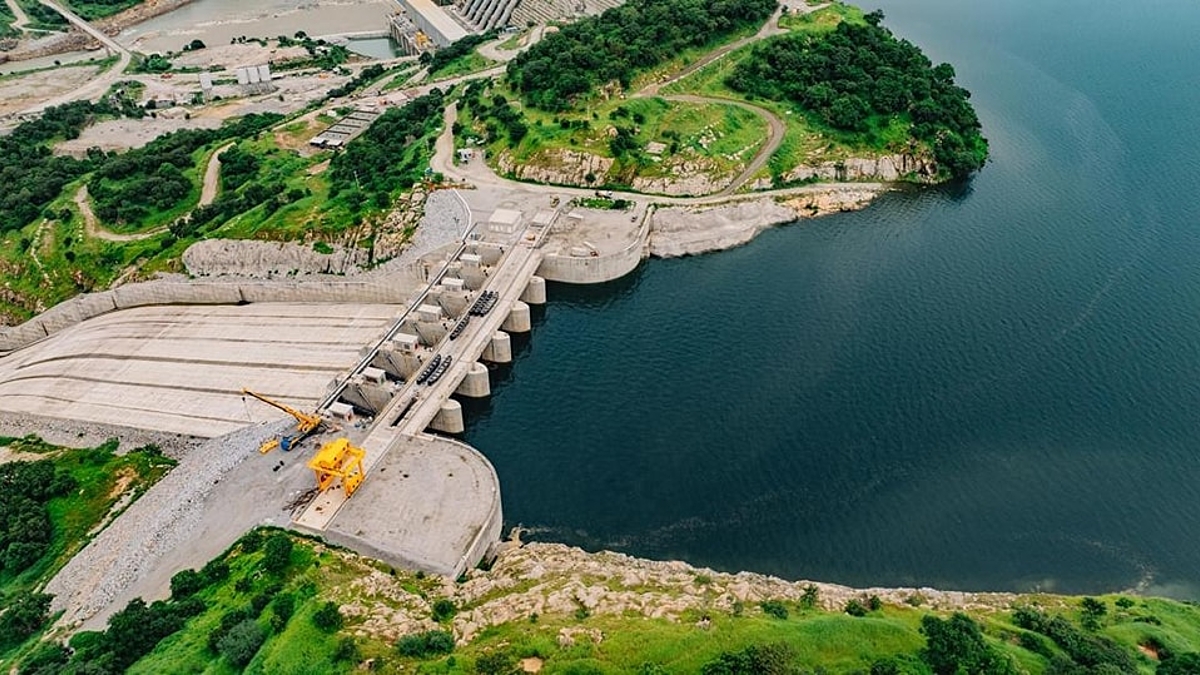
The GERD dam from aerial view
Prime Minister Office Ethiopia; https://www.facebook.com/PMAbiyAhmedAli
A Century long Dream Realized
On Tuesday, September 9, 2025, Ethiopia inaugurated the Grand Ethiopian Renaissance Dam (GERD). The project has been in the making for more than a decade and dreamed of for a century. Costing $4.6 billion, the dam measures 170 meters in height and stretches nearly 2 km across the Blue Nile. It can hold 74 billion cubic meters of water and generate 5,150 megawatts of electricity, comparable to the output of four modern nuclear power stations and more than double Ethiopia’s current power capacity (Endeshaw, 2025).
For Ethiopia, the GERD is not only an economic project but also a symbol of sovereignty. Construction, running from 2011 until 2025, was financed 91% by the state, with the remaining 9% covered through bonds and donations from Ethiopian citizens (Mureithi, 2025). The financial independence has been strongly emphasised by the government. The dam is communicated as a unifying cause in a country often marked by internal unrest.
The benefits for Ethiopia are clear. The dam will secure future energy supply, create opportunities, and stabilise the economy. Ethiopia is now in a position to export power to neighbouring countries such as Sudan, Kenya, and others. This gives Addis Ababa new political leverage in the region and challenges Egypt’s traditional dominance along the Nile.
Nile as Egypt's Lifeline
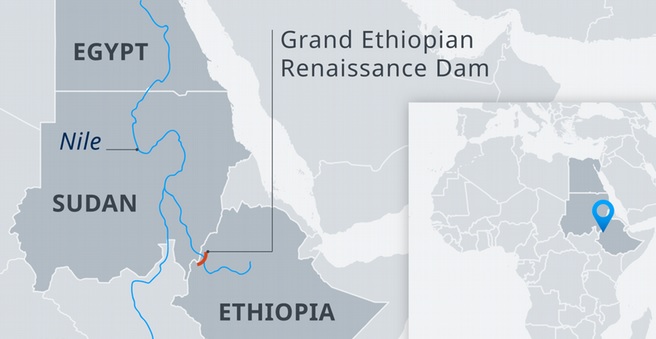
For Egypt, however, the picture looks far less optimistic. The country experiences very little rainfall. Around 93% of Egypt is desert, with nearly all of its 116 million people living along the Nile. The river provides 97% of the country’s water needs, making it a lifeline for agriculture, industry, and daily life (Khayry, 2022).
The Nile’s flow into the Mediterranean varies but is roughly 2,700 cubic meters per second, with 85% of that water originating from the Blue Nile. Egypt fears that in times of drought, the filling and operation of GERD could drastically reduce its water supply. The Foreign Ministry has appealed unsuccessfully to the United Nations (UN) Security Council, claiming that Ethiopia’s creation of the dam violates international law (Salman, 2013).
Sheetal Sinha; https://commons.wikimedia.org/wiki/File:Grand-Ethiopian_dam.jpg
Water Security and Climate Change
In Egypt, the per capita water availability is at just 660 cubic meters and thus, far below the 1.000 that signify the international scarcity threshold (Fanack, 2024). To solve this, Cairo started investing billions in water projects, e.g., $2.5 billion alone for 14 desalination plants (Ecofin Agency, 2021) supposed to be finalized by 2030. Agriculture, which is the major consumer of Egyptian water, is targeted for change as historic practices of flooding are not feasible anymore and are thus replaced by drip and sprinkler systems.
All of the already persisting problems intensify with the addition of global warming. The rising temperatures evaporate the water in Egypt's own dam, losing around 10 billion cubic meters a year. By 2030, the renewable water share is projected to drop to 500 cubic meters per capita per year which is reaching the UN-defined “absolute water scarcity” level. Rainfall in the Nile basin is becoming more and more erratic with long droughts and short periods of extreme rain. This global warming-influenced change leads to an even less predictable flow of the Nile, making water resource planning a nightmare (Wheeler et al., 2020). The rise of the sea level lastly means that saltwater is further pushed up the Nile, making the ground unusable for agriculture and leading to food shortages (Badawy et al., 2024). Layered on the existing population crisis, this could mean that even a small change from the GERD can tip the scale and lead to a water crisis in Egypt.
Regional Tensions
Politically, the impact of GERD has been predictable. Cairo had been protesting the construction for years. The previously mentioned independence and self-sufficiency of Ethiopia can also be read as a fear that other countries to invest, with only China lending money for turbines. Egypt, with clearly the most influence and the largest military along the Nile, has been reaching out to Ethiopia's neighbouring countries, creating a precarious situation for the country (Ilkbahar, 2024).
Sudan is caught in a dilemma. The country cannot afford losing Egypt as an ally. The fear of droughts is present as well, but Sudan also has to fight floods devastating parts of the country, so GERD could help regulate the incoming water of the Blue Nile. Furthermore, GERD could provide the struggling country with cheaper power (Dr. El Menawy, 2025).
Eritrea’s history with Ethiopia has been shaped by decades of distrust and war. Cairo, on the other hand, has been moving closer to Eritrea in the past decade, expanding its influence.
Lastly, Egypt has built ties with Somalia, supplying weapons and military aid amid its civil war. This support is partly strategic; Somaliland’s discussions with Ethiopia over granting sea access threaten Egypt’s regional position, making Somalia a natural partner (Sheik, 2024).
This exemplifies that GERD is more than a dam. It is a turning point for Eastern Africa, altering the new and challenging old power structures, forging rivalries and new alliances alike.
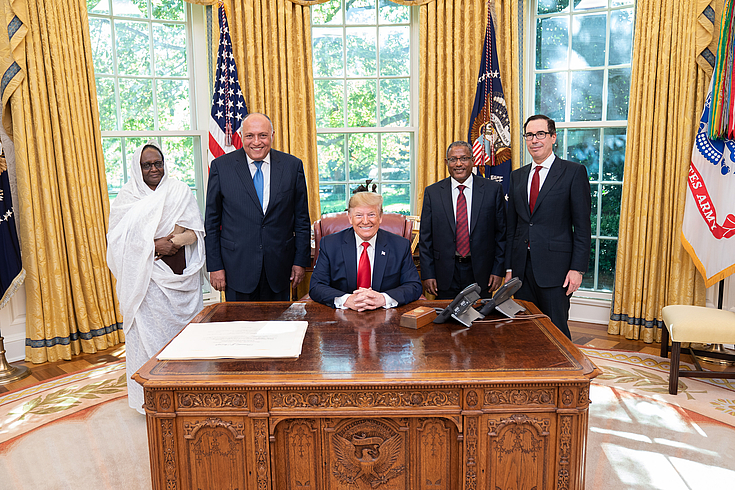
(2019) President Donald J. Trump, joined by Secretary of the Treasury Steven Mnuchin, meets with the Minister of Foreign Affairs of the Republic of Sudan Asma Mohamed Abdalla, left, the Minister of Foreign Affairs of the Republic of Egypt Sameh Shoukry, and the Minister of Foreign Affairs of the Federal Democratic Republic of Ethiopia Gedu Andargachew, in the Oval Office of the White House Wednesday, where President Trump expressed his support for Egypt, Ethiopia, and Sudan’s ongoing negotiations to reach a collaborative agreement on the Grand Ethiopian Renaissance Dam
Shealah Craighead); The White House; https://www.flickr.com/photos/whitehouse/49025412566/
Diplomacy
In this regard, de-escalation is not just important for Egypt and Ethiopia but also the whole “Horn of Africa". The African Union (AU) has hosted multiple negotiations. They hold large symbolic value, but without any incentive or power, the negotiations couldn't move the entrenched positions.
The European Union (EU) and especially the United States (US) also attempted talks. Ethiopia rejected Washington’s role in 2020 as obviously biased toward Cairo. This dented Western credibility, leading to the EU and US becoming non-players outside of technical aid on irrigation or climate adaptation (Mbaku, 2020).
True de-escalation has to originate from the People's Republic of China and the Gulf states. China financed and built GERD infrastructure. Simultaneously, Beijing holds strong trade ties with Egypt and invests in the Suez Canal. This influence also increased as both countries joined BRICS in 2024, giving China a platform for brokering.
The United Arab Emirates (UAE) invests in Ethiopian agriculture and port access, as well as in military and financial support for Cairo. This gives the UAE incentive on both sides, similar to China. Unlike the AU or United Nations, the UAE can back diplomacy with hard cash and infrastructure deals.
A Shared Future
What the future holds is still unclear, but one thing is certain: the resource of water will continue to rise in value. This makes the GERD both a wonder for the Ethiopian economy and also a tightrope-balancing act between cheap electricity exports, appeasing Egypt, and risking a water war on the Nile. This challenge will most likely define the two states’ near future. Diplomacy and a shared plan for all the countries on the Nile are needed, and the international community should strive to support equitable negotiations.
Sources
Badawy, A., Abdelaziz, O., & Hassan, S. (2024). Floods of Egypt’s Nile in the 21st century. Scientific Reports. https://doi.org/10.1038/s41598-024-77002-8
El Menawy, A. (2025, July 20). Why the Nile dam crisis demands action from the global community. Arab News. https://www.arabnews.com/node/2608804
Endeshaw, D. (2025a, September 9). Ethiopia launches Africa’s largest hydroelectric dam. Reuters. https://www.reuters.com/sustainability/boards-policy-regulation/ethiopia-launches-africas-largest-hydroelectric-dam-2025-09-09
Endeshaw, D. (2025b, September 9). Ethiopia opens Africa’s largest hydroelectric dam to Egyptian protest. Reuters. https://www.reuters.com/sustainability/boards-policy-regulation/ethiopia-opens-africas-largest-hydroelectric-dam-egyptian-protest-2025-09-09
Fanack. (2024, June 5). Water resources in Egypt. Fanack – Water Resources. https://water.fanack.com/egypt/water-resources-in-egypt/
İlkbahar, H. (2024). Egyptian foreign policy and the Nile River: A historical analysis. İçtimaiyat, 8(2), 369-384.
Khayry, F. (2022). The Grand Ethiopian Renaissance Dam and Egypt’s water security. Undergraduate Research Journal, 8(1), Article 2. The American University in Cairo. https://fount.aucegypt.edu/urje/vol8/iss1/2
Mbaku, J. M. (2020, August 5). The controversy over the Grand Ethiopian Renaissance Dam. Brookings Institution. https://www.brookings.edu/articles/the-controversy-over-the-grand-ethiopian-renaissance-dam/
Mureithi, C. (2025, September 9). Ethiopia inaugurates Africa’s largest hydroelectric dam, deepening rift with Egypt. The Guardian. https://www.theguardian.com/world/2025/sep/09/ethiopia-inaugurates-africa-largest-hydroelectric-dam-egypt-rift-deepens
Sheikh, A. (2024, September 23). Egyptian warship delivers arms to Somalia, officials say. Reuters. https://www.reuters.com/world/africa/egyptian-warship-delivers-arms-somalia-officials-say-2024-09-23
Salman, S. M. A. (2013). The Nile Basin Cooperative Framework Agreement: A peacefully unfolding African spring? Water International, 38(1), 17–29. https://doi.org/10.1080/02508060.2013.745074
Wheeler, K. G., Jeuland, M., Hall, J. W., Zagona, E., & Whittington, D. (2020). Understanding and managing new risks on the Nile with the Grand Ethiopian Renaissance Dam. Nature Communications, 11(1), 5222. https://doi.org/10.1038/s41467-020-19089-x

About the Author
Julian Pretzl is a Bachelor’s student of Liberal Arts in Social Sciences at Tallinn University. He is currently completing an internship at the Hanns Seidel Foundation’s Cairo office, where he supports research, project coordination, and communication tasks.
Kontakt
