
Partnership for Mutual Benefit
Quo Vadis Global Gateway?
Visit of Ursula von der Leyen, President of the European Commission, to South Africa Wall display for the South Africa-EU leaders' meeting (C) European Union, 2025
Global Gateway is the EU’s flagship initiative to promote sustainable investment in partner countries. It is designed as a values-based alternative to other global investment programmes, particularly China’s Belt and Road Initiative, and combines foreign policy, economic, and development objectives. According to the European Commission, more than 270 flagship projects had been identified and around €306 billion mobilised by the end of 2024. However, the report criticises the lack of transparency in how this figure has been calculated.
In the report, the European Parliament highlights the growing geopolitical relevance of Global Gateway, particularly in the context of increasing global competition and declining levels of development financing. At the same time, it points to shortcomings in implementation. Governance is seen as highly centralised and driven by the Commission, while transparency in project selection, the involvement of partner countries, and the participation of civil society and the private sector are considered insufficient. The rapporteurs therefore call for a shift from a top-down approach to needs-based planning, as well as improved monitoring and evaluation mechanisms.
“To succeed, Global Gateway needs faster decision-making, clearer governance, and financing instruments that genuinely support the private sector, along with better alignment with national and regional development priorities,” said rapporteur and Chair of the European Parliament’s Committee on Development, Hildegard Bentele (CDU). “Only then can we build sustainable, long-term partnerships that benefit all sides.”
Next steps: strengthening governance, increasing impact
Looking ahead, the report recommends reforms to governance structures, including a stronger role for the Global Gateway Board, enhanced parliamentary oversight, and closer coordination between EU institutions and Member States within the “Team Europe” framework. It also calls for a clearer anchoring of Global Gateway in the EU’s future external financing architecture, particularly in the successor instrument to NDICI – Global Europe for the 2028–2034 budget period. This could enhance the initiative’s contribution to sustainable development, strengthen the EU’s global role, and support a rules-based international order.
At the same time, the Parliament stresses that EU development cooperation must remain focused on poverty reduction and human development, particularly in areas such as health, education, and social protection. Investments should also strengthen local value creation, employment, and small and medium-sized enterprises in partner countries, while avoiding the creation of new debt risks.
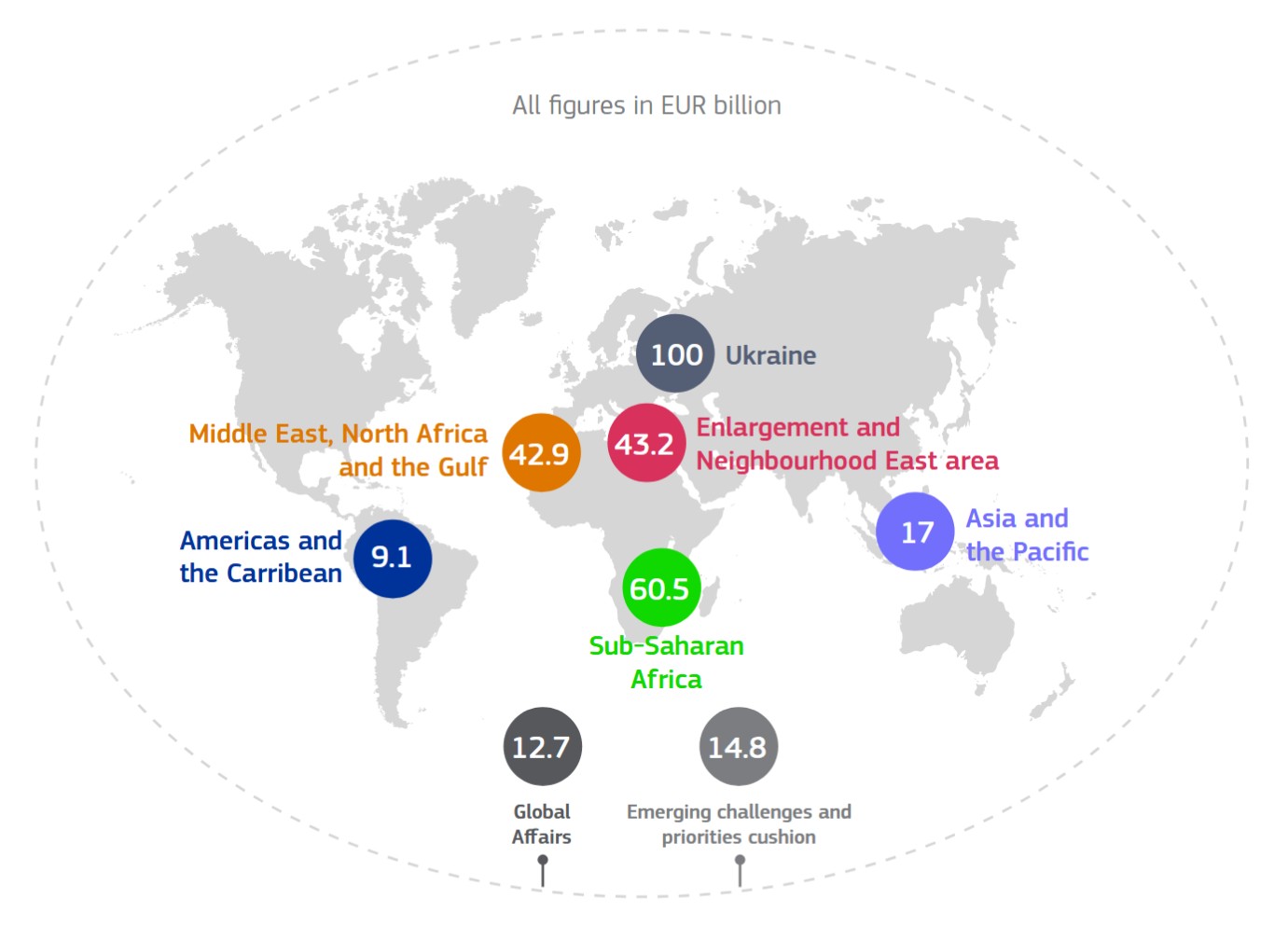
Figure: Global Europe Instrument in figures
Linking strategic interests and development cooperation
To assess the Global Gateway strategy and the reorientation of the EU’s international partnerships under the Global Europe instrument (see figure), the concept of “mutual interest ODA” can provide a useful analytical framework. This approach seeks to identify areas of development cooperation that generate evidence-based positive effects for both donor and recipient countries. The concept was proposed by Tobias Heidland et al. in a working paper for the Kiel Institute for the World Economy published in June 2025.
Empirical examples illustrate the potential of this approach. Instruments such as Aid for Trade produce positive outcomes for both donors and recipients by increasing exports as well as foreign direct investment. Similarly, development funding deployed in post-conflict settings to stabilise partner countries generates strong benefits on both sides. In other cases, the positive effects of development cooperation are less direct and harder to measure, for example in relation to geopolitical interests such as influence in the United Nations or through the use of soft power.
The concept of mutual interest ODA can also serve as a guiding principle for the further development of Global Gateway. Development cooperation is no longer understood as a one-sided transfer, but as a strategic investment in shared stability, prosperity, and resilience. When designed effectively, projects can simultaneously contribute to sustainable development in partner countries and advance key EU interests—for example by strengthening supply chains, opening new markets, reducing migration pressures, or enhancing security.
For the EU’s international partnerships, this implies a stronger focus on areas where development objectives and European interests credibly overlap. This requires a clear alignment with the needs of partner countries, transparent criteria for project selection, and a consistent focus on impact. Only if development cooperation is framed as a genuine partnership with tangible benefits for both sides can it remain politically sustainable in the long term and contribute to strengthening the EU as a global actor.
Contact

Program Manager