
Weaving the Threads of Influence: Serbia's International Dynamic
Introduction
With the Russian attack on Ukraine in February 2022 has supplanted the COVID-19 as the main crisis affecting European continent, Western Balkans found itself in new, dynamic shifts. From EU and NATO point of view, the missions in Kosovo (KFOR) and Bosnia and Herzegovina (EUFOR Althea) had to be strengthened immediately. As Putin’s army marched towards Kiev, the worry was that it could be a signal for other actors to act in other areas, and these Balkan polities were deemed as neuralgic hotspots.
April 2022 general elections in Serbia – for the president, parliament and local assemblies – were held in the shadow of both war and strong domestic polarization. The war and the start of sanctions regime against Russia became a hot topic in the campaign. Immediate decision by the president, and then by the Government, was to refrain from joining the sanctions regime. This policy has remained unchanged so far, and it is quite certain that it will remain so under the ruling coalition of Serbian Progressive Party (SNS) and Socialist Party of Serbia (SPS). That was not really a surprise. The main consistency that has characterised Serbian foreign policy over the last decade is that Serbia has never joined declaration or specific measures by the EU aimed at Russia or China.
Zooming into the Balkans, the complex issue of relations with Kosovo is still unresolved. Belgrade is constantly accusing the Priština authorities for not holding up their part of the two previous deals, the Brussels (2013) and Ohrid (2023) agreements. To be fair, the EU, USA and Quint countries are also putting pressure on prime-minister Albin Kurti to honour the creation of Association of Serbian majority municipalities and to refrain from the unilateral moves against the Serbian community in north Kosovo. The relations remain tense, and are far away from vaunted ‘normalisation’ that is being sought. This is hobbling Serbian relations with the EU but to a degree its regional position as well. Serbian-Kosovo relations are spilling over few regional initiatives such as CEFTA or Common Regional Market, as vehicles for further economic liberalisation across the region.
Serbia’s EU integration process has really stalled, as only new one cluster of negotiation chapters (Cluster 4) has been opened over the last four years. Main problems in this process remain well known: Serbia’s poor record in tackling high corruption, its judicial weakness and poor state of political and media freedoms; its non-alignment with the EU on the matter of sanctions towards Russia. Serbian government is used to, and fairly well adapted to navigating these issues and keeping itself in power.

Haisollokopas; https://commons.wikimedia.org/wiki/File:Russo-Serbian_Friendship_flag.png
The Diminishing Russian Role
Relatively strong contemporary Serbian – Russian ties have at least two bases. One is historical, where the narrative is one of ‘Slavic’ or ‘Orthodox’ brotherhood, of mutual affinities or at least of collective positive perception. Serbia has no historical experience of Russian or Soviet attack or occupation, no specific baggage to burden the political relations. The other base is quite political. As the process of Kosovo’s detachment from Serbia from 1999 took place, and its independence was gaining shape in the last phases of unsuccessful negotiations in 2007/2008, Serbia looked for partners at the global stage to stop or to slow down that process. As the majority of EU countries and the USA stood firmly on the side of Kosovo’s unilateral declaration of independence in February 2008, Serbia turned to the UN and especially to Russia and China as the permanent members of the UN Security Council to block the wave of recognition of Kosovo’s independence.
At the same time, Serbia signed a first strategic partnership agreement with China, and sold its state-owned oil company and de-facto monopoly, NIS, to Russia’s Gazprom Neft. Belgrade also wanted to continue down the path of EU membership, and thus the policy ‘both Kosovo and the EU’ was born, alongside with the ‘four pillars’ of Serbian foreign relations (EU, USA, Russia, China). This is the bedrock of multi-vector approach to major powers, where the interest of keeping some sovereignty over Kosovo is the key, and the room for manoeuvre in relation to all actor is always a premium. As the SNS-SPS coalition took power in 2012 it gave much more room to positive news coverage of Russia and especially to Putin’s personal image. Both him and Russia remain strongly popular in Serbia, but especially so with the electorate of the ruling parties. By the end of the last decade, Serbia bought complex military hardware from Russia (Pantsir air defence system), got involved in large scale military exercises with both Russia and Belarus (‘Slavic Brotherhood’ exercises), even thought the majority of Serbian Military international activities was decidedly held with NATO or NATO member states’ militaries. Serbia received six MiG-29 fighter planes from Russia as a gift in 2018, that were modernized in Belarus. Also, some 30 fairly modern tanks T-27B3 in 2020.
Economically, last major state-to-state agreement came in 2013 with a railway credit agreement to the tune of $800 million. The credit was used over next ten years for the construction of some new and refurbishment of some old rail lines. Russia is still the main gas supplier to Serbia. Now the gas mostly comes through ‘Turkish Stream’ via Bulgaria, instead through Ukraine and Hungary which was the main route before 2022. Serbia is engaged as a partner for developing gas lines with Bulgaria and Greece, to connect regasification facility in the Greek port of Alexandropoulos in the Aegean, with consumers in Bulgaria and Serbia, all co-financed by the EU. Such a facility will accommodate LNG tankers, which will finally allow for competition in Serbian domestic market that was completely held by the Gazprom. Despite strong ties, economic relations have dwindled as a result of sanctions and overall expulsion of Russian economic interests from most of Europe. Gas lines, NIS as an oil company with refineries and dominant market position, and some trade lines in agriculture that are important for Serbia, remain as essential link.
Serbia is regularly criticised for not joining the sanctions regime against Russia, and it remains one of three major stumbling blocks on its EU integration path. Also, this remains as a constant public issue in regional relations, where Serbia is easily portrayed as a ‘Russian ally’, ‘Russian hand in the Balkans’ etc. But effectively, none of that is truly correct, as whatever remains of the Belgrade – Russia link has any political teeth left in it. Serbian president is rarely ready to meet any of the Russian dignitaries, and he has seen Putin only once since the start of the war, in October 2023 on the sidelines of the Belt and Road summit in Beijing. He has refused to go to Russia even for multilateral summits, such as BRICS+ summit in October this year for which he was officially called, stating that he has already too many obligations at home and internationally. He has practically delegated the public side of the Russian relationship to Aleksandar Vulin, deputy Prime-minister, already seen as the main pro-Russia member of the government. But Vučić keeps communication channels open, meeting (and publicizing that) with Russian ambassador to Serbia and talking to Vladimir Putin on the phone.
Seeking New Accommodation with the USA
In practical sense, a turn to the West can be observed over the last two years and traced to the US influence in Serbia. State institutions are not keen to publicly discuss the topic, but Serbian arms manufacturers are part of the international network of military aid to Ukraine, mostly in artillery ammunition which is essential. Arms exports totalled over €1,6 billion, up from €500 million in 2021. Serbia has sent some €50 million in direct budgetary aid to Ukraine, along with humanitarian aid. Ukrainian diplomats speak of considerably better position of Serbia regarding the war now. Serbian Minister of Foreign Affairs Marko Đurić was present at the Peace Summit in Switzerland, organized by Ukraine to bolster its diplomatic chances to end the war in favourable terms. Serbia regularly signs up for numerous pro-Ukrainian declarations issued at the multilateral regional summits in the Western Balkans.
Washington was a ‘friendly critic’ of Serbian pro-Russian attitude, seeking to slowly influence the course of Serbian foreign policy instead of to vocally grand-stand against it. In September, USA and Serbia signed a strategic agreement in energy, opening the new investment possibilities. Serbia seeks to further diversify its energy portfolio along the path of Green Transition, where the Government is even slowly pushing for the abolishing the old moratorium on nuclear development (adopted shortly after the Chernobyl accident in 1986), and is starting the talks on the Djerdap 3 hydro power-plant. All of this will inevitably further diminish the Russian role in Serbian energy sector and overall.
Per recent public polling, Trump is singularly popular in Serbia when looking at other European countries. And members of the Serbian ruling coalition made an effort to keep connections with people close to Donald Trump even while he was out of office. His electoral victory is surely viewed with sympathies in Belgrade, with high hopes for further development of bilateral relations and widening the portfolio of topics of mutual interest.
Serbia and the new EU Enlargement Drive
Serbia’s economy is fully dependent on the EU as about 80% of Serbia’s foreign trade is done with the EU and CEFTA neighbours. But formal integration is going painfully slow: only 22 of 34 negotiating chapters have been opened after 10 years of negotiations, and a number of EU members have serious concerns about Serbia’s policy in several fields. The EU commission is usually interested in moving forward in areas where it is possible. The Serbian government, in a form of transactional approach, also pushes forward in areas of its own interest which is usually down to economics.
The official Belgrade reacts strongly to criticism it receives from many EU quarters regarding political and media freedom, the integrity of electoral process where the necessary changes are still to be made, to its positions on Russia. But the gradual moves towards supporting Ukraine over the last two years, and the new enlargement drive by the Brussels that now includes Ukraine, Moldova and (possibly) Georgia, has opened new paths for practical interaction between Belgrade and Brussels.

Cradel; https://commons.wikimedia.org/wiki/File:Serbia_EU_%28with_Kosovo%29.svg
Belgrade is truly interested in Commission’s ‘Growth Plan for the Western Balkans’ as it is pragmatically designed to offer financial support in turn for tangible process in administrative reforms. The EU is wary of starting a confrontation with Belgrade, centreed on the issues of mutual contest, and has chosen a path of cooperation where it is possible. Also, the EU has its own needs that put it in a peculiar spot when it comes down to Serbian realities. Take ‘Jadar Project’ for example. The proposed lithium mine on the site in Western Serbia under Rio Tinto is still being debated in Serbia, where the government is for the project, but the opposition is against, backed by a large part of public and especially many eco-activists, all generally pro-EU forces in Serbian politics. The EU being interested in critical minerals being mined in Europe is supportive of the project, and has signed a Memorandum of Understanding with Serbian Government in July in Belgrade, with German Chancellor Olaf Scholz and EU Commissioner Maroš Šefčovič being present. Thus, the shifting dynamics of political economy in Europe is twisting local allegiances in Serbia, where the EU is now readily criticised by the most pro-EU parties, and being lauded by to more EU sceptic ones.
Conclusion
As the turn to the West continues, the question whether it is of tactical or strategic nature remains. Belgrade has made many practical steps, and some declaratory and symbolic ones, but is has not fully and clearly committed to the turn. It still wants to have room for manoeuvre, and to keep up the solid relations it has built with both Russia and China. These two countries remain very popular in Serbian public. In a way, the ruling coalition is mindful of this but has also for a long time directly cultivated such and image through its media ecosystem. Therefore, any major moves are perceived to be costly in terms of voter reactions, and that would partly explain the unwillingness to make firm commitments that would clearly and irrevocably downgrade the relations with Russia.
Developing economic relations with the West and especially bringing in new investments is now the critical interest of the Belgrade government. The ideal scenario is to do that to the limit of not breaking down the established relations with Russia or China. And where is that limit and how will it change with the new EU Commission and Donald Trump once again in the Oval Office is yet to be seen.
About the Author
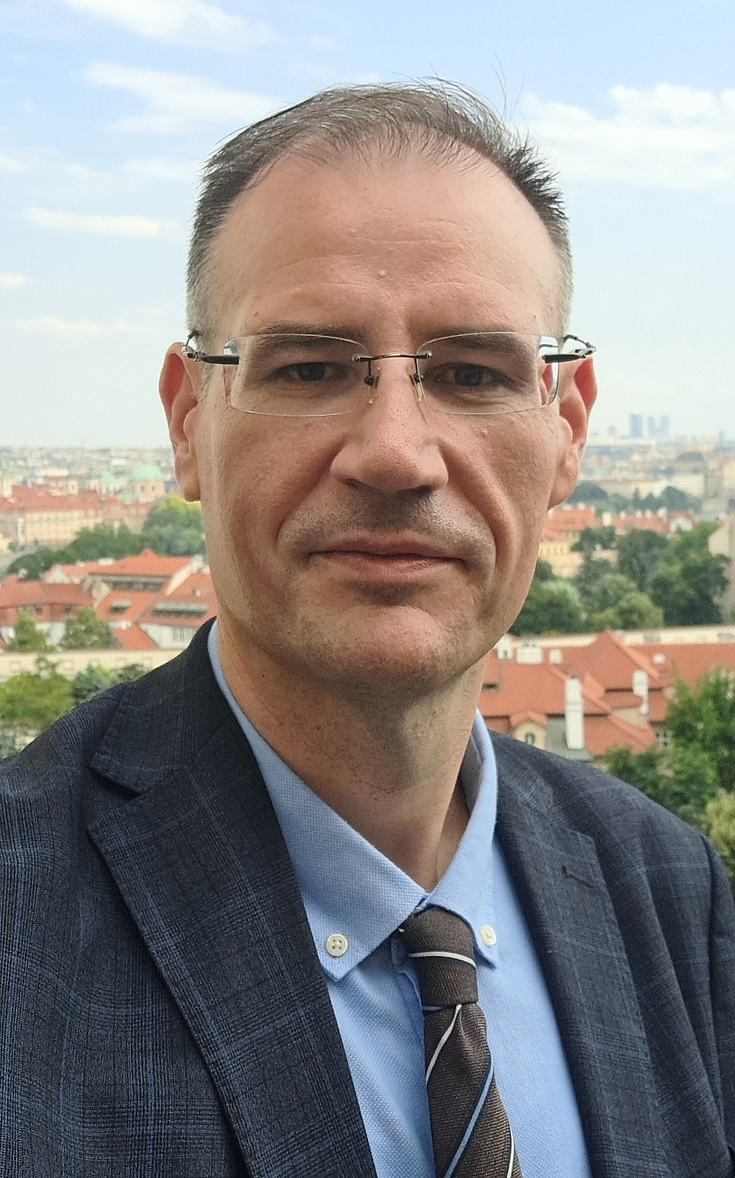
Dr. Milan Igrutinović is a Research Associate at the Institute of European Studies in Belgrade, specializing in foreign policy, security, and defense of the EU and Serbia, as well as the history of Yugoslavia. His recent work focuses on strategic culture, Serbia’s contemporary foreign policy, and the EU’s foreign and defense policy. His current research explores the role of strategic narratives in foreign policy and the integration of the Western Balkans into the EU.