
Short Article
Bulgaria Joins the Euro — But Political Turbulence May Trigger Spring Snap Elections
At the start of the new year, Bulgaria replaced it`s lev with the Euro – 19 years after joining the EU. The Southeast-European country is now the 21st member of the Eurozone – a reward for Bulgaria's positive and, above all, stable economic development over the last decade. However, the country’s political stability is once again under threat. Following mass protests, the government in Sofia resigned last December. In all likelihood, Bulgarians will have to go to the polls again at the end of March 2026. This would be the eighth parliamentary election since 2021.
A new face can be seen on the freshly minted Bulgarian Euro-coins that have been in circulation since January 1st of this year: St. John of the Rila Mountains. St. John, who retreated as a hermit into the wilderness of the mountains, lived in a cave for a time and fed on herbs, is the country's principal saint, patron of the people and founder of Bulgaria's most famous monastery, the Rila Monastery.
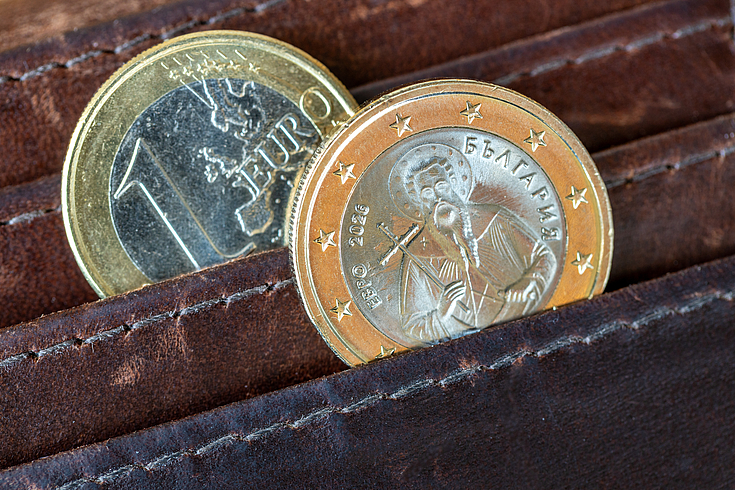
The country's previous currency, the lev, has been linked to the Euro since the Euro has been created.
Bulgaria`s national currency has been pegged to the single currency since the launch of the Euro in 1999. Sofia officially launched the process of joining the Monetary Union in 2018, and the Lev was included in the European Exchange Rate Mechanism in July 2020.
At the beginning of 2025, the EU Commission and the finance ministers of the Eurozone gave the green light for Bulgaria to enter the club. After joining NATO in 2004, the EU in 2007, and the Schengen area last year in 2025, the Balkan country, with a population of around 6.5 million, has thus integrated itself squarely into European structures.
Bulgaria's economy is robust
It is growing at a rate of three percent—twice as fast as the current EU average. Inflation is hovering around 2.8 percent. The budget deficit of approximately 3 percent and public debt of 24 percent comply with EU regulations, which require member states to limit their deficits to a maximum of three percent of gross domestic product (GDP) and their total debt to a maximum of 60 percent of GDP.
Following the introduction of the Euro, Bulgaria hopes to see a resulting surge in foreign investment and new competitive opportunities.
Bulgaria's accession to the currency club on January 1., 2026, which all previous Bulgarian governments, including the cabinet under the current acting Prime Minister Rossen Zhelyaskov, have been pushing for, is an important milestone for the Southeast European country, which joined the European Union together with Romania in 2007.
With Bulgaria's introduction of the Euro, only six of the 27 EU states are not yet part of the monetary union: Sweden, Poland, Czechia, Hungary, Denmark, and Romania, which would also like to join the euro zone but does not yet fully meet the criteria for doing so.
New currency as a strategic decision by Bulgaria
According to Bulgarian Prime Minister Rossen Zhelyaskov (Party GERB), the Euro is “not just a currency, but a strategic decision.” European Commission President Ursula von der Leyen similarly expressed her enthusiasm about Bulgaria's accession to the Eurozone on January 1st, 2026, emphasizing that this was a major success for Bulgaria, which would bring the country significant advantages in the single market and strengthen its position in Europe. She particularly praised the hard work and commitment of the Bulgarian people.
“I warmly welcome Bulgaria to the Euro-family and President Radev to the Governing Council of the ECB,” said ECB President Christine Lagarde. “The Euro is a powerful symbol: of what Europe can achieve when we work together. And of our shared values and our collective strength, which we can bring to bear in the current situation of global geopolitical uncertainty.” The ECB and the Bulgarian National Bank marked the historic milestone of Bulgaria's official adoption of the Euro by illuminating their main buildings in Frankfurt and Sofia. This served as a symbol of the integration and unity of the 358 million Europeans who use the euro as their currency.
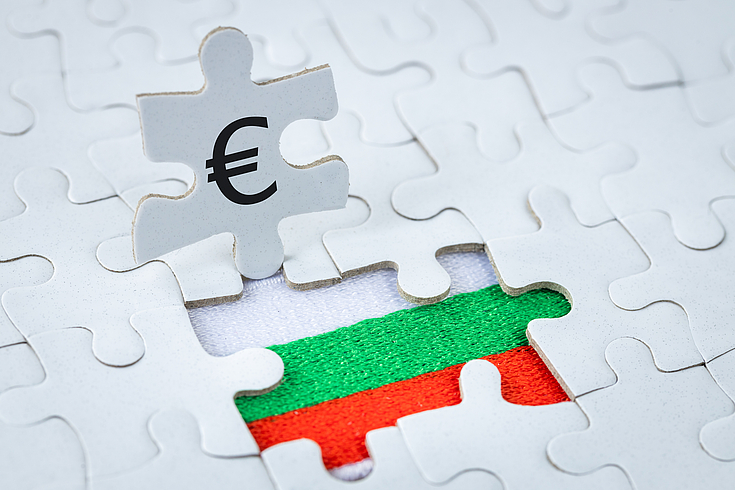
The transition from Lev to Euro has been smooth and orderly so far.
The feared chaos on January 1st has not materialized. This can partly be explained by the fact that Bulgarians can pay with both currencies within a grace-period until the end of January. The aim was to avoid long queues at ATMs. However, shortly after the introduction of the Euro, many Bulgarians are already complaining about striking rates of inflation, especially in the service sector. This gives the Euro-sceptics in Bulgaria, who have always been in the minority, further ammunition for their arguments against the Euro, especially in the run-up to the expected early parliamentary elections. Fears and anxieties about the introduction of the Euro have been fuelled not only by Bulgaria's nationalist parties, but also by Russian disinformation campaigns.
Resignation of Prime Minister Zhelyaskov's government December 2025
Bulgaria is still considered the poorest country in the European Union. As stable as the Balkan state appears in macroeconomic terms, at the moment it is proving to be fragile in political terms indeed.
The coalition government of GERB, BSP (Bulgarian Socialists) and the conservative-populist ITN under Prime Minister Rossen Zhelyaskov (GERB), which had been in office for just under a year since January 2025, announced its resignation in December 2025.
The three-party government did not have its own majority in parliament and was largely dependent on a party led by Bulgaria's most powerful oligarch, Deljan Peevski, who founded a splinter group of the DPS (Party of Rights and Freedoms/Turkish minority) last year. Deljan Peevski has been pulling the political strings for years, exerting considerable influence on politics and the media landscape, and he is currently considered Bulgaria's most controversial public figure. Even now, at the beginning of 2026, protest movements against him are forming again.
The protests that led to the government's resignation were triggered by the first-ever Euro- budget for the country, proposed by the governing coalition for the year 2026. This Budget provoked massive resistance not only from the unions, but also from employers and a large proportion of employees at the same time. Particular criticism was directed at the increase in social security contributions and taxes for the population, while simultaneously generous wage increases were planned for parts of the public sector, especially in the judiciary and police.
The government subsequently withdrew the draft budget, not least at the instigation of Boyko Borisov, the GERB party leader and former prime minister. However, too little, too late -the protests continued. Prime Minister Rossen Zhelyaskov was finally forced to announce - on December 11, 2025, after a meeting of the coalition partners and shortly before the vote on the sixth no-confidence motion against the cabinet was scheduled - that the government would resign. This sixth vote of no confidence against the Zheljaskov cabinet was based on accusations of failure in economic policy. The motion was tabled by 61 MPs from the opposition coalition “We Continue the Change—Democratic Bulgaria” (PP-DB), the APS, the Turkish party of Peevski's predecessor Ahmed Dogan, and METSCH, a new populist-nationalist party.
Way forward until scheduled new elections in spring 2026.
In the event of the government's resignation, the Bulgarian constitution empowers the President with exploratory mandates to form a new cabinet from the currently sitting Parliament. If these attempts fail, early parliamentary elections are scheduled and a transitional government is appointed. However, the constitution sets strict limits in this regard: the president can only choose between the Speaker of Parliament, the Governor or Deputy-Governor of the Bulgarian National Bank, the Chair or Deputy-Chair of the Court of Auditors, or the Ombudsman or his Deputy as interim prime minister.
Everything currently points to parliamentary elections taking place in spring 2026, most likely at the end of March. These would be the eighth parliamentary elections since April 2021, i.e., within a period of five years - and the first ones ever financed with Euros.
Resignation of President Radev
To complicate things further, Bulgaria's independent president, Rumen Radev, announced his resignation in a televised address on Monday, January 19, 2026. Radev was first elected head of state in 2016 and was re-elected in November 2021. According to the constitution, re-election is only permitted once. Radev is expected to participate in the upcoming parliamentary elections, possibly with his own party. Vice President Ilijana Jotova (Bulgarian Socialist Party) will continue to perform the duties of office for the time being.
Once again, Bulgaria's political future is shrouded in mystery. Can a last- minute solution be found, or will there be once again early elections? Can a stable majority government be formed after potential parliamentary elections at the end of March – and if so, how long will it remain in office? The start of 2026 is for Bulgaria marked not only by celebrations of its entry into the Eurozone, but also by uncertainty about the nature of its future government.

About the Author
Dr. Klaus Fiesinger is the Regional Director for Southeast Europe and the Project Manager for Bulgaria, Serbia, Montenegro and Albania
Kontakt
