
Event Report
Beyond Industry: How to Rearm Europe and Increase Institutional Defence Readiness?
AdobeStock
That the geopolitical situation for Europe has changed has become almost a truism: Washington shifts its strategic focus towards the ‘Western hemisphere’ and the Indo-Pacific, whereas Russia is expected to remain a hostile power even if a ceasefire in Ukraine could be achieved.
“For years, we have argued whether Europe needs to rearm,” says Markus Ferber, Chairman of the Hanns Seidel Foundation and Member of the European Parliament. “I think that question is now settled. The real question is: How do we rearm Europe?”
For this, leadership needs to come from France and Germany, argues General Christophe Gomart, Vice-Chair of the European Parliament’s Security and Defence Committee. “The unity of Europe depends on it.” With trade wars and Washington’s threats over Greenland in mind, the French General warns against what he calls a “Balkanisation” of Europe, a situation in which each country seeks to rearm on its own, at the expense of collective effectiveness. The spectacular failure of the Franco-German prestige projects of a joint fighter jet (FCAS) and a new battle tank (MGCS) is the first example that comes to mind.
From the 'Balkanisation' of European defence to a European military headquarters?
Gomart therefore urges European governments to “buy more European with European money”. “Many defence companies operate well below capacity. Some are using less than one third of their production capacity, in spite of highly automated production lines.”
In times of hybrid warfare and threats to critical infrastructure, priority should also be put on digital sovereignty and the ownership of strategic data. Europe should build its own sovereign cloud as quickly as possible.
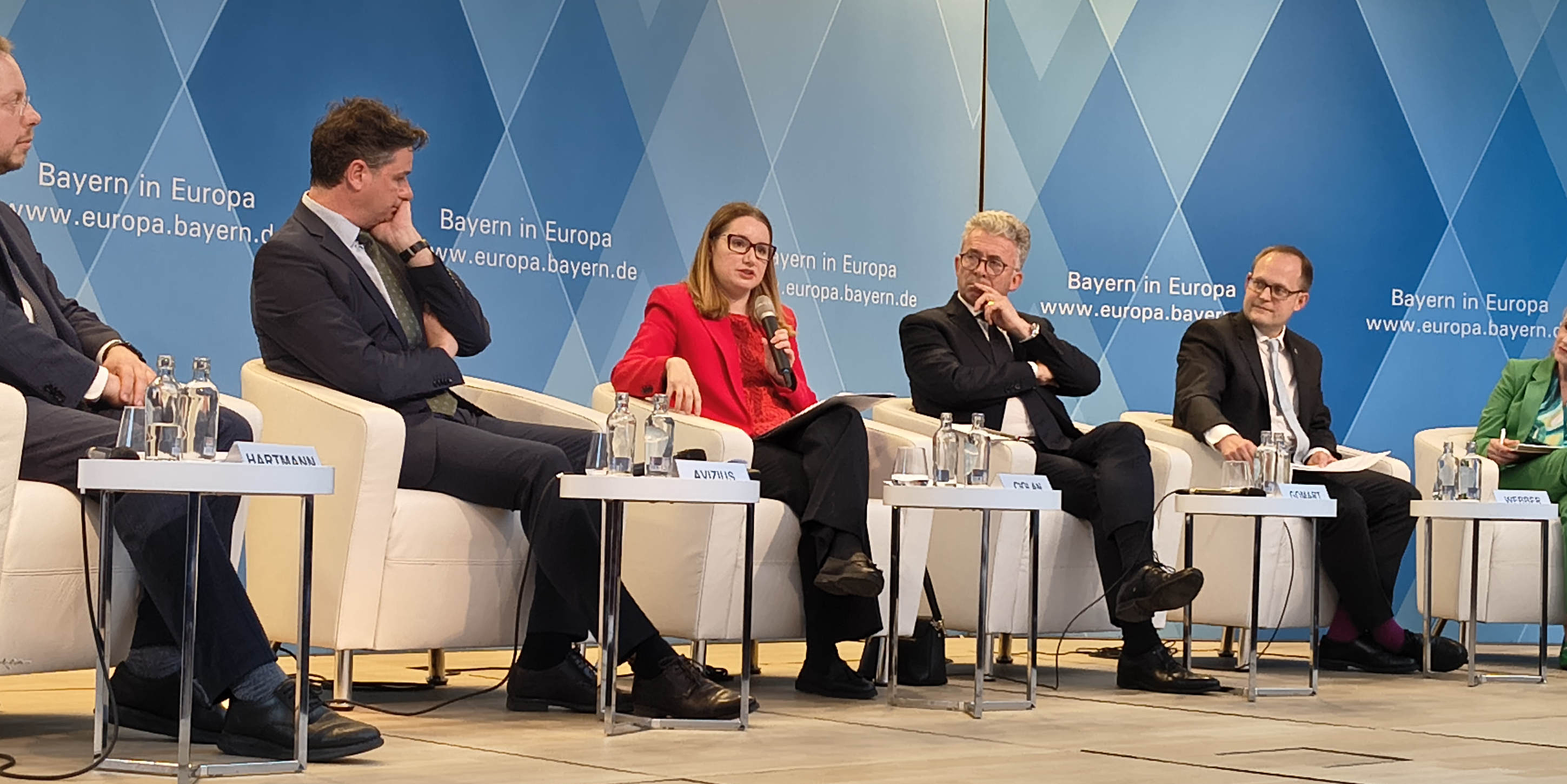
Ionela Ciolan, Research Officer at the Wilfried Martens Centre for European Studies, advocates for stronger institutional readiness for European defence. Brussels, 9 June 2026.
Hanns-Seidel-Stiftung; HSS Europe
Gomart, who also headed France’s military intelligence in the past, highlights that space has become an arena for geopolitical confrontation as well. But Europe has fallen far behind the United States, which spends twice as much on research and development. For the moment, Europe still does not have autonomous early warning systems to detect ballistic missiles.
“Europe is too dependent. But the United States has gone from being a ‘protector’ to being a ‘predator’.”
Earlier this year, the EU’s defence commissioner, Andrius Kubilius, has made headlines by re-introducing the idea of a European army. General Gomart suggests focusing on command structures and creating a “European War Headquarters”. The EU should merge the existing EU Military Staff (EUMS) and Eurocorps in Strasbourg.
In his vision, this would provide Europe structures equivalent to NATO’s Supreme Headquarters Allied Powers Europe (SHAPE) in Mons, Belgium.
Finally, however, European defence also requires the personnel to fight if necessary. Yet the demographic factor does not play in Europe’s favour. Or, as Gomart puts it pointedly: “No children, no army.”
Transatlantic defence cooperation: “Should not throw the baby out with the bath water”
Graham Webber, Minister Counsellor for Defence at the UK’s Joint Mission at NATO, however, warns starkly against a vision of strategic autonomy without any US involvement. “You’d throw away a tremendous amount of capability if you chase the US out of the door.” Nevertheless, the current task, in line with US demands and withdrawal plans, was to manage the transition to less US military capability without impacting NATO’s deterrence posture.
“But even if the US hugely reduces its capabilities, it’s probably remaining the largest conventional power in NATO,” Webber says, adding, “the US has capabilities that we want and we need. Pure protectionism isn’t the answer.”
In response to the French general’s proposal of new command and control structures, Webber questioned if it was possible to replicate the complexity and scale of NATO structures. That included the tricky question which nation would assume leadership in such a construct. “We should be very careful not to throw the baby out with the bathwater.”
The role of the European Commission: Accelerate defence cooperation and preparedness
While many expert analyses and political discussions revolve around describing known problems and easily handed policy recommendations, it is indeed worth speaking to those who look at these technical questions every day – and quite often find themselves in places where national interests cross. Benjamin Hartmann, for example, is a Cabinet Expert for the European Defence Commissioner. For him, it is worth taking a look in the rear-view mirror and sketch out the different work streams that the Commission has got off the ground over the past few years.
A "European army" has been under discussion since the beginning of the Cold War, but never materialised.
AdobeStock
A report by former Finnish President Sauli Niinistö had already, at the Commission’s request in 2024, conducted a needs assessment covering both military and civilian defence. In doing so, the Commission charted an early course that understands European defence not merely in military terms, but also as encompassing civil protection and a whole-of-society approach.
“The Commission has three tools,” Hartmann explains, “One is regulation, the second funding, and the third to act in an intellectual capacity like a think tank.” Following the Niinistö report, several Commissioners launched parallel work streams, including a Preparedness Union Strategy, an Internal Security Strategy featuring drone defence, and societal resilience with the Democracy Shield. “It’s segmented, of course. But there are no turf wars between Commissioners.”
Nonetheless, Hartmann underlines the limited role of the EU and the Commission in particular. “It’s not to replicate or duplicate NATO, or to be an obstacle.”
Instead, the Defence Commissioner focuses on issues that relate to speed, such as permitting procedures to expand ammunition facilities – which can take more than four years. Although this is not a matter of funding, this factor increases the costs for military and dual-use products.
A Defence Simplification Omnibus is currently under negotiation between the Commission, EU member states, and the European Parliament, in the so-called “trilogue”. If accepted, the regulation would, according to Hartmann, require member states to shorten permitting procedures for defence projects drastically. If respective authorities do not take a decision within 60 days, the permit would be considered granted.
The role of national parliamentarians: Defining defence budgets, legislation, and communicating with the public
Andrius Avizius, Director of the Political Committee at NATO’s Parliamentary Assembly, highlights the role of national politicians in defining defence budgets, legislation, and as a link between governments and the people.
“We hope our members can lead in their national parliaments when it comes to facilitating legislation that supports defence financing. Some defence companies still struggle to have access to credit because of ESG criteria. We also support multinational initiatives such as the development of the Defence, Security, and Resilience Bank (DSRB).”
While there was a strong consensus across the Alliance that the European pillar needed to be strengthened, Avizius highlights that this was already happening within NATO structures. For example, two NATO joint force commands – those in Norfolk and Naples – are currently being transferred to European leadership.
“The NATO Parliamentary Assembly is a champion of the transatlantic bond, which remains the foundation of European security.” This also includes engagement with lawmakers in Washington. “We are reassured of the support for NATO in the U.S. Congress,” Avizius says. “The commitment to the Alliance is still there.”
When it comes to communicating the necessity of increased defence spending to the public, Avizius cautioned against too alarmistic messaging, since this could backfire and be perceived as fear mongering.
Institutional readiness: A “European Security Council”?
Ionela Ciolan, Researcher at the Wilfried Martens Centre for European Studies, a think tank of the European People’s Party (EPP), argues that Europe needs to strengthen its credibility by improving political and institutional readiness.
With the current reshuffle of the international security architecture, Ciolan sees a new raison d’être taking shape. Lord Hastings Ismay once formulated NATO’s primary goal as to “keep the Americans in, the Russians out, and the Germans down.” Today, Ciolan thinks it should be
“Keep the Americans in, the Russians out, and the EU up.”
Observing the different threat perceptions across the transatlantic alliance, Ciolan thinks Europe needed to acknowledge its “strategic responsibility.” That required a stronger European defence pillar, “as part of NATO but also outside if necessary”. NATO remains a cornerstone of European security. But if consensus could not be achieved, in a worst-case scenario, Europe needs its own “Defence Union.”
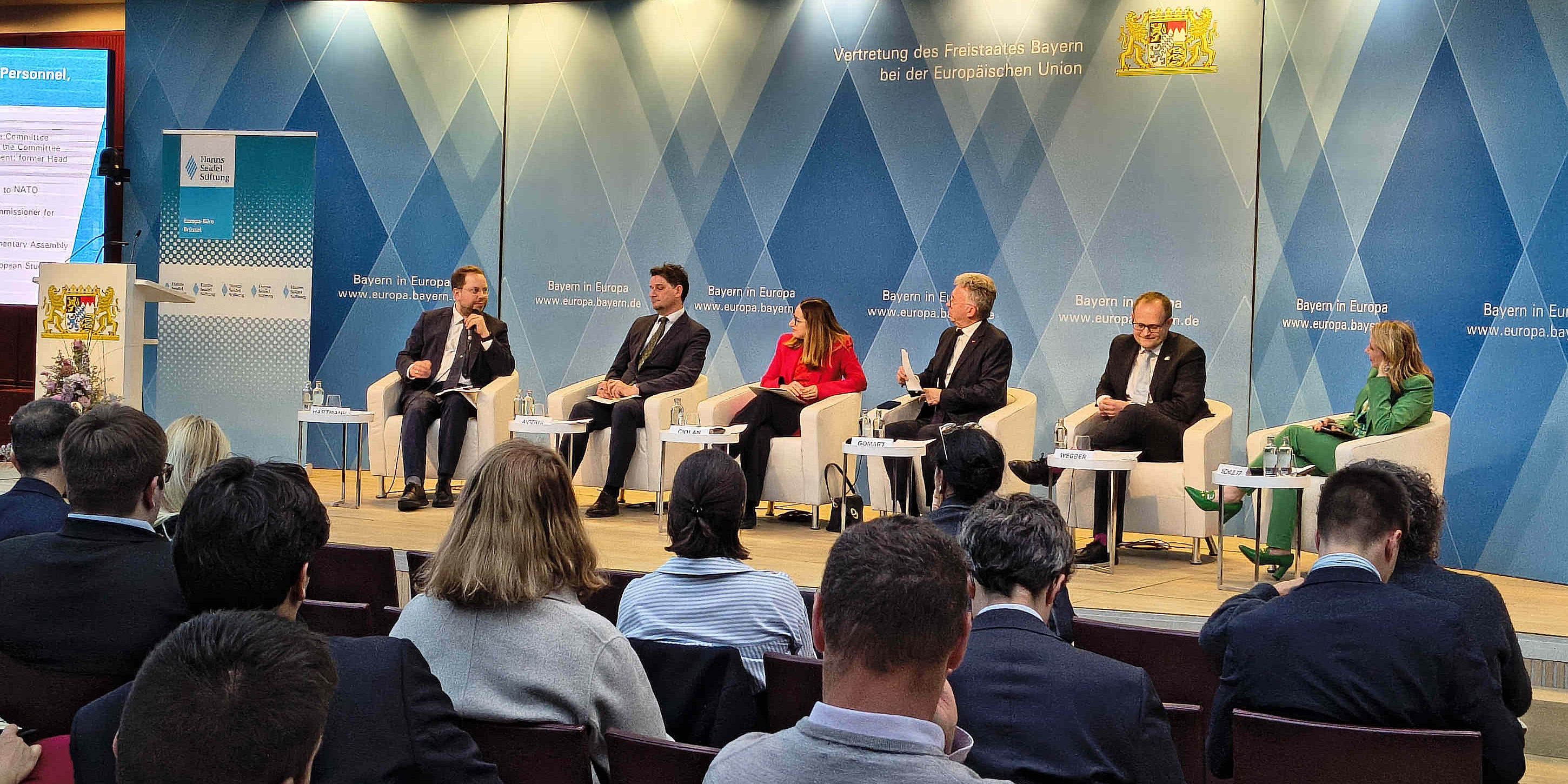
Discussed priorities and challenges for European defence (left to right): Benjamin Hartmann, European Commission; Andrius Avizius, NATO Parliamentary Assembly; Ionela Ciolan, Wilfried Martens Centre; Graham Webber, UK Joint Mission to NATO; Teri Schulz, Moderator. Brussels, 9 June 2026.
Hanns-Seidel-Stiftung; HSS Europe
To this end, so Ciolan, it was necessary to operationalise Article 42 (7) of the EU Treaty. However, this defence clause should not replace NATO’s Article 5, but be complementary.
“The EU’s Article 42 (7) might be triggered in addition to NATO’s Article 5. The EU could support by coordinating crisis management and the protection of critical infrastructure. This idea is not yet well explored in the NATO and EU bubbles.”
For the time being, the EU’s institutional setting remains highly fragmented; its bodies work in silos. “We need a unitary, comprehensive political decision-making body which is intergovernmental – a European Security Council. A Security Council should not only bring together EU member states but also the UK, Norway, Ukraine, and other like-minded partners that have concluded security and defence partnership agreements with the EU,” suggests Ciolan.
Contact

Policy Advisor

Director

Director