
Short Article
What the Social Market Economy Can Achieve Worldwide – International Summer School in Bavaria
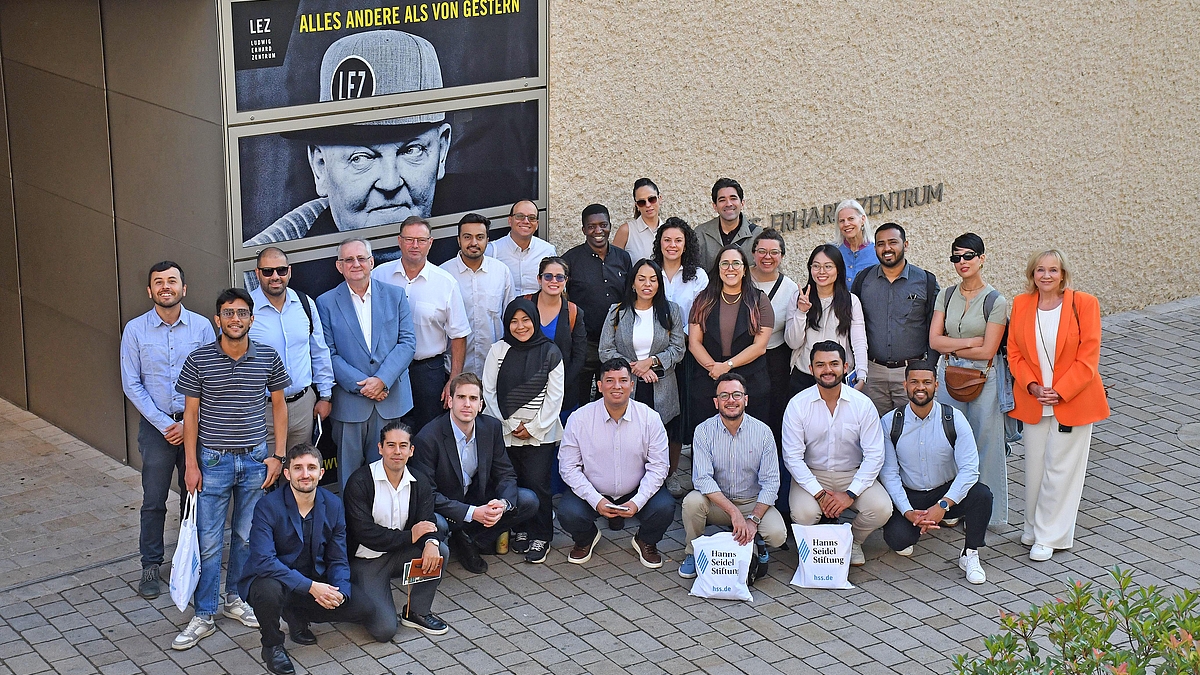
Participants of the 4th International Summer School on Social Market Economy in front of the Ludwig Erhard Centre in Fürth.
© Stiftung Ludwig-Erhard-Haus – Photographer: Thomas Scherer.
Can the Social Market Economy provide answers to the economic, social and environmental challenges of the 21st century? This question was at the heart of the 4th International Summer School on Social Market Economy, which brought together 23 young leaders from 18 countries across Africa, Asia, Latin America and the Middle East in Munich and Fürth. The Summer School was organised by the Latin America Division of the Hanns Seidel Foundation’s Institute for International Cooperation, in cooperation with the Ludwig Erhard Centre in Fürth and the Friedrich-Alexander University of Erlangen-Nuremberg.
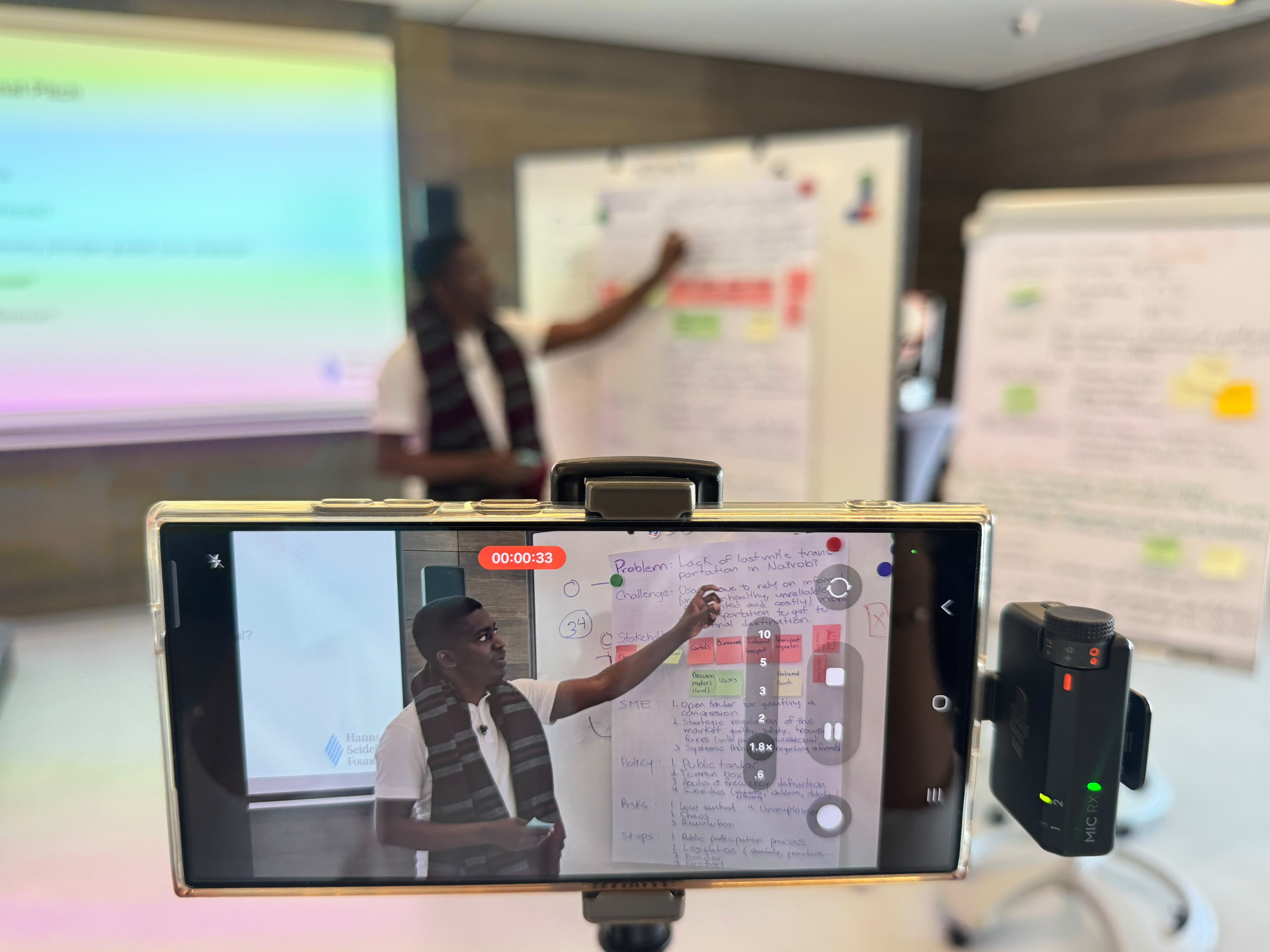
Developing solutions together: Based on the principles of the Social Market Economy, participants developed approaches to concrete challenges in their home regions.
© HSS – Photographer: Summer School participant Lorena Mejía.
The aim was not to export a German economic model. Instead, the focus was on an open exchange about which principles of the Social Market Economy can be applied to the different political, economic and social realities of the participating countries.
Through lectures, workshops and discussions, participants explored topics including the role of the modern tax state, the circular economy, sustainable corporate governance and regenerative economic models. Theoretical approaches were repeatedly linked to experiences from the participants’ home countries. This created a dynamic dialogue in which different perspectives came together around shared challenges.
The supporting programme also offered valuable insights. Following the opening at the Hanns Seidel Foundation’s Conference Centre and a visit to the Bavarian State Parliament, including an exchange with Member of the Bavarian State Parliament Peter Wachler (CSU), the group was welcomed at Fürth City Hall by Deputy Mayor Dietmar Helm (CSU). Another highlight was the visit to the long-established company Faber-Castell in Stein. Through its longstanding commitment to social responsibility, the company provided an example of how economic success and responsibility towards society can go hand in hand. A visit to the permanent exhibition at the Ludwig Erhard Centre also offered participants the opportunity to learn about Ludwig Erhard as a pioneer of the Social Market Economy, explore key chapters of German economic history and experience the fundamental principles of the Social Market Economy in an engaging and accessible way.
The Summer School is also an investment in an international network of young decision-makers. Many participants are already taking on responsibility in politics, public administration, academia, business or civil society. Exchanges with German institutions and among the participants themselves create lasting connections from which both sides can benefit: participants gain new ideas and perspectives for reform processes in their home countries, while Germany strengthens dialogue with a generation of multipliers who will play an increasingly important role in shaping the political and economic development of their regions.
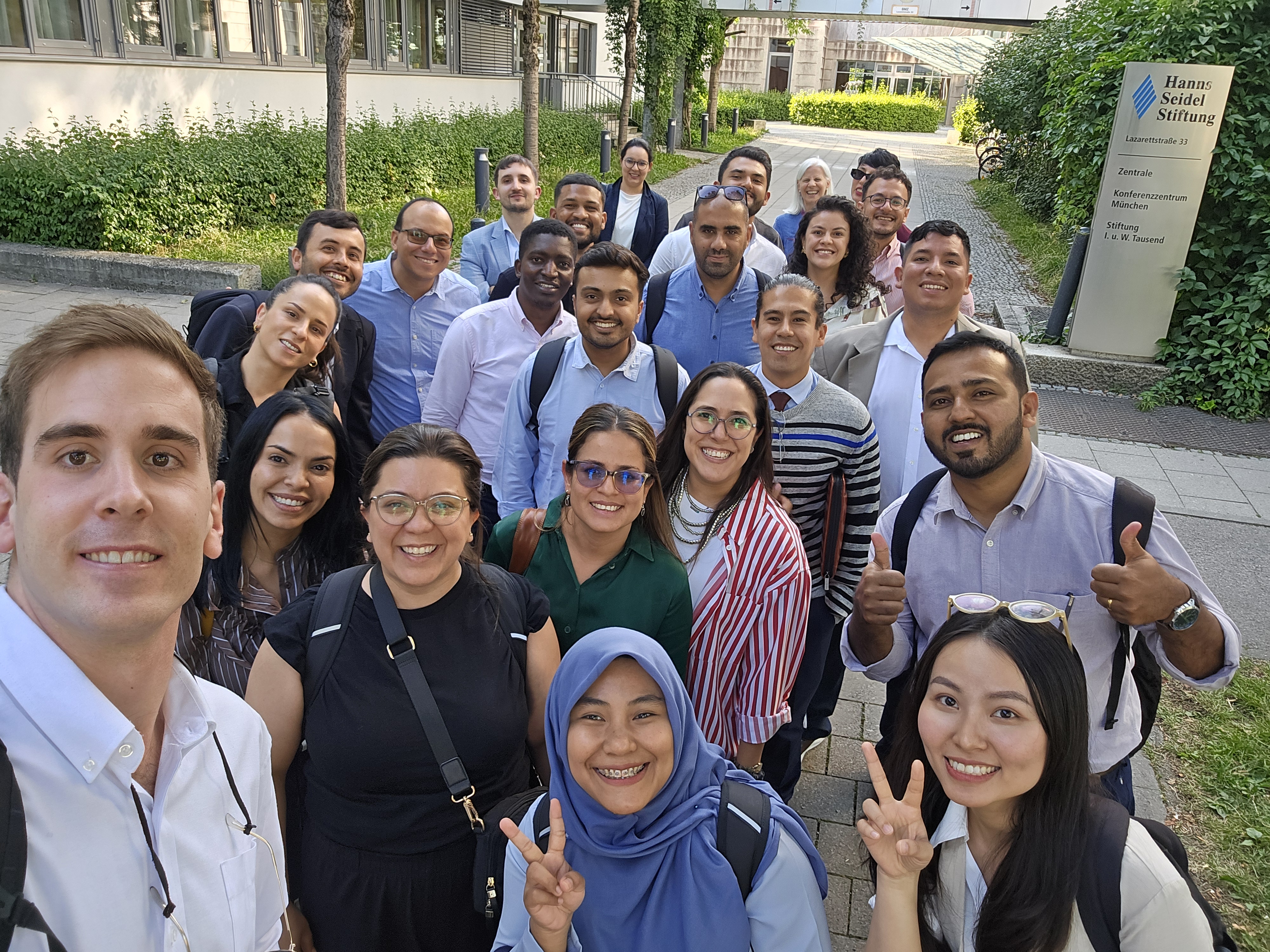
Learning, discussing and networking together: Participants of the Summer School in front of the Hanns Seidel Foundation’s headquarters in Munich.
© HSS – Photographer: Summer School participant Okoth Opondo.
Lorena Mejía, a participant from Colombia, summed up her experience:
“The Hanns Seidel Foundation’s Summer School showed me that economic development and social justice can go hand in hand when solid institutions, an engaged society and a long-term vision are in place. It was more than just a theoretical programme – it was an opportunity to gain first-hand experience that I hope to take back to Colombia in order to promote dialogue and develop solutions tailored to our own circumstances.”
The discussions throughout the week made clear that the Social Market Economy is much more than an economic policy model. It is built on strong institutions, responsibility and society’s confidence in its shared future. Hazem Khattab, a participant from Israel, captured this insight:
“One key insight was that a strong sense of community and social integration are not merely moral goals, but essential prerequisites for political stability and long-term economic strength.”
The 4th International Summer School demonstrated impressively that the Social Market Economy is not a rigid model, but rather a value-oriented framework that can provide food for thought worldwide. Particularly in a time of global upheaval, international dialogue, mutual learning and resilient partnerships are more important than ever – and this is precisely where the Hanns Seidel Foundation’s Summer School came into its own.
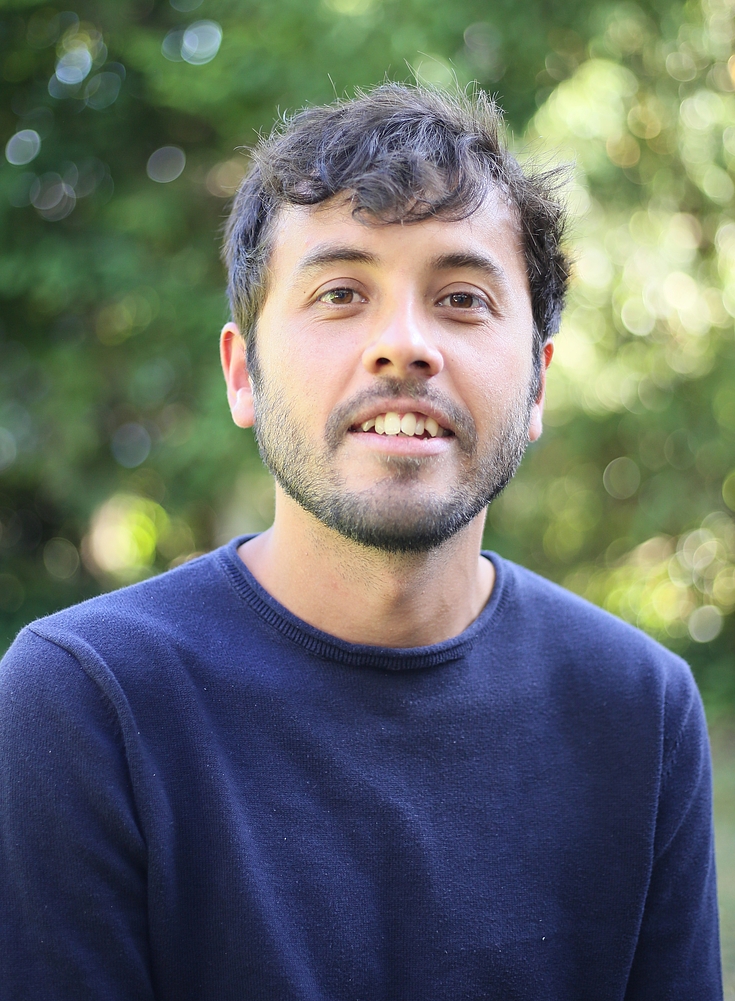
Mathias Walter
About the Author
Mathias Walter studied Political Science at the Technical University of Munich (TUM). Since 2023, he has been working at the Hanns Seidel Foundation as a Project Coordinator in the Latin America Division of the Institute for International Cooperation.
Contact
