
Political Analysis
USAID shut down in the U.S. – A prime example of the unprecedented
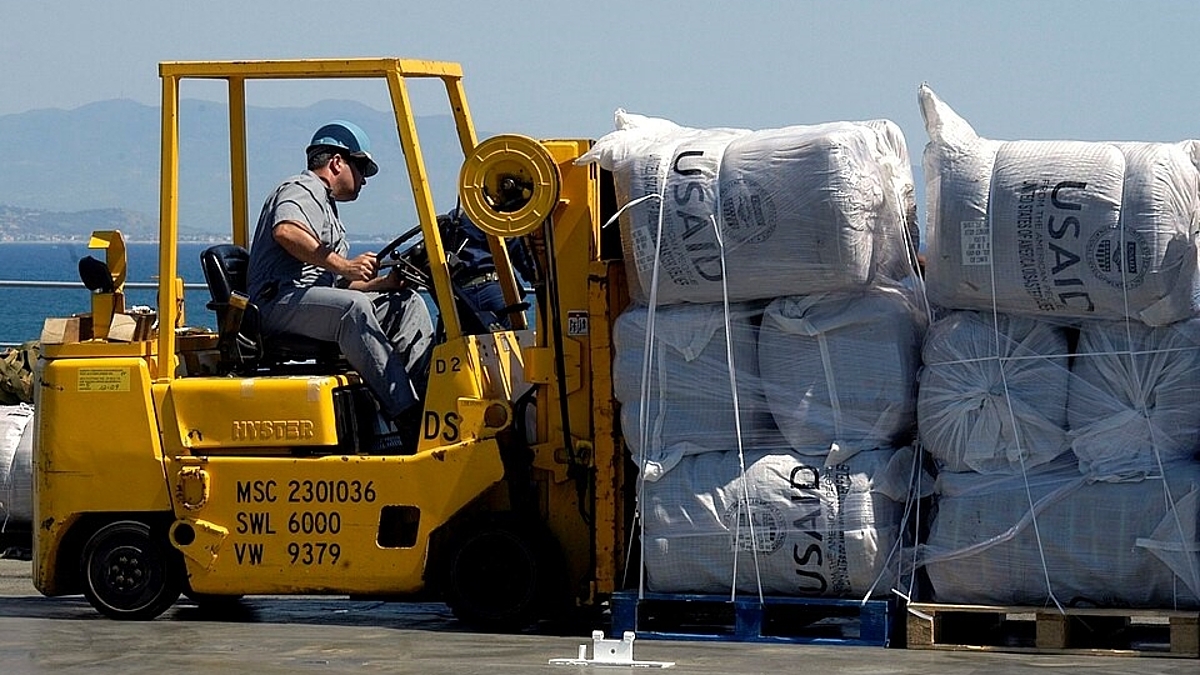
This file is a work of a sailor or employee of the U.S. Navy, taken or made as part of that person's official duties. As a work of the U.S. federal government, it is in the public domain in the United States.
https://commons.wikimedia.org/wiki/File:US_Navy_080819-N-9999N-001_Able_Seaman_Frank_Santanamoves_pallets_of_blankets_donated_by_the_United_States_Agency_for_International_Development.jpg
Background
The news of Trump’s administration shutting down U.S. Agency for International Development (USAID) completely, after announcing to freeze payments for 90 days, sent shockwaves around the world on February 3rd 2025. Headlines in response to the decision repeatedly warn of potentially devastating consequences. Experts raise alarms, countries voice complaints, and Trump? He sent his close ally, Elon Musk, who later posted on X: “We spent the weekend feeding USAID into the wood chipper.”
Since the news broke, much has happened. Many had hoped that legal action would put a stop to it. The initiative hasn’t been entirely easy for Trump and Musk either, yet Secretary of State Rubio has reaffirmed: by June 1st, the agency responsible for about 42 percent of global development aid funding will be fully dismantled - after already having been reduced to a mere fraction of its former self.
For many, the question remains: What does this actually mean? According to supporters of the decision, led by Trump himself, billions of dollars that previously funnelled into a "criminal organization" and funded "a viper’s nest of radical-left Marxists who hate America" have now been saved. At the same time, critics warn of irreparable harm. A look at official data, jointly provided by the U.S. Department of State and USAID, aims to shed light on the situation.
This image is a work of a United States Agency for International Development employee, taken or made as part of that person's official duties. As a work of the U.S. federal government, the image is in the public domain in the United States.
https://commons.wikimedia.org/wiki/File:Flag_of_the_United_States_Agency_for_International_Development.svg
USAID in Numbers
On the website of both institutions, ForeignAssistance.gov, you can take a detailed look at which funds went into which sectors and over what time period. Zooming in even further and linking the funds to representative projects then allows you to grasp the significance of USAID for recipient countries.
One ironic observation that could hardly be omitted at this point is that, as of today, the total sum of development aid is still listed under the term "obligations" - a word that inherently frames aid as a commitment rather than a discretionary act. Or, to put it in the exact words of the Department of State: “Obligations are binding agreements that will result in outlays, immediately or in the future”.
Agreements for example in the fields of humanitarian aid and health, which together accounted for a significant share of USAID’s funding and required approximately $20 billion in 2024 - excluding expenditures in Ukraine. The largest share of these funds, nearly 50%, was directed toward Sub-Saharan Africa, with significant portions also allocated to the Middle East and North Africa (MENA) and South and Central Asia. So far, the consequences of the decision by the Trumps-Administration are already unfolding.
In Sudan, clinics treating severely malnourished children are on the brink of collapse. Without immediate support, essentials like oxygen, fortified food, and 24-hour medical care will disappear and many of these children could die within hours. In Uganda, the suspension of malaria prevention efforts for pregnant women and children - including bed net distribution and insecticide spraying - could lead to a sharp rise in infections during the rainy season. Meanwhile, more than 220,000 people worldwide who relied on U.S.-funded HIV treatment have been cut off. For many, a missed dose means more than a health risk - it’s a potential death sentence.
Altogether, USAID health interventions have reached hundreds of millions of people each year. According to WHO estimates, sustained access to HIV treatment alone prevents over one million deaths annually. The sudden loss of these programs is not only a budgetary shift - it is a rupture in the global safety net for the world’s most vulnerable.
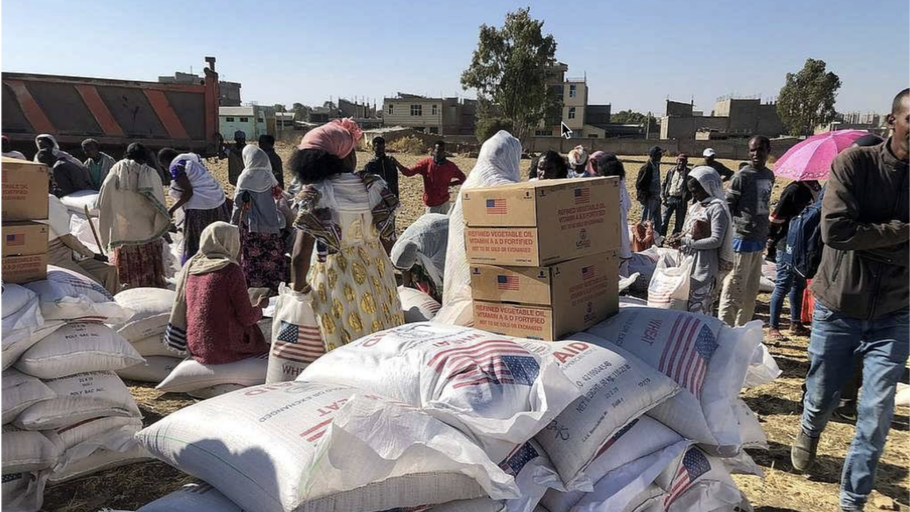
USAID humanitarian aid in Tigray
Contextualization
The projects mentioned only offer a glimpse into the impact generated by the funds flowing through USAID. Yet, even based on these few examples, one could argue that the Trump administration’s decision marks the pinnacle of moral bankruptcy. The decision itself is one thing - its execution is another. Without any kind of transition strategy, the abrupt shutdown has pushed millions of people across the globe into acute existential crises. Even within the United States, the decision resulted in the sudden loss of employment for more than 9,000 Americans. Internationally, it shattered the trust of countless individuals, governments, and partner institutions. Scandinavian countries, for example, are currently demanding clarification on millions in funding they had contributed to USAID programs - money intended to support people in need. All of this points to a level of political irresponsibility rarely witnessed in the modern Western world.
So why is Trump doing it anyway? Two explanations: The plan appears to bring the previously rather independent government agency under direct political control. According to Secretary of State Marco Rubio, who was put in charge of USAID, the administration intends to integrate USAID into the U.S. Department of State for greater “alignment with the national interest", and not to abolish it completely (see BBC). The reasoning behind this move is clear: it places the regulation of foreign aid funds directly under the administration’s authority, granting a level of political influence that should not be underestimated. The first signs of Trump’s vision are already evident in his dealings with Ukraine. His proposal? They should give America its lithium in exchange for aid, signalling to the world that programs without an immediate benefit to the U.S. may be cut permanently.
At this point, it’s fair to acknowledge that, historically, U.S. foreign aid has never been entirely altruistic, and hidden interests have often been suspected behind its support - whether in Iraq and Saudi Arabia, where oil played a key role, or in Afghanistan and Egypt, where funding ensured political influence.
However, this observation leads to the second reason - one that may be even more alarming than the disappearance of USAID itself. What is meant here is an unmistakable paradigm shift in political communication and consequently in American politics itself. Whereas in the past, economic or political conditions tied to foreign aid were carefully veiled in diplomatic language, today, self-serving demands are increasingly stated outright. This is not, as it is often implied in certain political and societal debates, simply Trump’s fault or a by-product of his unconventional style. No, it is far more a sobering reflection of American society itself - of those who, through democratic means, formed a majority in Trump’s favour. Collectively, it appears that the decision has been made to prioritize national self-interest above all else - no matter the cost.
Critique aside from Morality
Even from a purely strategic perspective, dismantling USAID is far from the masterstroke some in the administration believe it to be. U.S. development aid, though never purely altruistic, has long been a quiet instrument of geopolitical influence - stabilizing fragile regions, securing alliances, and expanding economic access. The decision to eliminate such a tool seems to assume that leverage can now be exercised more directly: by centralizing control, attaching explicit conditions to assistance, and reducing engagement to transactional terms. It is a model Trump and his allies - including Elon Musk - tout as efficient and honest: fewer bureaucracies, clearer deals, quicker wins.
However, this model is built on a dangerous miscalculation. Influence, especially in global politics, is not just bought in the moment - it is cultivated over time through credibility, reliability, and presence. Development policy was never just about generosity; it was about shaping environments in which American power could operate long-term. The current approach, by contrast, reduces influence to a price tag and treats international trust as expendable.
Meanwhile, global competitors are stepping into the void. China doesn’t just offer money - it offers infrastructure, long-term contracts, and political reassurance. Russia, with far fewer resources, gains leverage simply by being present where the U.S. no longer is. They are not winning because they spend more. They are winning because the U.S. is walking away.
Ultimately, the shift away from structured development policy in favour of selective, self-serving demands reflects even more than just a change in foreign aid philosophy and American morality - it signals a fundamental shift away from patient alliance building and toward transactional short-termism. This shift is encapsulated in what Trump calls “deal-making” - a term that, by the way, is eagerly adopted in European media coverage - but which, in reality, is nothing more than classic extortion. In the end, the West may feel the consequences, as the U.S. forfeits one of its most effective tools of influence in the name of autonomy. And while that loss of influence is measurable, the human cost is far less tangible.
About the Author
Felix Naumann is a political science student at Ludwig Maximilians University in Munich and currently an intern at the Hanns Seidel Foundation, gaining hands-on experience in international cooperation and policy research.
Contact
