What to Expect from Ursula von der Leyen's Second Term: Topics and Key Figures
The New European Commission Faces Major Challenges
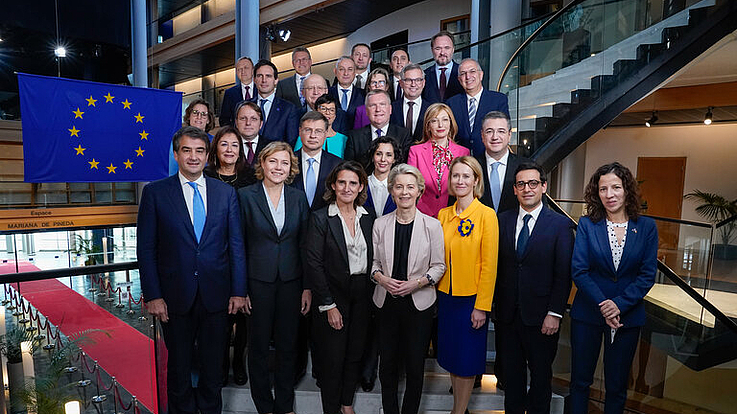
In the end, it happened surprisingly quickly: on 27 November, the European Parliament in Strasbourg confirmed the 27-member College of Commissioners with 370 votes, supported by the European People’s Party (EPP), Social Democrats (S&D), Liberals (Renew), and even parts of the Greens. Before that, the parliamentary hearings of the candidates in Brussels had been rather bumpy. The difficulties stemmed from disputes motivated by party politics between Christian Democrats and Social Democrats over two vice-presidential candidates: Raffaele Fitto (cohesion policy, right-wing conservative ECR) and Teresa Ribera (climate and competition, S&D). Whilst these disputes caused delays, they ultimately failed to block the confirmation of the College. For the first time this century, all nominees were approved by Parliament without delay.
In the second term of office of the old and new Commission President Ursula von der Leyen, the 27 EU Commissioners, who have been in office since 1 December, appear more diverse, team-oriented, and conservative. The College includes eleven women and six Executive Vice-Presidents working alongside the President. They represent a broad spectrum of the pro-European political parties, extending to Giorgia Meloni’s right-wing nationalist Fratelli d’Italia. The majority of the College—14 members in total—are affiliated with the EPP, which won the European Parliament elections this summer. The College is led by a strong President who, in her Mission Letters (the guidelines for the Commissioners), deliberately distributed key priority topics—such as security and defence, digital transformation, and reducing bureaucracy - across several portfolios. This strategy intends to foster cross-departmental cooperation under her leadership.
The Commission's priority lies in competitiveness and economic strength. Von der Leyen announced the 'Competitiveness Compass' as the first initiative of her new mandate. This initiative is built around three key pillars: innovation and digital transformation, decarbonisation and competitiveness (from the Green to the Clean Industrial Deal), and strengthening economic security (through diversification and further partnerships). These three pillars will serve as the guiding framework for the entire mandate.
In the following, we will highlight the key topics and Commissioners who will shape European policy over the next five years.
PHILIPPE BUISSIN; © EUROPEAN UNION 2024 ; EP
Strategic Impulses for Foreign, Security and Development Policy
Current geopolitical developments make it indispensable to strengthen Europe’s resilience and expand its global role. Security policy, therefore, ranks high on the political agenda for the new legislative term. Europe aims to become both more secure and independent – a goal to be achieved through joint investments in military capabilities and deeper cooperation between the EU and NATO. Key approaches include the European Defence Fund and an extensive defence strategy. Space also plays a critical role: Europe seeks to secure independent access to it whilst advancing dual-use technologies and space infrastructure. The responsibilities for these tasks will lie with Andrius Kubilius (Lithuania/EPP), the new Commissioner for Defence Industry and Space.
Equally significant from a geopolitical perspective is the EU’s enlargement policy, with a particular focus on Ukraine. The EU plans to support Ukraine by accelerating its path towards EU membership, providing financial assistance for reconstruction efforts, and promoting reforms to enhance governance and the rule of law. In addition, the EU aims to support reforms such as integration into the internal market and the strengthening of the rule of law in the Western Balkans. With a background in diplomacy, Marta Kos (Slovenia/Renew), the new Commissioner for Enlargement, is well-equipped to lead these efforts.
Development policy also reflects the strategic orientation of the new Commission. Within the Directorate-General for International Partnerships, the Global Gateway initiative will increasingly align sustainable and high-quality investments with geopolitical objectives. This translates into closely linking development and trade strategies whilst linking them to key EU priorities, such as migration, security, and climate protection. Private investments will play a key role in the successful implementation of Global Gateway, though significant challenges remain in transparently communicating achievements and building trust in EU initiatives. Jozef Sikela’s (Czech Republic/EPP) background in finance and investment makes him ideally suited for his role as the new Commissioner.
Climate and Environment: Clean, Fair and Competitive Transition
One of Ursula von der Leyen's key priorities is to decarbonise and industrialise the European economy. In practical terms, this involves aligning the objectives of the European Green Deal with the needs of the economy and industry. Implementing this ambitious goal is challenging and requires diplomatic skills, particularly given the overlapping responsibilities within the EU Commission.
One of the key figures in this effort is Executive Vice-President Teresa Ribera Rodríguez (Spain/S&D), who is responsible for a clean, just, and competitive transition. Alongside Stéphane Séjourné (Executive Vice-President for Prosperity and Industrial Strategy (France/Renew)), and Wopke Hoekstra (Commissioner for Climate, Net Zero, and Clean Growth (Netherlands/EPP)), she will coordinate the development of the so-called “Clean Industrial Deal”, set to be presented within the first 100 days. Ribera's primary task is to design a new aid framework that accelerates industrial decarbonisation and expands capacities for clean technologies. Together with Hoekstra, she will work to maintain Europe’s leadership in international climate negotiations and prepare the way towards the ambitious 90% emission-reduction target for 2040.
Together with the Commissioner for Energy and Housing, Dan Jørgensen (Denmark/S&D), Ribera will also focus on reducing Europe’s reliance on fossil fuels and lowering energy costs. Additionally, she will work alongside Jessika Roswall (Commissioner for Environment, Water Resilience and a Competitive Circular (Sweden/EPP)) to promote the sustainable use of natural resources. A new Circular Economy Act will be proposed to increase demand for secondary raw materials and establish a single market for waste, notably in relation to critical raw materials.
Security, Democracy and Technological Sovereignty
As Vice-President for Security, Democracy and Technological Sovereignty, former Finnish MEP and Minister, Henna Virkkunen (EPP), is responsible for tackling a range of increasingly complex challenges. These include the war in Ukraine, Europe's defence capabilities, hybrid and cyber threats, attacks on critical infrastructure, foreign interference, and the instrumentalisation of people.
Working alongside her is Magnus Brunner (EPP) the former Austrian Finance Minister, who serves as Commissioner for Home Affairs and Migration. His responsibilities include implementing the European Asylum and Migration Pact adopted in 2024, with a particular focus on strengthening external borders and combating migrant smuggling and human trafficking in close cooperation with countries of transit and origin. Additionally, he will work to create opportunities for legal labour immigration.
The development of digital technologies is essential for achieving a competitive, resilient and inclusive digital future, especially as the EU strives to be a leader in strategic technologies. With the decision to include start-ups as a separate area in the portfolio of the Romanian Commissioner for Start-ups, Research and Innovation, Ekaterina Zakharieva (EPP), the Commission President emphasises Europe's aim to create European champions and consolidate its position on the global stage.
The new Commission is also paying particular attention to strengthening the resilience and functioning of our democracy. A new European ‘Democracy Shield’ is intended to counter manipulation and foreign influence, as well as any other machinations that can contribute to the division of society and jeopardise democracy. The former Irish Finance Minister, Michael McGrath (Renew), will take decisive action against violations of the rule of law as the new EU Justice Commissioner. He will oversee the independence of the judiciary, the fight against corruption, media freedom, and institutional control mechanisms. In his hearing before the European Parliament, McGrath also mentioned a swift implementation of procedures for the suspension of EU funds in countries that violate the rule of law as a priority.
Competition, Prosperity and Industrial Strategy
Against the backdrop of stagnating economic growth, the second von der Leyen Commission is focussing on prosperity and competitiveness as key priorities. Europe should become simpler and faster, reduce red tape and deepen the single market. The Commission is striving for a balance between sustainability, innovation and global competitiveness. As a global player, the EU is also keen to develop its industrial strategy based on a decarbonised circular economy.
As a first initiative, Commission President von der Leyen announced a ‘Competitiveness Compass’ to close the innovation gap with the USA and China and drive forward the strengthening of Europe's economic security. In the first 100 days, concrete initiatives, such as a package for clean industries (‘Clean Industrial Deal’) and a ‘White Paper’ on European defence, are to be launched.
Responsible for the implementation is the Executive Vice-President for Prosperity and Industrial Strategy, Stéphane Séjourné (France/Renew), and his Spanish counterpart, Teresa Ribera (S&D), Executive Vice-President for a Clean, Just and Competitive Transition.
Both are supported by several Commissioners, including the Commissioner for Economy and Productivity; Implementation and Simplification, Valdis Dombrovskis (Latvia/EPP), who has been an experienced member of the College of Commissioners for ten years. In the future, he will coordinate the simplification of reporting obligations and better enforcement of EU laws in order to reduce the administrative burden. He is also responsible for monitoring national reform policies as part of the European Semester, particularly in the areas of competitiveness and sustainability.
Another long-serving and experienced member of the European Commission, Maroš Šefčovič (Slovakia/S&D), is responsible for Trade and Economic Security, as well as Interinstitutional Relations and Transparency. He faces the challenge of shaping a foreign trade policy that ensures Europe remains competitive, secure, and sustainable. A key objective is to promote free and fair trade, reduce dependencies, establish sustainable partnerships, and negotiate trade agreements, particularly with Latin America and the Indo-Pacific.
Former Portuguese Finance Minister Maria Luís Albuquerque (EPP) will be the new Commissioner for Financial Services and the Savings and Investment Union. Among other tasks, she will be responsible for completing the Banking Union and creating a European Deposit Insurance Scheme (EDIS) to ensure financial stability.
The Future of Cohesion and Agricultural Policy
Executive Vice-President Raffaele Fitto (Italy/ ECR) is responsible for cohesion and reform, including agricultural policy. His parliamentary hearing was dominated by discussions about the Commission's planned changes to cohesion policy. Because of his affiliation to the controversial 'Fratelli d'Italia' party, which is part of the ECR group in the European Parliament, his nomination was viewed critically in some quarters - not least because the ECR did not support the re-election of Ursula von der Leyen.
The Commission's proposed changes to cohesion policy are subject to debate. The plan is to link the allocation of funds to the successful implementation of structural reforms (conditionality mechanism). Under this proposal, cohesion funds would no longer be negotiated directly with regional administrations, as has often been the case, but instead would flow to national authorities for distribution. Therefore, there is growing concern in the regions about a loss of control and a reduction in funding. The CSU has already warned that the proposed reform could disadvantage Bavaria. In addition to reforming the distribution mechanism, cuts to the cohesion funds themselves are also under consideration. Such reductions would hit wealthier regions like Bavaria particularly hard.
As Commissioner for Agriculture and Food, Luxembourg politician Christophe Hansen (EPP) will ensure a fair and sufficient income for European farmers on a level playing field. In particular, he will be responsible for following up the strategic dialogue on the future of agriculture in Europe.
Outlook
The new Commission under President Ursula von der Leyen faces significant geostrategic and geoeconomic challenges at the start of its term. US President-elect Donald Trump announces a protectionist trade policy towards Europe, whose security is threatened by ongoing wars and conflicts on its eastern and southern borders. Moreover, the Franco-German tandem is failing to drive further integration due to the political instability of its governments.
However, the new Commission has an opportunity to fill this leadership vacuum by launching major initiatives such as the Competitiveness Compass and the White Paper on the Future of European Defence. Whether these initiatives will succeed depends on the approval of the Council and Parliament. The prospects, however, are favourable: the majority of EU Commissioners, of the heads of state and governments represented in the Council, and of the Members of Parliament belong to von der Leyen's party family, namely the European People's Party, led by Manfred Weber.