
EU Support for Ukraine
Task Force Report Calls for Coordinated Approach to Ukraine’s Agricultural Recovery
AdobeStock
Ukraine's agricultural sector remains a cornerstone of the national economy and a vital contributor to global food security. Its recovery and gradual integration into the EU agri-food market are therefore of strategic importance for the country, European resilience and the stability of international food supplies. As a result of Russia’s war, however, swaths of Ukrainian land have been destroyed and mined.
The Brussels Office of the Hanns Seidel Foundation therefore supported the Centre for European Policy Studies (CEPS) in conducting a Task Force on Ukraine’s Agricultural Recovery. Through several meetings in late 2025, the initiative brought together representatives of EU institutions and Ukrainian stakeholders, international organisations, development banks, the private sector, civil society and academia.
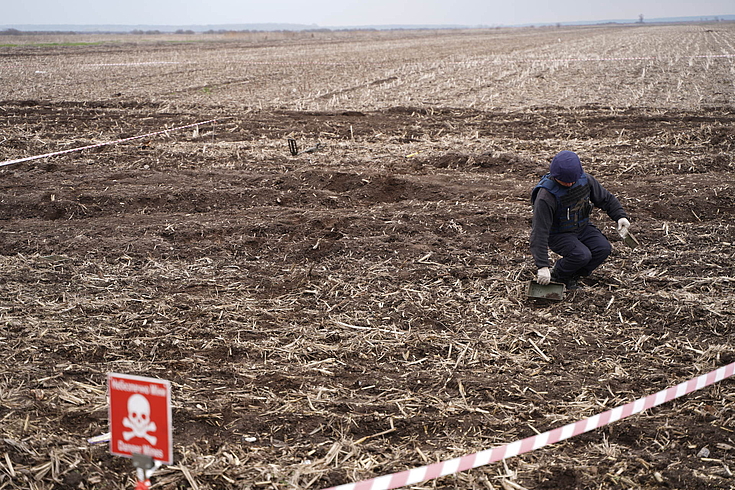
War-related damages in Ukraine: Swaths of Ukrainian agricultural land are contaminated and require de-mining.
AdobeStock
The resulting Task Force report, “From Mines to Markets: Pathways for Ukraine’s Agricultural Recovery”, was published this summer. It highlights both the continuing importance of Ukrainian agriculture and the scale of the destruction caused by Russia’s war. Despite wartime disruption, agriculture accounted for approximately 14% of Ukraine’s GDP and around 60% of its exports in 2024. Yet an estimated 23% of Ukrainian land is still at risk of contamination and requires surveying.
The report argues that Ukraine’s manifold challenges cannot be addressed separately. It advocates a “from mines to markets” approach that connects the clearance and restoration of agricultural land with access to finance, digitalisation, infrastructure reconstruction and reliable access to European and global markets.
Ukraine’s agricultural recovery: A European path forward
According to the report, the EU already plays a central role through the Ukraine Facility, the European Investment Bank (EIB), the Foreign Policy Instrument (FPI) and the Solidarity Lanes. Within these frameworks, Brussels also supports demining efforts and Ukraine’s farmer compensation programme for contaminated lands.
The report recommends that European support must increasingly combine immediate assistance with investment guarantees, war-risk insurance, institutional capacity-building and long-term regulatory alignment. For example, the report advocates closer cooperation with the EU institutions to accelerate certification and export procedures. In addition, it suggests that a joint certification label for products from restored lands could strengthen consumer trust. Moreover, financial instruments needed to be “gradually transitioned from emergency financial support to market-compatible financing mechanisms aligned with EU regulatory frameworks.”
For the digitalisation of Ukraine’s agricultural industry, it will become increasingly important to align these efforts with the EU’s digital governance, especially the EU’s emerging Common European Agricultural Data Space.
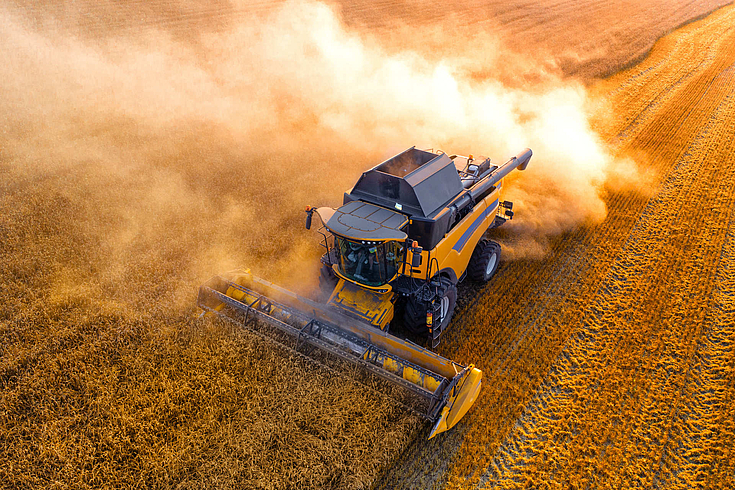
Wheat harvest in Ukraine: An important source of income for the country.
AdobeStock
Benefits for the EU and global food supply
Supporting Ukraine’s agricultural recovery, however, is not an act of philanthropy, but a strategic investment firmly aligned with the European Union’s own economic interests. Ukrainian grains, oilseeds, protein crops, feed inputs and fertilisers could help diversify European supply chains and strengthen the EU’s food security and strategic autonomy. At the same time, localised pressures on agricultural markets, particularly in neighbouring Member States, as demonstrated by French and Polish farmer protests against increased Ukrainian agricultural imports, must be addressed through improved transit infrastructure and predictable trade arrangements. “In many cases, the EU could serve as a transit and logistical partner rather than the final destination,” the report suggests.
“Ukraine’s agricultural sector should be understood as largely complementary to the EU agri-food system, rather than purely competitive,” argues Tinatin Akhveldiani, who authored the task force report which promotes aligning the sectors recovery closely with the EU accession process.
“Russia's brutal war against Ukraine constitutes a make it or break moment for Europe. Ukraine is defending Europe and fights a war that Europe is not able and partly not willing to fight. With this fight, Ukraine becomes a key factor of European security,” says Christian Forstner, Director of HSS Brussels office.
“Similarly important is Ukraine's role for global food security. The reconstruction of Ukraine is a tremendous task. The Ukrainian agricultural sector needs access to ports and free navigation in order to be able to reach global markets. Ukrainian agricultural exports will go to global markets rather than to European markets. It's in Europe's interest to facilitate Ukrainian agricultural exports. This important report shows how Europe can do this.”
The full report can be retrieved here.
_____
Nikoloz Lagvilava contributed to this summary analysis.
Contact

Director

Programm Managerin

Policy Advisor