
Short Article
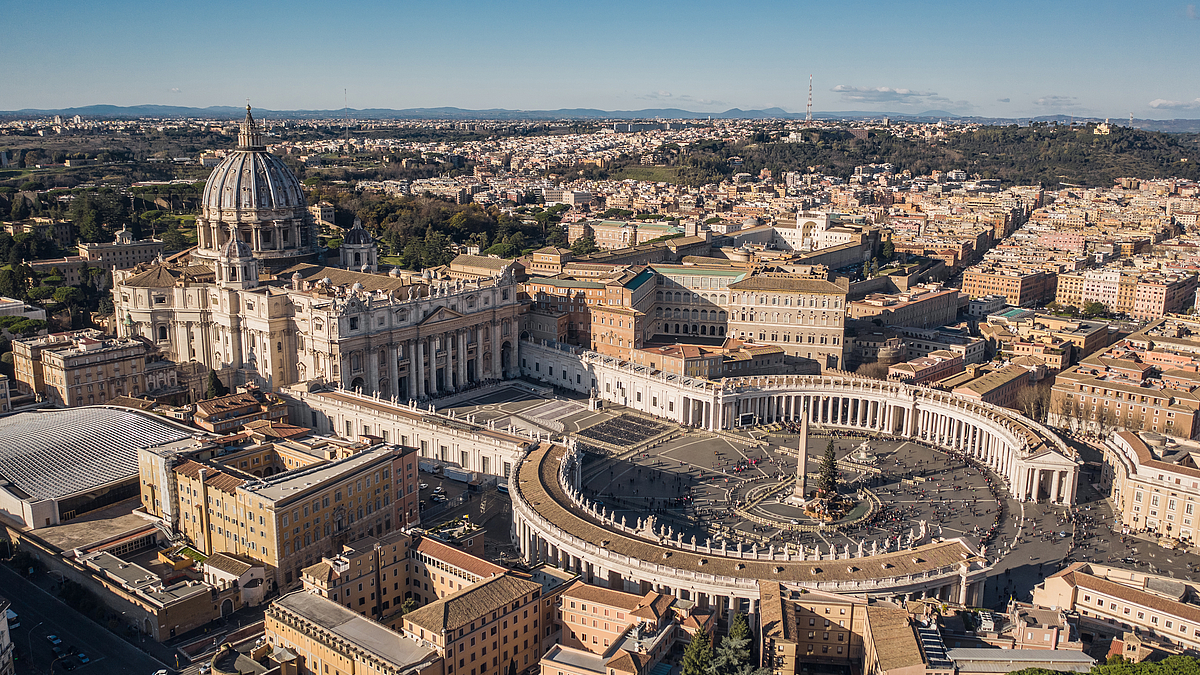
One Year of Leo XIV: Who Is This Pope?
Adobe STock/a_medvedkov
Head-on Attack Against Trump
With a head-on attack against his fellow countryman, the U.S. president has once again ensured that Leo’s persistent calls for peace are suddenly receiving widespread attention. Trump accuses the Pope of endangering “many Catholics and many people” with his statements on the war with Iran. Just a few weeks ago, the US President declared that the Pope was downplaying Iran’s nuclear weapons, was “weak” in the fight against crime, and “terrible” when it came to foreign policy. Trump made it clear that he is “no fan of Pope Leo,” whom he described as a “liberal” person. When Prime Minister Giorgia Meloni spoke up to defend the Pope, she too fell into disfavor: once praised by Trump as “fantastic,” he now called her “discouraged.”
Even if the Pope is reluctant to assume the role of Trump’s antagonist, he has nonetheless accepted the challenge. With the calm tenacity that characterizes him, he draws attention to the suffering of the innocent in Iran and Lebanon, calls for peace negotiations instead of bombs, and urges respect for international law.
Peace be with you
Peace — that was the first theme Leo emphasized when he took office on May 8 of last year. While his concept of peace is a Christian one, rooted in the resurrection of Jesus, his call for an “unarmed and disarming peace” is also aware of its political explosiveness. This pope is no mere pacifist. In conversation, for example, he readily admits that Ukraine naturally has the right to arm itself to confront the Russian aggressor. Such a statement would never have passed the lips of his predecessor, Francis (2013-25).
Yet such hints of Realpolitik do not prevent Leo from holding fast to the utopian potential of the discourse on peace. “As a shepherd, I cannot be in favor of war,” he told journalists in April upon returning from a trip to Africa. “The question is not whether a regime changes or not. The question is how we promote the values we believe in without the death of so many innocent people.”
Trip to Africa: No Fear of Autocratic Regimes
In Africa, the Pope addressed the topic of peace in a wide variety of contexts: in Algeria, as religious harmony between Christians and Muslims; in Cameroon, a country torn by conflict between its French- and English-speaking populations, as a social ideal. It also became clear during this trip that Leo has no qualms about engaging with autocratic regimes: even in the presence of corrupt or criminal political elites, he spoke plainly without straying from diplomatic protocol.
Stephan von Kempis
The Vatican: Neutral Ground for Peace Negotiations?
Leo’s steadfast focus on the issue of peace holds great promise for his pontificate. The Vatican could be considered as a venue for initiating or conducting peace negotiations; perhaps the American on the Chair of Peter will one day even become the first pope to be awarded the Nobel Peace Prize. In the long run, the theme of peace could even earn him an invitation to Beijing — something popes could only dream of for decades.
Social Teaching in the Age of AI
Peace, then, is the primary focus of this pontificate. Leo has set another tone through his choice of name: it refers to Leo XIII (1810-1903), who became the father of Catholic social teaching with his encyclical “Rerum novarum.” In a series of scattered remarks, the fourteenth Leo has outlined an update of this social teaching for the present day, especially in light of the challenge posed by AI. However, he has not yet fully lived up to this ambition. This may also be due to the fact that his predecessor, Francis, casts a particularly long shadow in this field with his pointed, often provocative formulations (a famous example: “This economy kills”), and it is difficult for his more measured successor to step out of that shadow.
Making an impact through short interviews and trips abroad
While Leo XIV has already issued his first encyclical, he has also sought to shape public debate through other means. This gives the impression that this pope intends to make an impact not only through writings — but how else, then? The answer is twofold. On the one hand, Leo deliberately uses short interviews — which he usually gives on Tuesday evenings in Castel Gandolfo near Rome — to take a stance on current events. It was in one of these statements that he called Trump’s threats to destroy Iranian civilization “unacceptable.” On the other hand, he seeks to make an impact through foreign trips, a tool that his Polish predecessor, John Paul II (1978-2005), in particular, knew how to use masterfully. Through these trips, the head of the Catholic Church generates strong media resonance with his concerns, including his political messages.
Symbolic politics with clear priorities
The fact that Leo knows how to play the game of symbolic politics is evident, for example, in his decision not to travel to Washington for the 250th anniversary celebrations of U.S. independence —despite an invitation from U.S. Vice President Vance — but instead … to the refugee island of Lampedusa. Or by the fact that he will almost certainly precede a visit to his US homeland with a trip to Latin America, where he served as a missionary for many years (in Peru). Incidentally, one can assume that Leo XIV will appear before the UN and the European Parliament in the foreseeable future.
Internal Church Priority: Unity
So far, we have viewed the new pope primarily through a political lens; now we will attempt to assess his stance on internal church matters as well. The key word in this regard is unity: it stems from his motto, “In illo uno unum” (In the One — meaning Christ — we are one). This is a quotation from St. Augustine; Leo belongs to the order that refers to this Doctor of the Church from late antiquity. Much more so than his predecessor Francis, who once even went so far as to remark that he had “no fear of a schism,” Leo XIV feels committed to the unity of the Catholic Church. This goes so far that he even offered the schismatic-leaning Society of St. Pius X a dialogue regarding the varying degrees of binding force of the documents of the Second Vatican Council (1962-65) — an astonishing concession for a pope who, at the same time, praises these very Council texts as visionary and groundbreaking at every Wednesday audience.
Reservations about the Synodal Path
It is also thanks to Leo’s commitment to unity that he has promised to continue the synodal experiment launched by Francis — in part with an eye toward the German Catholic reform process known as the “Synodal Path.” Although the actual Vatican World Synod has formally concluded since October 2024, but now the focus is on implementing a long and somewhat disparate list of resolutions. Leo has indicated that he intends to ensure that the multifaceted dialogue of the universal Church with itself does not go astray.
He appears to harbor some mistrust toward the German “Synodal Path” and the reform ideas associated with it, even if he phrases this more kindly than his predecessor. When asked about blessing ceremonies for same-sex couples — which the German Bishops’ Conference approved precisely during the “sedisvacancy,” that is, during last year’s papal vacancy — he explained that one must “understand that the unity or division of the Church should not revolve around sexual issues,” as other issues are “much bigger and more important.” One can hear a clear sense of bewilderment at the strange Germans in his words.
HSS und von Kempis
About the Authors
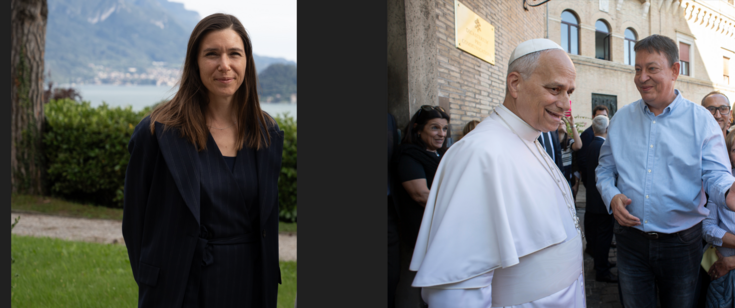
Stefan v. Kempis studied history and theology in Bonn, Freiburg, and Paris, as well as Islamic studies in Rome and Cairo. He heads the German-language program of Vatican News and Vatican Radio. His book on Pope Leo XIV remained on the Spiegel bestseller list for several weeks in 2025.
Silke Schmitt studied sociology, media, and communication studies in Marburg and Rome. In 2013, she completed her master’s degree in “Experts in Politics and International Relations” at LUMSA University. As a journalist, she worked in the German section of Vatican Radio and for the news agency KNA. Since 2021, she has headed the office of the Hanns Seidel Foundation Italy/Vatican in Rome.
Contact
