
Political Analysis
Mrima Hill: European critical minerals strategy meets Kenyan mineral governance
Underlying research: Veronika Wetzel, A geopolitical policy assessment of Kenya's titanium ore reserves within EU diversification and strategic autonomy debates, Hanns Seidel Foundation Nairobi Office Research Paper, February 2026 — [available through the link below].

Critical and strategic minerals sit at the intersection of multiple advanced industries. Rare earth elements (REE), niobium (Nb), and titanium (Ti) — the material families relevant to Kenya's coastal deposits — appear across digital, energy, aerospace, and high-performance materials applications. This convergence, more than the geological scarcity of any single material, is what has moved critical minerals into the centre of geopolitical contest.
Confirmed CC BY 4.0 — visible at the bottom right of the image itself ("IEA. CC BY 4.0."). ; International Energy Agency, Global Critical Minerals Outlook 2025, IEA, Paris. Licensed under CC BY 4.0.
Mrima Hill: European critical minerals strategy meets Kenyan mineral governance
On 24 March 2026, Kenya's Ministry of Mining, Blue Economy and Maritime Affairs gazetted an open tender for the Mrima Hill niobium and rare-earth deposit in Kwale County. It was the first competitive open-tender process for a strategic mineral deposit of this significance under the 2016 Mining Act.[1] The deposit is one of the largest undeveloped global sources of two material families that have, in the past five years, moved from technical supply concerns to the centre of a geopolitical contest.
Niobium is the alloying element that gives high-strength low-alloy steel its weight-to-strength ratio. Without it, jet engines, oil and gas pipelines, automotive frames and seismic-resistant construction become heavier and more expensive.[2] Niobium strengthens high-strength low-alloy steel used in pipelines, automotive frames and construction, and — via nickel-based superalloys — the turbine blades of jet engines.[3] Rare earth elements — yttrium, lanthanum, neodymium and the rest of the family — are the operating inputs of permanent magnets for wind turbines and electric-vehicle motors, of precision guidance systems for defence applications, and of much of the semi-conductor and clean-energy hardware on which European industrial competitiveness now rests.[4]
China supplies approximately 70 per cent of rare earth imports to the euro zone, directly and indirectly; global niobium supply is dominated by Brazil, with a smaller share from Canada.[5] Beijing's tightening of rare-earth export controls through 2024 and 2025 has reshaped supply assumptions across Europe.[6]
This is the reason why the Mrima Hill tender is of such significance to Europe. The European Union's Critical Raw Materials Act (Regulation (EU) 2024/1252) commits the Union to extract 10 per cent, process 40 per cent and recycle 25 per cent of its annual consumption of strategic raw materials by 2030, with no single non-EU country supplying more than 65 per cent of any strategic material at any stage of its supply chain — from mining to refining.[7] These benchmarks are still five years away. Bidder selections taking place in 2026 will shape supply-chain geography long after the CRMA deadlines have passed. American and Australian consortia have submitted proposals in relation to Mrima Hill. Chinese state-backed interest is widely anticipated. At the same time, no information on any European bid is publicly available.

World mine production of rare earths, 2024. China accounted for approximately 270,000 of an estimated 390,000 metric tons of rare-earth-oxide equivalent — close to 70 per cent of global mine output. Refining concentration is still higher. Source: US Geological Survey, Mineral Commodity Summaries 2025: Rare Earths. Public domain.
US Government work — public domain; US Geological Survey, Mineral Commodity Summaries — Rare Earths, 2025 edition (annual publication) Direct URL: https://pubs.usgs.gov/periodicals/mcs2025/mcs2025-rare-earths.pdf

The European Commission's methodology classifies raw materials by economic importance and supply risk. Materials crossing both thresholds are designated "critical"; a subset including rare earths and titanium metal are further designated "strategic." Source: European Commission, Joint Research Centre, Study on the EU's list of Critical Raw Materials (2023). © European Union, reused under Decision 2011/833/EU.
European Commission, Joint Research Centre, criticality assessment for the 2023 list of Critical Raw Materials (the underlying methodology behind the CRMA's 34/17 designations) Information page:https://rmis.jrc.ec.europa.eu/eu-critical-raw-materials
The European starting point
The CRMA, in force since 23 May 2024, identifies 34 critical raw materials and designates 17 of them as strategic, among them the rare-earth elements used in permanent magnets and titanium metal. Niobium, also present at Mrima Hill, is on the broader list of 34 critical raw materials but is not itself designated as strategic.[8] To meet its benchmarks, the EU pursues a two-track external strategy: bilateral Strategic Partnerships on raw materials value chains structured as templated Memoranda of Understanding, and recognition of individual Strategic Projects under the CRMA.
As of early 2026 the EU has signed roughly 15 Strategic Partnerships globally, of which five are with African states: Namibia (November 2022), the Democratic Republic of Congo and Zambia (October 2023), Rwanda (February 2024) which is subject to a European Parliament suspension call of February 2025 and under Commission review, and South Africa (November 2025).[9] On the project side, the Commission selected 13 Strategic Projects outside the EU in June 2025, of which four sit in Africa — in Madagascar, Malawi, South Africa and Zambia. Kenya features in neither list.[10] Recent analyses by SWP and ECDPM both observe that the EU's templated approach has so far moved slower than competing American and Quad-aligned offers in translating regulatory ambition into bankable projects on the ground.[11]
The Kenyan starting point
Kenya's mineral governance is under deliberate reconstruction. The 2016 Mining Act and the Mining and Minerals Sessional Paper No. 7 of 2016 establish a strategic-minerals regime: 14 minerals, niobium and rare-earth elements among them, are designated as strategic, with mandatory involvement of the National Mining Corporation (NAMICO) in commercial arrangements.[12] This is a different commercial model from those that underpin EU partnerships signed elsewhere, where private offtake can be negotiated directly.
Two state-building projects are currently in progress. A Geological Data Bank, supported by a recently completed nationwide airborne geophysical survey, is scheduled for completion by 30 June 2028; until then, geological information on most prospects remains fragmented.[13] A planned National Mining Institute, to be headquartered in Nairobi with regional centres, will provide technical training and applied research. The Sessional Paper commits the country to in-country value addition. The closure of the Kwale Mineral Sands Project at the end of 2024, an eleven-year operation that, until its conclusion, was the mainstay of Kenya's mineral-sector revenue (around 65% of mining output value and the country's largest mineral export), leaves Kenya without large-scale strategic (critical) mineral production for the first time in over a decade, with total mineral output falling to a nine-year low of Sh20.3 billion in 2025.[14]
Where the two logics align, or not
The European partnership template, as it has matured since 2021, presupposes a partner state offering reasonably consolidated geological data, a permitting environment compatible with international offtake structures, and a value-chain proposition that European co-financing instruments can credibly support. The five African partners signed to date fit this profile to differing degrees: Namibia and Zambia bring established production and relative regulatory predictability; the DRC, despite governance challenges, brings unmatched cobalt and copper scale; South Africa brings industrial sophistication and downstream capability.
Kenya's profile is different. It is still a work-in-progress, building the preconditions the European template presupposes — consolidated geological data, trained technical capacity, institutions to manage strategic minerals — and it is doing so on its own terms. Its strategic-minerals regime, including mandatory National Mining Corporation (NAMICO) participation and a commitment to in-country value addition, is a deliberate choice to capture more of the value chain domestically rather than export raw ore. For the EU's current instruments this raises a sequencing problem: a Memorandum of Understanding built around joint commitments on supply-chain integration, infrastructure financing, research, capacity-building and sustainable sourcing assumes a partner able to anchor most of those elements at signing. Kenya is not yet that partner — partly because the institutions are still a work-in-progress, and partly because the model it is building is not that which the template assumes.[15]

Refining capacity for critical minerals is heavily concentrated in a small number of countries. For rare earths, China refines close to nine-tenths of global output. Source: International Energy Agency, Global Critical Minerals Outlook 2025, IEA, Paris. Licensed under CC BY 4.0.
Creative Commons Attribution 4.0 (CC BY 4.0) — verified from the IEA citation template What it shows: The IEA Outlook contains charts mapping the geographical concentration of refining capacity for each critical mineral — rare earths, lithium, cobalt, copper, nickel, graphite. The rare-earth chart in particular shows China's dominance of refining in a single image. ; International Energy Agency, Global Critical Minerals Outlook 2025 (June 2025) Report URL:https://www.iea.org/reports/global-critical-minerals-outlook-2025
The structural picture: concentration, not scarcity
A wider reading of the critical minerals problem reframes what is actually at stake at sites like Mrima Hill. A recent assessment by the Institute for Security Studies (ISS), drawing on the International Energy Agency, argues that the central difficulty for critical minerals is not geological scarcity but the geographical concentration of refining and processing, the long lead times of new supply, and the timing of investment.[16] On this account the materials themselves are comparatively abundant and widely distributed; the scarcity lies in diversified processing capacity and the patient capital required to build it. China currently refines between (roughly) half and nine-tenths of the world’s critical minerals, depending on the material, and much of that output is now subject to some form of export control.[17]
Two features of this structural picture bear directly on Kenya. First, new mines typically take close to two decades to move from discovery to production, and exploration and processing investment slowed after the price surge of 2022 and 2023, which means that decisions about which deposits are developed, and by whom, are made years before any material reaches a market. Second, Africa is widely held to be resource-rich but investment-poor: the continent holds substantial shares of several energy-transition minerals yet attracts only a modest share of global exploration and mining capital, constrained by perceived political risk, infrastructure gaps and the cost of capital.[18] For a deposit such as Mrima Hill, this is the decisive context. The question is less whether the niobium and rare earths exist than whether a bidder can assemble the capital, the processing pathway and the social licence to develop them on terms a host country will accept; and whether external partners are structured to support that over a fifteen- to twenty-year timeline. American capital is already moving through these assets: in late 2024 the US firm Energy Fuels acquired Base Resources, operator of the recently closed mine in Kwale county, and is now replicating the model at a heavy-mineral-sands project in Madagascar — itself one of the EU's five African Strategic Projects.[19]
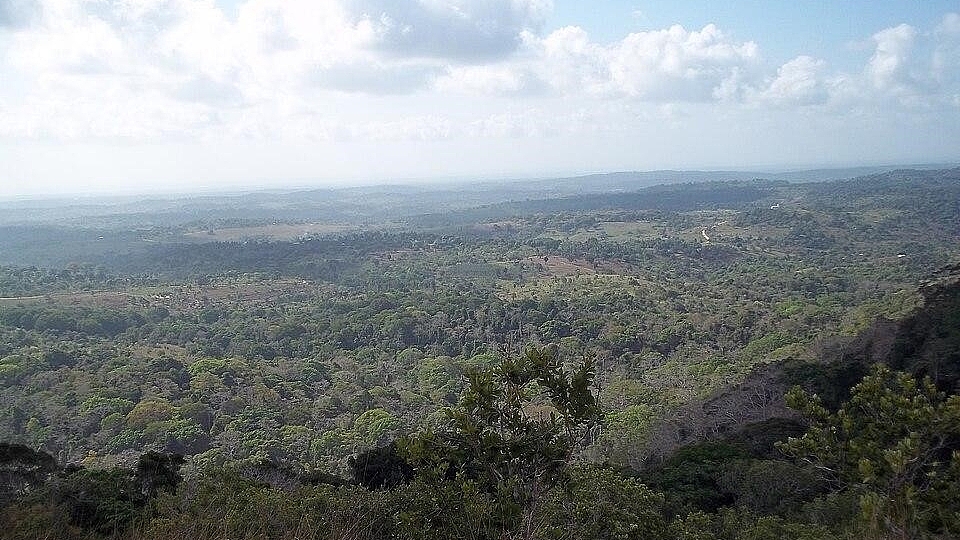
A visual anchor for the coastal forest ecosystem to which Mrima Hill belongs
Holger Günther; Creative Commons Attribution-ShareAlike 3.0 Unported (CC BY-SA 3.0)
Mrima Hill: a stress test
Mrima Hill compresses these structural questions into a single decision. The site is approximately 390 acres (157 hectares) of forested hill in Kwale County, double-gazetted as a protected forest reserve, and as a sacred site of the Mijikenda people. It hosts several of the sacred kaya forests, forest shrines that remain active places of worship governed by community elders, and are recognised on the UNESCO World Heritage Site List. These coastal forests are also rich in biodiversity. Since 1952, at least five international mining firms have attempted to develop here; all have been rejected through community and legal resistance. The most recent attempt, by Cortec Mining Kenya, a subsidiary of Pacific Wildcat Resources, ended with the revocation of its Special Mining Licence in 2013 and a 2018 ruling against the company at the International Centre for Settlement of Investment Disputes.[20]
The site's physical characteristics add further complexity for any prospective developer. Gamma dose rates[21] within a two-kilometre radius exceed the global population-weighted average by between 1.5 and 33.8 times, indicating elevated natural background radiation. The presence of thorium (and associated uranium) means rare-earth extraction would generate naturally occurring radioactive material, predominantly low-level radioactive waste requiring dedicated management.[22] Community institutions such as the Kaya elders who serve as custodians of the sacred forest and the Mrima Hill Community Forest Association have publicly demanded consultation and a transparent process, insisting that engagement conditions (cultural protection, employment, fair compensation and relocation safeguards) be met before any licence is granted.[23]
The American-backed Mrima Earth Consortium proposes the equity-stake and value-added processing model that has come to define recent US minerals diplomacy in Africa, with technical leadership drawn from the Mountain Pass rare-earth project in California.[24] The RareX/Iluka joint bid links Mrima Hill to Iluka's Eneabba refinery in Western Australia via a binding offtake term sheet, embedding the site, if successful, in an Australian government-backed, Western-aligned supply chain, one that fits the critical-minerals cooperation agenda of the Quad.[25] Chinese state-backed interest is anticipated, but has so far not materialised through a confirmed bid. No European participation, at the level of either national champions or an EU-coordinated consortium, has been publicly visible. Read against the site's profile, this absence suggests erring on the side of caution. A site combining cultural sensitivity at this depth, a seventy-year history of community resistance, an unresolved ICSID precedent[26], elevated radiation and an incomplete geological data base is a demanding entry point for any developer, and particularly demanding for a partnership architecture built around templated Memoranda and consolidated regulatory readiness.
What the tender will and will not settle
A successful tender will identify a bidder for one site. It will not, on its own however, resolve the broader question of how Kenya integrates into European critical minerals supply chains. Three of the elements that would matter most for such integration are still being developed domestically: the Geological Data Bank, the National Mining Institute and institutional capacity to manage strategic minerals at multiple sites simultaneously. The titanium licensing landscape along the coast — Sokoke, Kilifi, Lamu, Tana River — moves in parallel to Mrima Hill and is shaped by a different set of bidders, with Chinese-linked entities currently more visible than European ones.[27]
The political calendar adds another layer of complexity. Kenya's general election falls in August 2027, seventeen months after the tender's gazettement. Mining-rights awards of this scale typically run through evaluation, negotiation, and licensing windows that can extend over a year, which means the bidder selection process at Mrima Hill will unfold within a tumultuous domestic political timeline. The interval creates space for the decision to be deferred, restructured, or carried into a new political cycle — particularly given the site's history of legal challenges and the sensitivities documented above. External partners reading the tender as a discrete commercial event risk missing the extent to which its timing is also relevant with respect to Kenyan political dynamics.
For European decision-makers, the more useful framing of the Mrima Hill moment may not be “where is Europe in this tender” but rather “where does European engagement add comparative value over a five to ten-year horizon”. On the technical instruments most directly tied to bidding — equity stakes, refinery offtake, sovereign-backed finance — Europe is currently less competitive than American or Quad-aligned offers. On the institutional preconditions — geological data infrastructure, mining-sector training, governance of strategic minerals, value-addition policy support — there is a closer fit with European comparative advantage.
In conclusion
The Mrima Hill tender is one of the most consequential mineral governance decisions Kenya will make in this decade. It is also, for European observers, a useful diagnostic of where European and Kenyan policy logics converge and where they remain out of sync. Europe's absence is better explained by the limits of its partnership instruments than by neglect; Kenya's position is better explained by deliberate policy choices than by a lack of readiness alone. The more productive question is what kind of cooperation instrument would fit a country that is deliberately building its strategic minerals architecture from the ground up.
The Hanns Seidel Foundation Kenya Office is observing the Mrima Hill process closely and is developing the broader critical minerals question — its institutional, governance and value-chain dimensions for East Africa and Europe — as a programme priority for the period ahead.
References
[1]Kenya Gazette Notice, Ministry of Mining, Blue Economy and Maritime Affairs, 24 March 2026 (issued under sections 14(1) and 223(2)(e) of the Mining Act, Cap 306); statement by Cabinet Secretary Hassan Ali Joho, 9 January 2026.
[2]CBMM and US Geological Survey, Mineral Commodity Summaries — Niobium, 2024 and 2025. Niobium content in high-strength low-alloy steel is typically 0.02–0.10 per cent.
[3] niobiumcanada.com/what-is-niobium-used-for/
[4]European Commission, Joint Research Centre, Raw Materials Information System; International Energy Agency, Critical Minerals Outlook 2024; US Department of Energy, Critical Materials Strategy. Permanent magnets typically use neodymium, praseodymium, dysprosium and terbium; phosphors and ceramics use yttrium, europium and lanthanum.
[5]International Energy Agency reporting on the Chinese share of global rare-earth refining capacity; CBMM and US Geological Survey on niobium supply concentration in Brazil and Canada.
[6]Reporting on China's tightening of rare-earth export licensing through 2024 and 2025; cross-referenced with the preamble to Regulation (EU) 2024/1252.
[7]Regulation (EU) 2024/1252 of the European Parliament and of the Council of 11 April 2024, establishing a framework for ensuring a secure and sustainable supply of critical raw materials, OJ L of 3 May 2024.
[8]Regulation (EU) 2024/1252, Annexes I and II.
[9]European Commission, Raw Materials Diplomacy page, single-market-economy.ec.europa.eu (signed Memoranda of Understanding, accessed May 2026). The Rwanda partnership has been paused in the light of allegations concerning the M23 conflict and the smuggling of minerals from the Democratic Republic of Congo.
[10]European Commission press release IP/25/1419, 4 June 2025: Commission selects 13 Strategic Projects in third countries.
[11]Stiftung Wissenschaft und Politik, Strategic Raw Material Cooperation between Africa and Europe, SWP Comment 2026/C 07, 9 February 2026; European Centre for Development Policy Management, The EU's partnerships around critical raw materials: Do its ambitions match reality?, March 2025.
[12]Government of Kenya, Mining Act 2016 (Cap 306); Mining and Minerals Sessional Paper No. 7 of 2016.
[13]Ministry of Mining, Blue Economy and Maritime Affairs, Mining Sub-Sector Report MTEF Period 2026/27–2028/29, October 2025.
[14]"End of an era as Base Titanium ends Kenya operation," Business Daily (1 January 2025); Base Titanium, "Kwale Operation" (Kwale ≈ 65% of mining output value); "Kenya mineral output falls to nine-year low of Sh20bn," Business Daily, citing the KNBS Economic Survey (29 April 2026).
[15]European Council on Foreign Relations, From ore to more: Mineral partnerships for African industrialisation, September 2025; Africa Policy Research Institute and Deutsche Afrika Stiftung, Navigating Critical Mineral Supply Chains: the EU's Partnerships with the DRC and Zambia, March 2024.
[16]Jakkie Cilliers, Critical minerals and energy resources in Africa: myth or opportunity?, Institute for Security Studies, African Futures and Innovation programme, 2026, drawing on the International Energy Agency, Global Critical Minerals Outlook 2025. Figures on the Chinese share of refining (approximately 50 to 90 per cent depending on the material) and on the post-2022 investment slowdown are as reported there.
[17]China refines between roughly half and nine-tenths of key critical minerals depending on the material — more than 50% of aluminium, lithium and cobalt, around 90% of rare earths and manganese, and nearly all natural graphite. UNCTAD data, charted by Statista, "Top Countries Processing Critical Minerals" (2024); see also IEA, Global Critical Minerals Outlook 2025 (Paris, May 2025), which notes that China leads refining for 19 of 20 strategic minerals and that a growing share of these are subject to export controls.
[18]Cilliers (2026), on Africa’s “resource-rich, investment-poor” position and the constraints of capital, perceived political risk and infrastructure; see also the ISS African Futures programme analyses on financial flows and energy futures.
[19] _Limo Substack: The Base Titanium Legacy in Kenya - A flagship mining project ends as interest in the sector takes off; bankelele.substack.com/p/the-base-titanium-legacy-in-kenya
[20]Cortec Mining Kenya Ltd, Cortec (Pty) Ltd and Stirling Capital Ltd v. Republic of Kenya, ICSID Case No. ARB/15/29, Award of 22 October 2018; UNESCO Tentative Lists, on the cultural significance of Mrima Hill and the Mijikenda Kaya forests.
[21] M.I. Kaniu, H.K. Angeyo, I.G. Darby, et al., "Assessment and mapping of the high background radiation anomaly associated with laterite utilization in the south coastal region of Kenya," Applied Geochemistry (2019); drawing on M.I. Kaniu et al., "Rapid in-situ radiometric assessment of the Mrima-Kiruku high background radiation anomaly complex of Kenya," Journal of Environmental Radioactivity 188 (2018): 47–57.
[22]International Atomic Energy Agency, Radiation Protection and NORM Residue Management in the Production of Rare Earths from Thorium-Containing Minerals, Safety Reports Series No. 68 (Vienna: IAEA, 2011); see also IAEA, "NORM in Industrial Operations and Regulatory Considerations."
[23]"Members of the Mrima Hills Community Forest Association... accused local leaders [of holding] meetings concerning the future of the Mrima Hills mines... without the involvement of the affected community," KBC/NTV Kenya (Jan 2026); see also "The hill that the world wants," Ethical Business Africa (24 Feb 2026), quoting CFA secretary Ayub Suya on the community's memorandum of minimum conditions; and "Global race for rare earths comes to Kenya's Mrima Hill," Reuters/The Standard (31 Oct 2025).
[24]"Mrima Hill rare earth project attracts new US-backed consortium," The Standard (9 December 2025); on the US policy model, see "MP Materials Deal Marks a Significant Shift in US Rare Earths Policy," Columbia Center on Global Energy Policy (11 July 2025).
[25]"RareX, Iluka establish consortium to develop project in Kenya," Mining Weekly (22 April 2025); "RareX and Iluka lodge joint bid for Kenya's Mrima Hill critical minerals project," Intellinews (23 April 2025); on Eneabba's government backing, "Additional support for rare earths refining for a Future Made in Australia," Prime Minister of Australia (6 December 2024).
[26] In 2013 Kenya revoked the Special Mining Licence held by Cortec Mining Kenya (a subsidiary of Pacific Wildcat Resources) over Mrima Hill, citing environmental and procedural irregularities. Cortec's challenge at the World Bank's investment-arbitration body, ICSID, was dismissed in 2018, with the tribunal ruling in Kenya's favour. The case is noted as a cautionary precedent on the fragility of mining rights at the site, not as an open dispute.
[27]Republic of Kenya, gazette notices on titanium licensing (Celestlink Investment Ltd, Lamu and Tana River Counties, May 2025; Jialin East Africa Mining Company Ltd, Kilifi County, 2025); Wetzel (2026), section 3.

Uta Staschewski
About the Author
Uta Staschewski has been Resident Representative of the Hanns Seidel Foundation in Kenya since September 2025. She previously led the Foundation's office for Tunisia, Libya and Algeria from 2021 to 2025, and served as Resident Representative for Kenya and Ethiopia between 2015 and 2021. From 2012 to 2014 she headed the Foundation's office in Namibia, having earlier worked in Ghana. She trained as a lawyer in Germany.
Contact
