
Short Article
Japan in Transition: Political Change and Global Implications

US President Donald Trump and the Japanese Prime Minister Sanae Takaichi in the White House in October 2025, with „Japan is back“ hats
Source: White House, public domain
The election of 2026, a landslide victory for the ruling Liberal Democratic Party (LDP), a conservative party led for the first time by a woman, Sanae Takaichi, was almost a miracle. The LDP won 316 of the 465 seats in the lower house, the House of Representatives of the Japanese two-chamber Diet, a super-majority able to change the Japanese constitution. Only months before, the fate of LDP was quite dubious and the LDP´s prospects did not look so rosy. True, since the reestablishment of Japanese sovereignty after the end of World War II, most of the time the country was governed by one party, the conservative Liberal Democratic Party (LDP). It was almost a one party system – but only almost: from 1955 the party governed until 1993 (an era called „the 1955 system“), then, after only an 11-month hiatus, the party took power again until 2009, and then – after a three-year break from 2009 to 2012, again. While the LDP oversaw all the important decisions leading to Japan´s spectacular rise to wealth and related power in the postwar period, the economic instability following the crash of 1989, the obvious ossification of the LDP, and frequent corruption scandals as well as the inability to modernize the economy brought much more rocky stewardship from the 1990s. In 2024 another crisis loomed large: since 2021 prime minister Fumio Kishida governed the country, with very low approval ratings. Discontent was high in the wake of the Covid pandemic, in particular with rising living costs. A slush fund scandal at the ruling party annoyed the voters. Finally, in the autumn of 2024 Kishida stepped down and made place for Shigeru Ishiba.
Ishiba, who had come to power through internal strife in the LDP, wanted to bolster his weak credentials by calling a snap election, which is a right of the Japanese prime minister. However, his calculation was wrong: the grievances of voters did not evaporate; the new Constitutional Democratic Party of Japan, successor of the notoriously inept and unlucky center-left Democratic Party of Japan, looked stronger and more able, and in the end the snap election brought a loss of majority for the ruling LDP - still the largest party - and its minor coalition partners. Ishiba stepped down and in October 2025 Sanae Takaichi became the first woman prime minister of Japan – thanks to a system, where the largest party gets the post of prime minister, even if she lacked a majority.
Source: Ministry of Foreign Affairs, Japan, CC BY 4.0
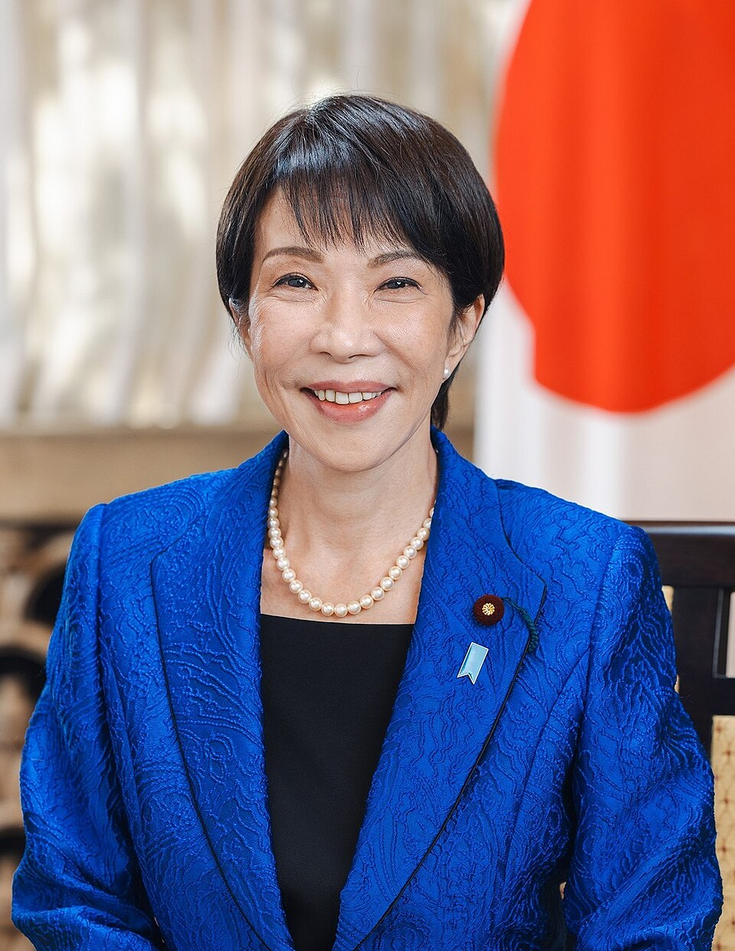
Who is Sanae Takaichi?
Born in 1961 and raised in Tenri, Nara Prefecture, on the central Honshu island, bordering Osaka and Kyoto, she graduated from Kobe University and was, among others, legislative aid and broadcaster before being elected as an independent in 1993 to the House of Representatives. Prime Minister Shinzo Abe (governing from 2006-2007 and then 2012-2022) promoted her to Minister for Internal Affairs and Communications. After Abe stepped down, Takaichi was one of the candidates for the leadership post in LDP, but came only in third, and served as Minister for Economic Security under Prime Minister Kishida. In 2024, she finished second in the leadership election, and lost to Shigeru Ishiba, but only a year later, she won the leadership, defeating among others Shinjiro Koizumi, the son of the former Prime Minister. Since the old coalition of LDP and the Komeito party, a moderate party with center-left social policy views, lost its parliamentary majority, she formed a new coalition with the Japan Innovation Party, another minor moderate party, with a platform of market economy reforms.
As a minister under Abe and Kishida, and later as a prime minister, Sanae Takaichi soon gained a reputation for her blunt and clear messaging and her strong work ethic – “work, work, work” she frequently quoted as secret of her success. As such, she was perceived very different from the old elite of the country and as the first female leader she also had a strong appeal for women. With a politically very conservative message, she nevertheless attracted the overwhelming support of young voters, who wanted a more dynamic and reform-oriented person in charge. The indirect ways and indecisiveness of former politicians confronted with stronger competition with China and several “lost decades” of low growth, in a time seemingly heralding a general decline of Japan, were equally attributed to the “old LDP” and the opposition parties, and Takaichi successfully could contrast her own, fresher approach, including a MAGA-style slogan, “Japan is back”. Among the successful campaign issues of the LDP were a focus on economic security and protection of domestic industries, stronger military capabilities, tighter immigration policies and opposition against rising China, which was seen as too assertive. Especially the last issue soon gained traction. Takaichi, who in April 2025 had visited Taiwan and met President Lai Ching-te and later at the APEC summit in October 2025 met the Taiwanese representative, answered on November 7 a question in the Japanese House of Representatives regarding potential survival-threatening situations for Japan by an opposition lawmaker with referring to a potential invasion of Taiwan by mainland China with military force. This was understood by the Chinese side as a challenge to the “One China” policy and China’s consul-general in Osaka, Xue Jian, posted a day later on X (formerly Twitter, later deleted after Japanese protests) a threat interpreted as “we have no choice but to cut off that dirty neck/head that has lunged at us without hesitation.” After that, accusations and condemnations of both sides followed, including Chinese complaints to the UN Secretary-General António Guterres and statements in the General Assembly and Security Council. But China exerted also economic pressure: a travel warning was issued warning Chinese citizens of “poor security” in Japan, cultural and tourism events were canceled, including J-Pop events in China, imports of Japanese (highly-priced) seafood and sake in China were delayed. Additionally, the Chinese People Liberation Army conducted live-fire drills and coast guard standoffs near the contested Senkaku Islands (called Diayou islands in China) and Chinese military aircraft and drone activity near Japan increased. This resembled the economic and political pressure China exerted over South Korea, when it installed US anti-missile (THAAD) equipment. However, while in Korea the pressure was at least partly successful, in Japan it fired back: voters loved Prime Minister Takaichi for her strong stance and her uprightness was one factor for her decisive election victory three months later.
https://www.kantei.go.jp/jp/104/actions/202601/13korea.html; Source: Cabinet Public Affairs Office of Japan, Public data license Ver. 1 of Japan
Japan and its neighbors in Northeast Asia
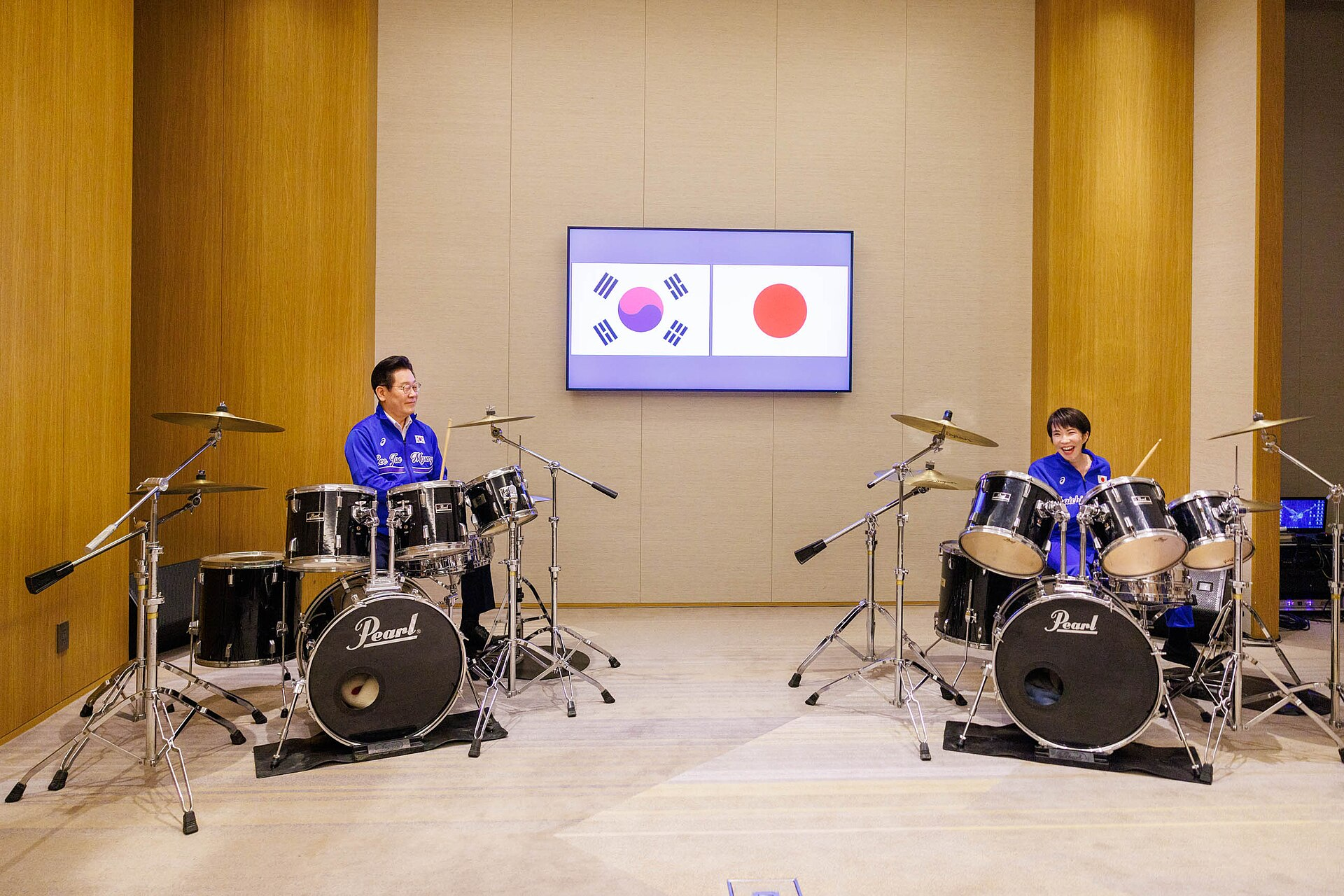
In neighboring countries - not only China, but also South Korea, North Korea and Russia- the victory of Takaichi is seen as a potential threat. Russia and North Korea especially focus on the stronger military built-up of Japan, which after World War II had an explicit “peace constitution”. With the current 2/3 majority in the Parliament Prime Minister Takaichi could change the constitution, if she also wins a similar majority in the Upper House in 2028 and if a national referendum agrees. Most likely, however, even in the case of a change, would be a very moderate change of constitution, mainly a formal recognition of Japan´s military, the so-called Self-Defense Forces, while keeping the core pacifist clause renouncing the war. This – a long-standing goal of the LDP – would be not very dramatic. Emergency powers for the government in crises (like wars and disasters) as well as powers to fight hybrid warfare might be added, but a full-scale renouncement of pacifism is not to be expected. Nevertheless, the Japanese military built-up and its close alliance with the US and closer attachment also to NATO will be observed by neighbors. South Korea itself was on a similar path under previous, later ousted President Yoon Seok-Yeol, but became more cautious under the current President, left-wing Lee Jae-Myeong. Also, the stance of Takaichi, the LDP and conservatives in Japan on Japanese war guilt, the honoring of war criminals in Yasukuni Shrine and unresolved issues of so-called comfort women (forced prostitution) and forced labor in World War II remain stumbling blocks to an otherwise “natural” alliance of two democracies and market economies in Northeast Asia. Surprisingly, until now, both Takaichi and Lee seem to go on very well and a short drum session of both during their summit in January 2026 in Nara, the hometown of Takaichi, went viral. In particular, this meeting also was seen as a re-confirmation of “shuttle diplomacy” of both countries despite the aforementioned differences.
The US-Japan alliance has always been a cornerstone of Japanese foreign policy after World War II. President Donald Trump endorsed Prime Minister Takaichi and her agenda, which he defined in sync with his own agenda as “conservative, peace through strength agenda”, and after her victory called her “a great woman” and “highly respected and very popular leader”. While this kind of praise sometimes tends to be temporary only, certainly the agenda of Japan and the USA do coincidence. In particular, the stronger stance against Chinese influence in the region needs an alliance of like-minded countries. Increased Japanese defense spending, a deeper military cooperation (ideally, trilateral, including South Korea) and a stronger alignment on strategic issues, including a more proactive Japanese foreign policy, all are helpful for that. Nevertheless, as in the USA, the foreign policy agenda can only succeed, if the domestic agenda also succeeds – how to cope with rising living costs, how to deal with rapid ageing in a non-immigration society, how to unleash the power of the market economy while protecting existing domestic companies and how to deal with one of the highest debt burdens of developed countries (around 230 percent of GDP or 9-10 trillion USD, compared to around 120 percent in the US and 90 percent in the Eurozone). This year, the debt is projected to slightly decrease, but the current economic turmoil following the Iran war might change this again. If Prime Minister Takaichi can handle these challenges, Japan will again be an international force to be reckoned.

About the Author
Prof. Dr. Bernhard Seliger has been the Director of the Hanns Seidel Foundation for the United States and Canada since 2026, based in Washington, D.C. Prior to this, he worked for 23 years with the foundation on the Korean Peninsula and in Northeast Asia.
Contact
