
Short Article
Information security during the Polish Presidency of the Council of the European Union

Donald Tusk outlined to MEPs on Wednesday 22 January 2025 his goals for Poland’s helming of the EU Council presidency and the country’s "Security, Europe!" strategy.
CC-BY-4.0: © European Union 2025– Source: EP; https://www.flickr.com/photos/36612355@N08/54284665254
Polish approach to information security
While some countries treat information security (the protection of all forms of information from unauthorized access, modification, or destruction) separately from cybersecurity (the protection of digital systems from cyber threats such as hacking, malware, or phishing), Poland adopts an integrated approach that interconnects both spheres.. This is particularly relevant in the context of the rise of hybrid threats, which combines various tools to achieve specific objectives. For instance, cognitive warfare employs a range of tactics, including cyberattacks, sabotage, and disinformation campaigns, with the aim of influencing public opinion and undermining trust in public institutions. Since Russia's full-scale invasion of Ukraine in February 2022, such threats have significantly increased in Poland and across the European Union.
To better counter diverse and interconnected threats, Poland has developed a holistic approach to information and cybersecurity. An example of this is the Elections Protection Program, known as the “Election Umbrella” (Parasol wyborczy), which was prepared by the Polish Ministry of Digitalization and the Ministry of the Interior and Administration for the upcoming presidential election on May 18, 2025. The program focuses on identifying disinformation, ensuring the cybersecurity of electoral commissions, and providing specialized workshops for relevant stakeholders such as journalists and members of election commissions.
Information security in the Polish Presidency
The Polish Council Presidency has prioritized seven dimensions of security: external, internal, informational, economic, energy, food, and health. The third dimension focuses on resisting foreign interference and disinformation to strengthen the resilience of European democracies and curb societal polarization and radicalization. Consequently, the Polish Presidency plans to improve coordination among member states in combating disinformation and preventing hostile actions against the EU and its members in cyberspace. Furthermore, Poland aims to contribute to "the development of modern, secure digital services".
The respective 52-page program provides a detailed overview of the presidendy’s objectives. Poland supports "the development of a comprehensive and horizontal approach to cybersecurity, working on updating and strengthening the EU's cyber crisis coordination framework." This will be implemented through the work of the Transport, Telecommunications, and Energy Council (TTE). Furthermore, it aims to update and strengthen the EU’s cyber coordination framework (Cyber Blueprint) while improving coordination and cooperation between civilian and military sectors on this issue.
As part of efforts to enhance energy security, Poland also plans to improve the physical and cyber resilience of strategic infrastructure, which it considers a crucial element of the new energy security architecture. Regarding information and cybersecurity, it acknowledges the dynamic development of the medical devices market. Consequently, the presidency will initiate actions within the Employment, Social Policy, Health, and Consumer Affairs Council (EPSCO).
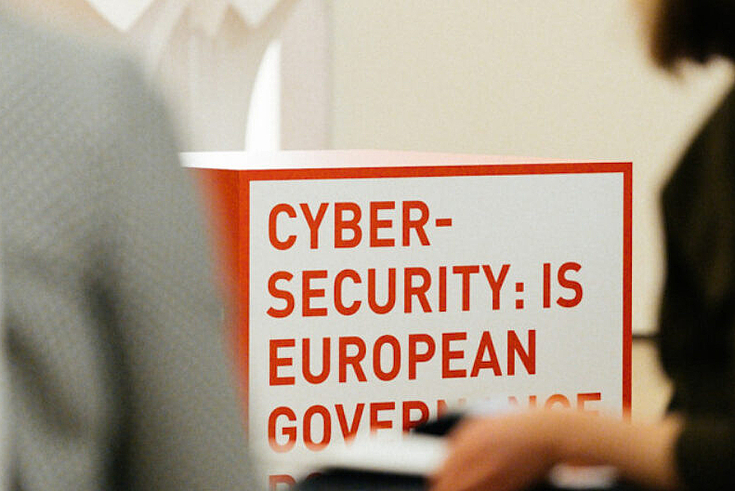
Ramin Aryaie; cc by-nc-sa; https://www.progressives-zentrum.org/en/cybersecurity-is-european-governance-possible/
Actions taken by the Polish presidency
As of today, the most significant achievement of Poland's Council Presidency in the field of information and cybersecurity has been the adoption of the Warsaw Call during the first-ever meeting of EU ministers responsible for cybersecurity in the TTE Council format, held in Warsaw on March 5, 2025. The primary focus of this discussion was enhancing European cyber resilience. During the meeting, the Warsaw Call was adopted as a "key reference point for the EU’s future efforts to protect the digital space and enhance resilience amid growing geopolitical challenges". It includes thirteen recommendations endorsed by the participants. Additionally, ministers discussed updating the Cybersecurity Blueprint, an eight-year-old document that defines EU procedures for addressing large-scale cyberattacks and crises.
Poland's Council Presidency is accompanied by numerous side events aiming at strengthening cooperation among stakeholders and experts in information and cybersecurity. Notable examples include:
The CyberCO 2025 conference in Legionowo (March 24–26, 2025).
The SECURE International Summit in Bydgoszcz (April 3–4, 2025).
Cyber Week in Kraków (May 12–16, 2025).

About the Author
Martin Wycisk is Research Associate at the Prague Office of the Hanns Seidel Foundation responsible for Poland. He holds a Master´s Degree in Eastern European Studies from the University of Warsaw and a Master´s Degree in European Interdisciplinary Studies from the College of Europe.
Contact
