
Political Analysis
How to revitalize the Sustainable Development Goals: The Case for a Circular Economy

Group photo of an HSF-supported global delegation comprising circular startups, policy makers and civil society organizations working on circular economy to the ASEAN Circular Economy Forum 2024 in Bangkok
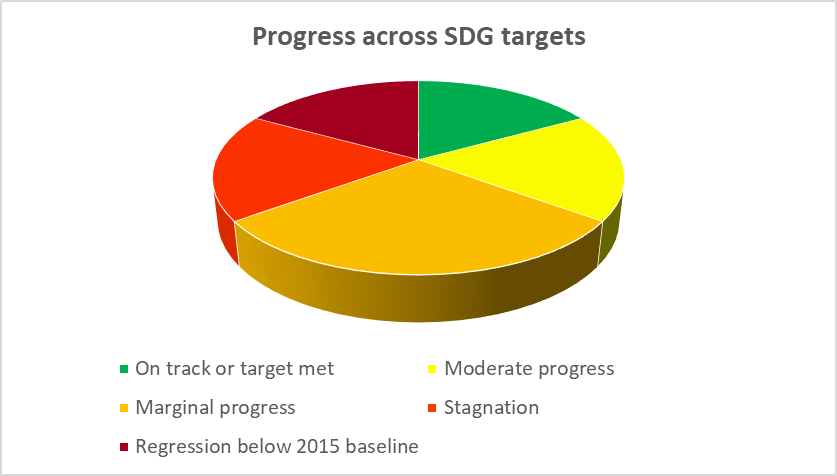
Source: own illustration based on the Sustainable Development Goals Report 2024 (United Nations, 2024).
Michael Siegner; United Nations, 2024
In this year's Sustainable Development Goals Report 2024, the United Nations Secretary-General Antonio Guterres noted that the world's lack of progress towards the Sustainable Development Goals (SDGs) is “sobering” (United Nations, 2024). The report finds that the world is severely off track to realize the 2030 Development Agenda. Only 17 percent of the SDG-targets are on track to be achieved by 2030 while 18 percent show stagnation, and an alarming 17 percent even indicate regression below the 2015 baseline levels (see Graph 1). This dire situation is partly due to recent global developments, including the Covid-19 pandemic and the rising geopolitical tensions. When the SDGs were agreed on in 2015, such levels of global crises were not anticipated. Another inherent challenge stems from the fact that the SDGs require deep transformations across all sectors of the economy. Existing forms of governance at national, regional and global levels have struggled to finance the long-term investments that are required for such transformations. In particular, low-income countries have not received sufficient financial support to make progress towards the SDGs, while weak institutions and corruption have further undermined SDG implementation (United Nations Inter-Agency Task Force on Financing for Development, 2023).
SDG action has also often remained siloed and with insufficient strategic alignment between each goal. This has ultimately led to a lack of coordination between the SDGs, and has even created trade-offs between individual goals. While this poses a serious challenge to a holistic approach towards SDG delivery, the growing importance of addressing climate change exacerbates this problem. Research has shown that only a few countries’ climate commitments under the Paris Agreement systematically consider the broader SDG outcomes beyond climate action (Nerini et al., 2024). This includes impacts of climate action on economic indicators such as economic growth, incomes, labor markets and inequality.
Recognizing these challenges and with only six years remaining until the 2030 SDG deadline, policymakers and the international community face the dual challenge of making immediate progress on the SDGs while also thinking beyond 2030 and the priorities of a post-2030 development agenda. The remainder of this article argues that a global transition towards a circular economy can be a catalyst for revitalizing the SDGs and serve as a cross-cutting blueprint for the post-2030 development agenda.

Circular Economy Futures 2050: Shaping the Circular Economy Agenda, co-hosted by Hanns Seidel Foundation Vietnam and international partners at the sidelines of the Summit of the Future 2024 in New York
What is the circular economy and why is it relevant?
The circular economy is a model of production and consumption that aims to keep resources in use for as long as possible, extract the maximum value from them, and then recover and regenerate products and materials at the end of their service life (Chatham House, 2021). Ultimately, the circular economy is a “system that seeks to deliver social and economic prosperity without requiring unsustainable levels of raw material extraction, consumption and pollution.” (Schröder, P/ Barrie, J., 2024). While there is still a lively debate about the conceptual and terminological intricacies of the circular economy, the concept generally combines three design principles: eliminating waste and pollution, extending the lifetime of products and materials for as long as possible, and regenerating natural systems (see Kirchherr, J./ Reike, D./ Hekkert, M.,2017). This contrasts the traditional linear “take-make-waste” economic model, where resources are extracted, used and then discarded as waste.
The potential of a systematic adoption of the circular economy is manifold. Moving towards a circular economy can create new business opportunities and revenue streams as companies find ways to reuse, repair, and recycle products and materials. This can increase competitiveness, stimulate innovation and create jobs (Jordan, J./ Siegner, M., 2024). In its New Circular Economy Action Plan of 2021, the European Parliament estimates that the circular economy has the potential to create 700,000 jobs by 2030 in the EU alone (European Parliament, 2021). In the U.S., the Ellen McArthur Foundation, a leading circular economy think tank, recently published a study estimating that the shift of three key industrial sectors towards circularity could unlock $883 billion to $1.5 trillion in economic value (equivalent to 4 to 7 percent of the U.S. GDP) (see: Ellen McArthur Foundation and Oliver Wyman, 2024).
While the economic benefits of a shift towards a circular economy are vital for enabling the transition, circularity is also becoming increasingly important in the context of an ever-more challenging geopolitical context. Adopting circular economy practices for critical raw materials naturally mitigates import dependencies and supply disruption risks. This in turn increases resource security and serves strategic autonomy objectives at a time of geopolitical tensions. The European Union’s 2024 Critical Raw Materials Act for instance underscores the significance of circularity as a safeguard for the EU’s economic resilience, open strategic autonomy as well as the ability to successfully advance the green and digital transition (the so-called “twin transition”) (Official Journal of the European Union, 2024).
Finally, the circular economy has the potential to reconcile economic growth objectives with the environment as it enables the disconnection of growth from the extraction and use of natural resources. In terms of non-monetary environmental benefits, the circular economy may complement climate action by transforming the way products and materials are made and used. Consequently, circular strategies could facilitate 45 percent of the global greenhouse gas emissions reduction that is needed to decarbonize the economy (Schröder, P. /Barrie, J., 2024).
This considerable potential is evidenced by the increasing prominence of the circular economy at the global and national levels. For example, the World Circular Economy Forum (WCEF) has been held on an annual basis since its inception in 2017. In multilateral fora, such as the United Nations Environment Assembly (UNEA), the circular economy has also gained traction. Resolution 11 from the fifth session of UNEA (UNEA-5), for example, outlined the importance of the circular economy for promoting sustainable development (United Nations Environment Programme, 2022). At the most recent edition of the United Nations Climate Change Conference in Azerbaijan in November 2024 (commonly known as COP29), the German government hosted a side event highlighting the potential of resource efficiency and circular economy measures. In a statement released on the social media platform X (formerly Twitter) on the sidelines of COP29, the German Ministry of Environment asserted that “circular economy means climate action. Circular Economy must play a crucial role at the UN Climate Conference in Baku” (Bundesumweltministerium on X, 2024).
These developments on the global stage are complemented by the rapidly evolving circular economy frameworks at national levels. Since 2016, over 70 national circular economy roadmaps and strategies have been launched (United Nations Industrial Organisation, 2024). This proliferation further demonstrates the growing momentum and a shared aspiration for a transition towards a circular economy.

A snapshot at a Workshop on circular solutions for waste management in Quang Ninh province in Northern Vietnam
The circular economy as a catalyst for revitalizing the SDGs
In light of the dearth of progress towards the SDGs and the transformative impact potential of the circular economy that was shown above, it is surprising that circularity principles have not yet been systematically embedded into the SDGs and the respective approaches to achieve them. The previously mentioned SDG Report 2024 only refers to circular economy in the context of SDG12 (responsible consumption and production). This is insofar striking, as research has shown that over half of the SDG targets will not be achievable without a transition towards circular economy (Schröder, P./ Anggraeni, K./ Weber, U., 2018). Circular economy practices can be regarded as a “toolbox”, which can contribute to the achievement of a significant number of SDG targets. Besides the clear connection between circular economy and SDG 12, the strongest relationships exist between circular economy practices and the targets of SDG 6 (Clean Water and Sanitation), SDG 7 (Affordable and Clean Energy), SDG 8 (Decent Work and Economic Growth), and SDG 15 (Life on Land). As was shown above, a shift to a circular economy can also play a significant role in climate action (SDG 13), by helping countries to meet their emission reduction targets (Bengtsson, M./ Schröder, P./ Siegner, M. ,2021). If implemented in a socially inclusive manner, the circular economy will also contribute to poverty reduction (SDG 1), reducing inequalities (SDG 10) and gender equality (SDG 5). The following table outlines how an inclusive circular economy already contributes or has the potential to contribute to each of the 17 SDGs (Schröder, P. /Barrie, J. ,2024).
| SDG | Examples of benefits and potentials of the circular economy |
| SDG 1: No poverty | Circular economy businesses create local jobs, especially in recycling, upcycling, repair and refurbishment sectors. |
| SDG 2: Zero hunger | Regenerative and restorative farming practices can enhance local food security, food safety and livelihoods. |
| SDG 3: Good health and well-being | Reducing pollution and mismanaged waste through the application of circular economy can improve public health outcomes, for example by reducing pollution-related illnesses. |
| SDG 4: Quality education | Vocational training programs on circularity and circular business models for startups and micro, small and medium-sized enterprises (MSMEs) can minimize the risk of job losses during the transition from a linear to a more circular economy. |
| SDG 5: Gender equality | The circular economy has the potential to empower women by providing entrepreneurial opportunities (for example, involving women-led circular start-ups) and enabling women to participate in sustainable initiatives. |
| SDG 6: Clean water and sanitation | Circular water-recycling technologies and solutions that reduce and reuse wastewater and improve access to clean water, water security and sanitation. |
| SDG 7: Affordable and clean energy | Using recycled and recyclable materials in the manufacturing of renewable energy applications such as solar panels and wind turbine blades can help to improve the sustainability of renewables throughout the entire life cycles of products and technologies. |
| SDG 8: Decent work and economic growth | A transition towards the circular economy can provide opportunities to bring more informal workers (e.g. informal waste collectors) into the formal labor market, boost skills and economic prospects through training (see SDG 1&4), and build capacity in new or existing circular industries (see SDG 9). |
| SDG 9: Industry, innovation and infrastructure | The development of new circular technologies and industrial processes has the potential to foster innovation and stimulate the development of infrastructure for circular waste management. |
| SDG 10: Reduced inequalities | Circular business models (such as product sharing and leasing) can provide more affordable access to essential goods and services. |
| SDG 11: Sustainable cities and communities | The integration of circular principles and zero-waste initiatives into urban planning can facilitate more resilient and sustainable cities. |
| SDG 12: Responsible consumption and production | Circular practices include extending product lives, using resources more efficiently, and reducing waste through recycling, remanufacturing and sustainable consumption. |
| SDG 13: Climate action | Adopting circular principles in the use of materials reduces greenhouse gas emissions along value chains, from extraction to processing to manufacturing to consumption. |
| SDG 14: Life below water | Reducing the deployment of single-use plastics and adopting closed-loop systems of resource use through reuse and recycling can prevent plastics from leaking into the marine environment and thereby address plastic pollution in the oceans. |
| SDG 15: Life on land | Using materials made from renewable sources (e.g. bioplastics) can help reduce plastic pollution and its impact on land ecosystems. |
| SDG 16: Peace, justice and strong institutions | Transparent and inclusive governance in circular economy initiatives can foster trust and cooperation between stakeholders. |
| SDG 17: Partnerships for the goals | Existing and new regional and global circular economy alliances, networks and platforms facilitate collaboration across sectors, value chains and regions. |
While some of the circular economy benefits outlined above may improve short-term prospects for achieving many of the SDGs and their associated targets, it is inevitable at this stage that most of the SDGs will not be met by 2030. Given this situation and the fact that the global debate on what the post-2030 development agenda should look like has already commenced, there is an opportunity for the circular economy to assume more prominent role in addressing the pressing development challenges.

Consultation workshop in Hanoi on circular solutions towards a global plastics treaty in November 2024
The circular economy as a cross-cutting blueprint for the post-2030 development agenda
There is considerable debate surrounding the shape of the post-2030 development paradigm. Some propose to codify the SDGs into international law (International Law Association, 2023) while others have advocated for greater ambition by incorporating new developments such as the potential impacts of artificial intelligence (AI) (Nature Editorial 630, 2024). Yet others argue that the SDGs are overloaded, and the world should therefore focus on fewer strategic priorities (Bhowmick, S., 2023). There is consensus however that the contradictions and trade-offs between the SDGs and their targets have impeded their overall progress. Since 2015, actions pursuing economic growth under the SDG 8 targets have for instance hindered progress on climate action under SDG 13.
Instead of replacing the SDGs or prioritizing some goals over others, a more effective approach may be to seek solutions that create synergies between the different SDGs. In line with some prominent scholars that advocate for the extension of the SDG framework to 2050, (Nerini et al., 2024) this article therefore argues that the SDGs should remain at the center of the global development agenda – but with a circular twist. This implies a systematic integration of circular economy principles into an adapted and extended SDG framework to 2050.
The opportunity for promoting the circular economy in a post-2030 development agenda lies in its cross-sectoral and holistic nature that can serve as an effective remedy to the rightly criticized trade-offs between the existing SDGs. As was shown above, the circular economy may be a promising tool to advance individual SDGs but beyond that it offers a more systematic approach towards all SDGs. For example, the circular economy’s potential in ending hunger (SDG 2) by promoting regenerative and restorative farming complements actions on climate change (SDG 13) and land ecosystems (SDG 15). Equally, the circular economy’s potential to facilitate new types of jobs and business models is in line with efforts to end poverty (SDG 1), to promote decent work and gender equality (SDG 8 and SDG 5) while also supporting innovation (SDG 9) (Schröder, P. Barrie, J., 2024).
To realize such a circular twist in a post-2030 SDG framework, two priorities come to mind: first, an overarching circular vision to 2050 is necessary that enshrines the transformative power of the circular economy for sustainable development. And secondly, measurable and achievable circular economy indicators must be embedded across all goals while stressing the interdependence of economic, social and environmental ambitions. These indicators can then be translated into national level implementation roadmaps. By embracing such a comprehensive and systematic approach, the international community can deliver an inclusive and sustainable development agenda until 2050.
References
[1] This article draws on the outcomes of the “Global Roadmapping Process for an Inclusive Circular Economy” that brings together 13 partners organizations working on circular economy around the world. The Hanns Seidel Foundation has been part of this initiative led by Chatham House since 2023 and more details about this process and insights into the potentials of the circular economy can be found in a comprehensive research paper published at the sidelines of the Summit of the Future in New York in September 2024: Schröder, P. Barrie, J. (2024): How the circular economy can revive the Sustainable Development Goals, Research Paper, London: Royal Institute of International Affairs, URL https://doi.org/10.55317/9781784136222 [23.11.2024].
[2] United Nations (2024): The Sustainable Development Goals Report 2024, URL https://unstats.un.org/sdgs/report/2024/The-Sustainable-Development-Goals-Report-2024.pdf [23.11.2024].
[3] United Nations Inter-Agency Task Force on Financing for Development (2023): Financing for Sustainable Development Report 2023: Financing Sustainable Transformations. URL https://developmentfinance.un.org/fsdr2021 [23.11.2024].
[4] United Nations (2024): The Sustainable Development Goals Report 2024, URL https://unstats.un.org/sdgs/report/2024/The-Sustainable-Development-Goals-Report-2024.pdf [23.11.2024].
[5] Nerini et al. (2024): Extending the Sustainable Development Goals to 2050 – a road map, URL: https://www.nature.com/articles/d41586-024-01754-6 [23.11.2024].
[6] Chatham House (2021): What is the circular economy?, URL: https://wwwchathamhouseorg/2021/06/what-circular-economy [23.11.2024].
[7] Schröder, P. Barrie, J. (2024): How the circular economy can revive the Sustainable Development Goals, Research Paper, London: Royal Institute of International Affairs, URL https://doi.org/10.55317/9781784136222 [23.11.2024].
[8] For a deep dive into the conceptual debate in the context of the circular economy, see Kirchherr, J., Reike, D. and Hekkert, M. (2017): Conceptualizing the circular economy: An analysis of 114 definitions”, Resources, Conservation and Recycling, pp. 221-32, https://dx.doi.org/10.2139/ssrn.3037579 [23.11.2024].
[9] Jordan, J., Siegner, M. (2024): Towards a sustainable future: EU-ASEAN Cooperation for a Circular Economy, in: International Cooperation on Climate Change: Insights from South and Southeast Asia and the EU, p. 18-22.
[10] European Parliament (2021): European Parliament resolution of 10 February 2021 on the New Circular Economy Action Plan, URL https://www.europarl.europa.eu/doceo/document/TA-9-2021-0040_EN.html#def_1_24 [23.11.2024].
[11] The three industrial sectors are: grid-scale and EV batteries, built environment and infrastructure, and electronic equipment. For details, see: Ellen McArthur Foundation and Oliver Wyman (2024): An innovation pathway to decarbonization. URL https://emf.thirdlight.com/file/24/sjZ_pROsjBjvF8IsjokJs9ovSQ/Industrial%20Decarbonsation%20Report%20H%2004-24.pdf [23.11.2024).
[12] Official Journal of the European Union (2024): Regulation (EU) 2024/1252 of the European Parliament and of the Council of 11 April 2024. URL http://data.europa.eu/eli/reg/2024/1252/oj [23.11.2024].
[13] Schröder, P. Barrie, J. (2024): How the circular economy can revive the Sustainable Development Goals, Research Paper, London: Royal Institute of International Affairs, p. 9. URL https://doi.org/10.55317/9781784136222 [23.11.2024].
[14] United Nations Environment Programme (2022): Resolution adopted by the United Nations Environment Assembly on 2 March 2022 –5/11. URL https://digitallibrary.un.org/record/3999172?ln=fr&v=pdf [23.11.2024].
[15] Bundesumweltministerium on X (2024): URL https://x.com/BMUV/status/1859154462784245988 [23.11.2024]. Quote was translated by the author.
[16] United Nations Industrial Organisation (2024): National Circular Economy Roadmaps: A Global Stocktake for 2024. URL: https://www.unido.org/sites/default/files/unido-publications/2024-05/UNIDO_National%20circular%20economy%20roadmaps_v07.pdf [23.11.2024].
[17] Schröder, P., Anggraeni, K, and Weber, U. (2018): The Relevance of Circular Economy Practices to the Sustainable
Development Goals. Journal of Industrial Ecology, 23: 77-95. https://doi.org/10.1111/jiec.12732 [23.11.2024].
[18] See Bengtsson, M., Schröder, P. and Siegner, M. (2021): Building back better through circular economy - opportunities for ASEAN countries, in: Climate Change and Sustainable Development. Munich, pp. 38-50.
[19] The table presents a summary of chapter 2 in Schröder, P. Barrie, J. (2024): How the circular economy can revive the Sustainable Development Goals, Research Paper, London: Royal Institute of International Affairs, URL https://doi.org/10.55317/9781784136222 [23.11.2024].
[20] International Law Association (2023): SDGs beyond 2030, White Paper 18, URL https://www.ilaparis2023.org/wp-content/uploads/2022/10/ADI-ILA-ODD-VHD-EN.pdf [24.11.2024].
[21] Nature Editorial 630 (2024): The Sustainable Development Goals: can they be made smarter?, URL: https://www.nature.com/articles/d41586-024-02023-2 [24.11.2024].
[22] See Bhowmick, S. (2023): Navigating the Complexities: Prioritizing the SDGs in a Changing World, URL: https://www.cfr.org/councilofcouncils/global-memos/sdgs-are-not-track-here-what-world-should-do [24.11.2024].
[23] See Nerini et al. (2024): Extending the Sustainable Development Goals to 2050 – a road map, URL: https://www.nature.com/articles/d41586-024-01754-6 [23.11.2024].
[24] For a more comprehensive analysis of how the circular economy could fit into a revised set of SDGs after 2030, see chapter 4 in: Schröder, P. Barrie, J. (2024): How the circular economy can revive the Sustainable Development Goals, Research Paper, London: Royal Institute of International Affairs, URL https://doi.org/10.55317/9781784136222 [23.11.2024].

About the Author
Michael Siegner has been the Resident Representative of the Hanns Seidel Foundation’s Vietnam Office since 2020. In this capacity, he has overseen projects in Vietnam and at the ASEAN-level related to sustainable consumption and production, with a particular focus on circular economy and sustainable business models. He holds degrees in Peace and Conflict Studies (MA) and Political and Administrative Science (BA).
Kontakt
