
EU and the Democratization of the Western Balkans
Introduction
Among numerous other international actors that play a significant role in the process of democratization and democratic consolidation of third countries, the European Union occupies a special place, which has been shown in the process of democratization of Southeast European countries, including the Western Balkans1. The process of Europeanization, which consists of all institutional, strategic, and normative processes caused by the process of European integration (Palier and Surel 2007: 39), has been of paramount importance for the democratization and political stabilization of all Eastern European countries (Pridham, 2005; Lippert and Umbach, 2005). Therefore, many authors explain that the processes of Europeanization and democratization are inseparable, while Fink-Hafner (2007: 5) points out the "cordial link" between democratization and Europeanization processes, explaining that in post-socialist countries the direct link between the process of Europeanization and democratization is established by the EU conditionality policy.
In that way, undoubtedly, the EU represents a “democratising factor of the region" and is conditioning the EU acceding states to observe democratic standards, norms, and values by promising full membership and material aid in return (Đukanović, 2019:149). There is a wide variety of EU mechanisms for influencing the Europeanization of the acceding countries, from determining normative and institutional arrangements which are to be met or implemented to financial and technical aid, defining the criteria in the negotiation process and evaluation of their fulfilment, conditioning the progress in the negotiation process with the prior meeting of the criteria, etc. (Grabbe, 2006). On the other hand, the EU strives to minimise the chance of future entrants being politically unstable, as well as economically burdensome for the Union through its condition policy (Grabbe, 2006:10).
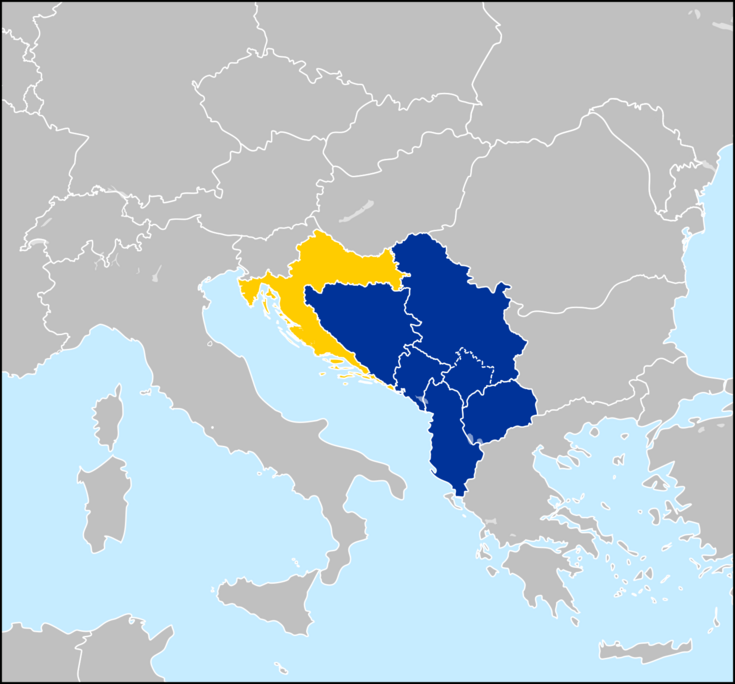
Countries of the Western Balkans; Albania, Bosnia & Herzegovina, Montenegro, North Macedonia and Serbia. Kosovo, whose independence is disputed, is also demarkated. Croatia, sometimes considered a part of the Western Balkans, joined the EU in 2013.
Olahus; https://commons.wikimedia.org/wiki/File:Western_Balkans.PNG
However, special attention should be paid to the issue of the present EU impact on the internal processes in the EU acceding states, considering the trends of democracy undermining in almost all countries of the region, despite the integration processes spanning over several decades. Regardless of the critical role of the European Union and the Europeanization process, many Western Balkan countries have been stagnant in recent years, while some are taking a step backwards in the reform processes. This stagnation is also indicated by data from all relevant international reports (EC, Freedom House, The Economist, Bertelsmann Stiftung), which classify many countries of the region within the category of hybrid regimes or categorise them as "defective democracies” due to the values of overall consolidation and political transformation indicators.
On the other hand, because of the great differences between the new and old members, as well as due to the long process of transition of the Western Balkans countries, the European Union has developed and to a large extent tightened the criteria for membership (Đukanović, 2019:148). The EC initiated a new enlargement methodology "Enhancing the accession process - A credible EU perspective for the Western Balkans" (COM 2020), in order to dynamize the EU enlargement process to the Western Balkans. A credible accession perspective is a key tool to promote democracy, rule of law and the respect for fundamental rights, which are also the main engines of economic integration and the essential anchor for fostering regional reconciliation and stability (COM 2020). In 2021, an idea was gaining ground that a system of accession to the EU in stages was needed, as the best incentive for the Balkan countries to strengthen the process of European integration and restore confidence in the further enlargement of the Union (Emerson and al. 2022: 1). However, the new negotiation methodology did not yield the expected results in intensifying relations between the countries of the region and the EU, nor in implementing reforms and advancing in their accession process until the policy of conditionality itself loses its power to sanction the countries due to the lack of concrete results in their process of implementing reforms. Then, the insufficient presence of the EU in the region opens the possibility for greater influence of the great powers: China, Russia, Turkey, and other countries.
The Influence of Great Powers in the Western Balkans
Among influences of great powers in the Balkans, it is crucial to consider the Russian impact in the Western Balkan region and its repercussions on the European integration process of these countries. In the last few decades, it is evident that Russia views the Western Balkan region as a political field to keep the score in its rivalry with the West. In that context, Russia especially strives to negate the EU and NATO achievement in the region by using the area for geopolitical conflict with the EU and the US. That is why Russia has vehemently opposed Montenegro and North Macedonia's membership in the NATO alliance and has also opposed the EU integration process in recent years.
Even though the Balkan countries have traditionally solid political, historical, and cultural ties to Russia, following September 11th, 2001, Russia has filled the political vacuum in the area. However, in the last decade, the Western Balkans has become a region of high-priority foreign policy interest for the Russian Federation. The Russia-West relations have dominantly predefined the relationship between Russia and the Western Balkans. The worsening of these relations was caused by the EU and US decision to introduce sanctions on Russia following the Crimea annexation in 2014, but also due to the more active EU role in Belarus, Georgia, and Moldova by signing several agreements on cooperation and association - while today - it is primarily characterised by the Russian aggression on Ukraine. Additionally, the lack of EU presence and engagement has been skilfully used to strengthen the Russian presence and its interference in the internal issues in the region's countries. Such a thing would not have been possible if the regional leaders, especially those of the semi-authoritative regimes, disapproved of Russian politics towards the Balkans. The proof lies in many Russian officials visiting the region and the Balkan politicians' visits to Moscow in recent years, while Russia has been strengthening its impact, particularly in Serbia. Russia primarily bases its influence on the Balkans on its position as the permanent member of the Security Council in the United Nations (vetoing the international recognition of Kosovo through the UN membership) as well as putting the Western Balkan countries into a dependant position by Russian energy-generating products, giving them reduced prices of gas and oil. Furthermore, Russia also uses different channels of influence in the Balkans, such as supporting religious organisations and media with a dominantly anti-western affiliation, backing up right-wing populist parties that oppose the Western Balkan relations with NATO and promote an anti-European narrative.
Montenegro – between Europeanization and the Influence of Great Powers
After three and a half decades of functioning as a multiparty system, a prolonged transition period, a partially successful transformation, incomplete democratic consolidation, and modest structural and institutional reforms of the Montenegro's EU accession process, Montenegro remains far from achieving a liberal democratic order. According to numerous international organizations that measure democracy indices, particularly values related to overall consolidation and political transformation of states, Montenegro’s data has worsened year after year. There are many reasons for this situation. Primarily, Montenegro still lacks the fundamental prerequisites to be defined as a democratic country. While there is a structured universal suffrage and the possibility of public competition in elections, a well-developed system of civil liberties is missing. Thus, the formal democratic normative-institutional constitution of the system grew into an autocratic or populist regime, since there is no integration of the principles of citizenship and liberalization, equality, civil rights and individual freedoms. Instead of progressing through its three key phases (end of autocratic rule, democratization, and consolidation of democracy), Montenegro's transition has primarily resulted in the establishment of a formally democratic system with undemocratic features, significant economic and social challenges, a weakened civil society, low political participation, and limited public trust in the functioning of the system and institutions, as well as an unsuccessful process of democratic consolidation.
Although in Montenegro, the democratization and social transformation process is predominantly influenced by the European Union, Montenegro still faces challenges in meeting key prerequisites for advancing in the integration process even after a long negotiation period. This situation may stem from the EU’s limited focus on the region and the declining effectiveness of its conditionality policy, which no longer yields the same results as it did in Central and Eastern European countries. Additionally, the lack of internal pro-democratic capacities, which are essential for establishing democracy alongside external influences, contributes to this issue. Furthermore, foreign influence, particularly from Russia on majority of political parties, is a major factor in the slow Europeanization process of Montenegro.
https://www.flickr.com/photos/142872259@N05/25791379707/
The first change of government in the post-socialist period occurred in August 2020. Numerous and relatively divided opposition parties managed, with decisive support from the Serbian Orthodox Church and the influence of authorities from the Republic of Serbia, to form a coalition for establishing a government and to support the creation of the first 'expert' government led by Prime Minister Zdravko Krivokapić. However, the government was backed by a coalition of as many as 10 political parties with very diverse programmatic and conceptual frameworks, which soon jeopardized its stability. Consequently, this government was voted out of office a little over a year after its formation. In April 2022, a minority government was appointed, but it was ousted by a no-confidence vote in August of the same year due to its signing of the Fundamental Agreement with the Serbian Orthodox Church. The most recent early parliamentary elections were held in June 2023, in which the newly formed 'Europe Now' Movement, led by former ministers from Zdravko Krivokapić's government, achieved significant results. Today, these former allies, now major opponents, hold the positions of president and prime minister of Montenegro. Just over a year after these elections, this Movement has seen a decline in public support in the 2024 local elections (in Podgorica and Budva), resulting in political instability due to an unconsolidated party system at both the local and national levels, which remains a constant feature of Montenegro’s political life.
However, these political changes have not led to substantial progress in the democratization process or advancement in democratic consolidation. According to relevant reports from international organizations, Montenegro is still categorized as a hybrid regime, a classification for systems that exhibit characteristics between democracy and autocracy and show no progress in democratic consolidation (Freedom House 2024). The primary reasons for the ongoing failure of democratic consolidation lie in the influence and role of weak political actors, fragmented political parties, a poorly institutionalized party system, and the legacy of single-party dominance that persisted in Montenegro until 2020, as well as the influence of Serbia and Russia on the parliamentary majority’s political parties.
Although Montenegro received a positive report on the fulfilment of the interim benchmarks in Chapters 23 and 24 (IBAR) in June 2024, and despite the fact that this year’s European Commission report shows improvement over previous reports, indicating that the integration process has resumed after years of stagnation, tangible results in reforms are still lacking. Consequently, the praise from Brussels can be more readily understood as a reaction to geopolitical developments in Europe rather than a reflection of substantial achievements by the Montenegrin administration.
Even four years after the change from decades of rule by the Democratic Party of Socialists, and despite the emergence of new political structures, their establishment on the political scene, and strong external influences, Montenegro continues to struggle with failed democratic consolidation, partial reforms in the Europeanization process, and slow adoption of democratic values. The establishment of a formal democratic system with undemocratic characteristics, a weak civil society, and the continued rule of new/old elites prone to selectivity, non-transparency, corruption, and weak institution-building continue to hinder democratic consolidation and prevent progress in the European integration process.

About the Author
Nikoleta Đukanović is an assistant professor and researcher at the Humanistic studies, University of Donja Gorica in Podgorica, Montenegro