
Political Analysis
Elbows Up: Canada Enters a New Political Era
The phrase Elbows Up comes from ice hockey, Canada's national sport. It refers to a player raising their elbows in response to aggressive play from the opposing team, preparing to counter any incoming blows. This phrase reflects Canada's current political mood as it adapts to today's challenges in real time. But how did it get here? Why are the famously polite Canadians evolving into gritty brawlers? What does it mean for the future? Events were set in motion just a few months ago.
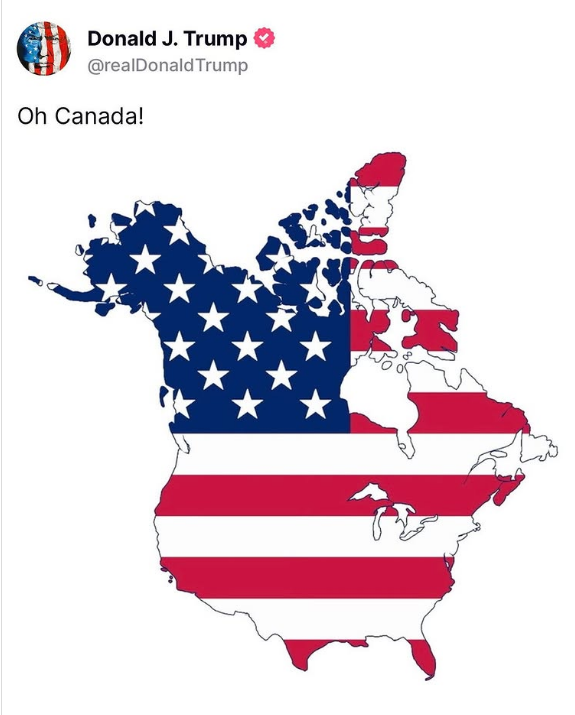
https://www.instagram.com/realdonaldtrump/p/DEjLlrVMpFE/?locale=de&hl=de
Trudeau Resigns as Governor
In November 2024, Donald Trump was reelected as President of the United States (US) for the second time. Swiftly, he and his team initiated the groundwork for the policy priorities that would be implemented on day one of his return to the White House. A particularly significant development was the proposition of tariffs on Canada if it did not take stronger measures to secure its shared border against undocumented migrants and illegal drug trafficking. Such tariffs had the potential to cripple the Canadian economy, which relies heavily on trade with its close southern neighbor. Adding to a sense of rising tension was Donald Trump's Thanksgiving dinner suggestion to his long-time political rival and dinner guest, Canadian Prime Minister Justin Trudeau, that Canada should become the 51st state.[1]
With the remarks becoming public, Trudeau’s advisers downplayed the situation stating the President was merely teasing or joking[2]. However, behind the scenes, Trudeau was deeply concerned about the real substance behind the words[3]. Trump continued his annexation suggestions on social media, posting a map of the US and Canada under the Stars and Stripes with the caption “Oh Canada!” — a reference to the Canadian anthem (Figure 2). The US President also began publically referring to Trudeau as the “Governor… of the Great State of Canada”[4] in online posts.
Frustration was mounting among Canadians over Trudeau's handling of the situation. To make matters worse, even members of his own governing coalition appeared to share these concerns. In December 2024 Jagmeet Singh, leader of the coalition partner New Democrat Party, withdrew his party’s support of the government stating the Prime Minister could no longer deliver for Canadians. This was followed closely by the resignation of Trudeau’s ally, Liberal Party Finance Minister Chrystia Freeland. In an open letter Freeland accused him of taking part in “costly political gimmicks” and being ill-prepared to face the serious challenges posed by Donald Trump and the US[5]. Amid growing domestic discontent, declining public polling numbers, and increasing pressure, Justin Trudeau announced in January 2025 his intention to prorogue (suspend) Parliament and resign as Prime Minister of Canada[6]—or, as Donald Trump saw it, as its Governor.
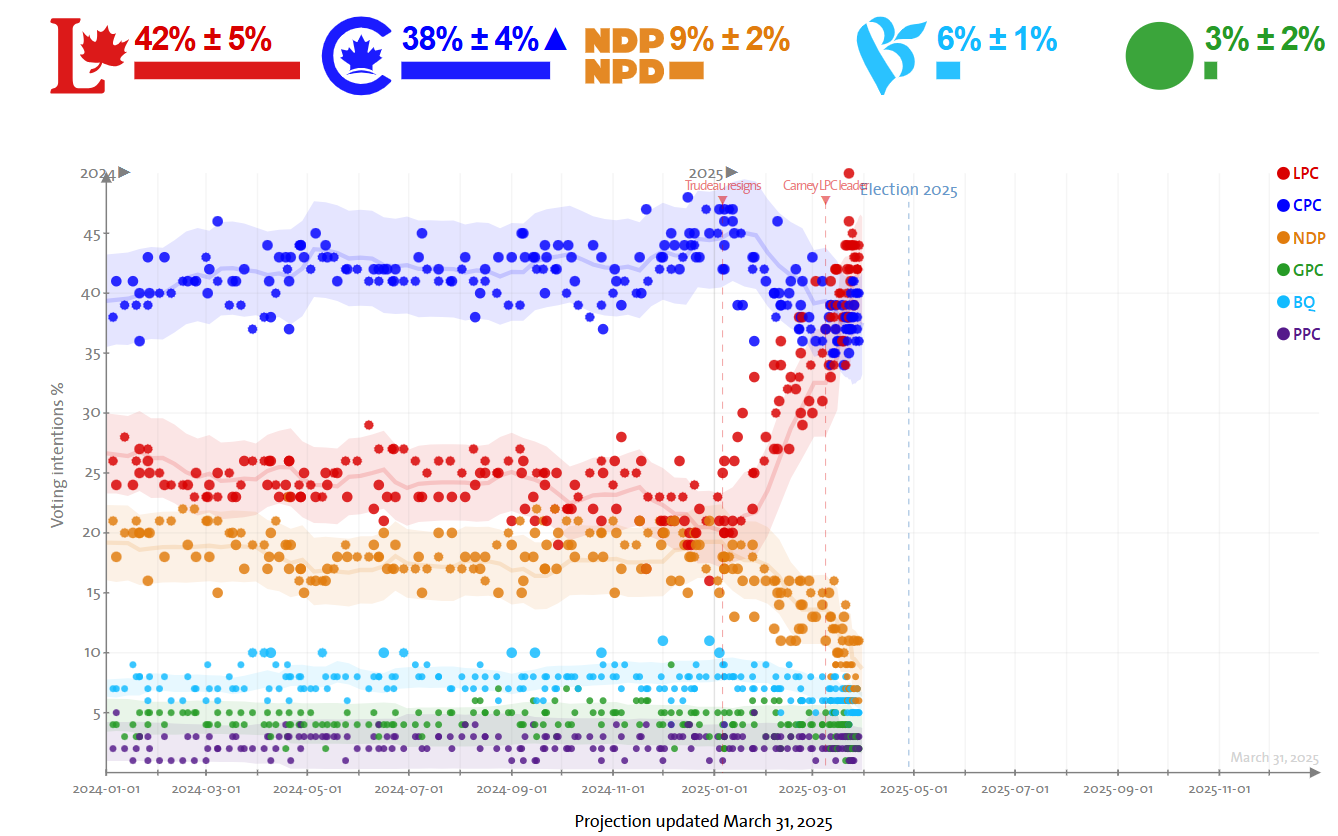
Projection Map March 31, 2025
https://338canada.com/polls.htm
The Liberal Party Votes for a New Leader
Justin Trudeau’s resignation triggered the first leadership race of the Liberal Party in nearly 12 years, the last being his own election in 2013. The next leader would face two major challenges: revitalizing the party’s dwindling electoral prospects and confronting Donald Trump’s aggressive trade and annexation rhetoric. The contest quickly narrowed to four candidates: Chrystia Freeland, Trudeau’s former Finance Minister who played a key role in his downfall; Karina Gould, then-Government House Leader; Frank Baylis, an engineer and politician; and Mark Carney, the former Governor of the Bank of Canada. Carney, though not an elected Member of Parliament, was a seasoned economic strategist. He had served as an informal adviser to Trudeau and most recently chaired the Liberal Party Task Force on Economic Growth. The races defining issue was how each candidate would handle the threat of tariffs and annexation from Donald Trump[7]. Freeland and Carney supported aggressive dollar-for-dollar retaliation on any tariffs, while Gould and Bayliss favored strategic counter-tariffs coupled with international outreach campaigns. On defense, all candidates agreed on increasing military spending to meet NATO’s 2% of GDP requirement—on the condition that the funds were spent entirely in Canada rather than the US. Notably, Carney went a step further by advocating for an increased Canadian military presence in the Arctic with at least two new military bases in the region[8]. Throughout the campaign, a common theme emerged: a shift away from cooperation with the US in favor of inward-focused and defensive policies — a dramatic change, especially for the Canadian Liberal Party.
The campaign concluded on March 9, 2025, with Carney securing a decisive 85.9% of the vote[9]. Freeland finished in a distant second, winning 8%, followed by Gould and Baylis who earned 3.1% and 3% respectively.
The Liberal Party Leadership race and Carney’s victory transformed the political landscape. The once-declining Liberal Party surged in the polls, erasing what had been a 20+ point Conservative lead under Pierre Poilievre. According to independent aggregator 338Canada, the next federal election, once seen as a Conservative landslide, had quickly become a neck-and-neck race (see Figure 3). This was a scenario few could have imagined had Trudeau remained in office.
Elbows Up: Carney Calls Snap Election
Shortly after his election victory, Mark Carney released the Elbows Up political advertisement in collaboration with Canadian comedian Mike Myers, seemingly in response to growing threats of a trade war and annexation rhetoric from the recently inaugurated President Donald Trump.[10] In the short social media video, the two appear wearing Canada hockey jerseys, humorously discussing what it means to be truly Canadian. Myers asks, “Will there always be a Canada?” to which Carney responds, “There will always be a Canada.” The two then raise their elbows in a nod to ice hockey defensive posturing. The video ends with a shot of the back of Myers’ jersey which states Never 51 – a direct response to 51st state rhetoric – followed by the slogan Canada Strong. Carney’s motive for releasing the video soon became clear as he aimed to kick off the campaign to secure a mandate and win election himself—ironically running in the Ottawa region riding adjacent to Pierre Poilievre—by calling snap parliamentary elections.
The elections, set for April the 28th, will give Canadians a choice among six parties: the Liberals, Conservatives, Bloc Québécois (running only in Quebec), The New Democratic Party, Greens, and the People’s Party. Voters will cast their ballots in 343 first-past-the-post electoral ridings (districts) throughout the 10 provinces[11]. While these parties span the political spectrum and debate policy areas such as tax, healthcare, social spending, and energy, the election seems to hinge on a common theme — opposition to the US.
Pierre Poilievre and the Conservative Party will be one of the main contenders in the election. Drawing on popular support in the provinces of Alberta and Saskatchewan the party will likely unite a wide coalition across Canada. While the Liberals have made it a strategy to tie the Conservatives to support of Trump (the Conservatives campaign slogan is “Canada First”), Poilievre has stated that he would insist Donald Trump recognize the independence and sovereignty of Canada, insist on ending tariffs against Canada, and strengthen the country’s ability to stand up to the US where and when necessary. Though his rhetoric is firm in opposing the US, some Conservative supporters reportedly feel the stance does not go far enough and desire him to speak out more forcefully against Trump on the campaign trail[12]. Donald Trump himself has been less than supportive of Poilievre, surprisingly stating he would find a Liberal government easier to deal with. He added that the Conservative leader was not supportive of the MAGA movement, had made some "negative" remarks, and was not a friend[13]. Whether or not this trend continues as the campaign progresses could prove pivotal to the electoral prospects of Poilievre.
The New Democratic Party (NDP), generally seen as sitting to the left of the Liberals, still led by Jagmeet Singh, has called for retaliatory tariffs[14] and advocates for the diversification of trade partnerships internationally. However, the party appears to be hardest hit by the rise of Carney. At the time of writing the NDP are polling at around 9% nationally – down from approximately 19% when Trudeau resigned.
The Quebec nationalist party, Bloc Québécois, led by Yves-François Blanchet, has struggled to formulate the right message for their voters when it comes to the trade war and 51st State rhetoric[15]. Blanchet has focused strongly on Carney’s gaffes in the French language and perceived disconnect with the province’s general population to bolster his own appeal. At the time of writing the lack of a strong stance could explain its polling at around 6% nationally.
The environmentalist Green Party, led publically by 35-year-old Jonathan Pedneault, has condemned Trump’s trade policies as the “dumbest trade war ever”. The Greens support retaliatory tariffs while building a self-sufficient sustainable economy, and protecting Canadian workers[16]. Despite these efforts, the Green Party are trailing in the polls gathering only 3% support nationally.
Maxime Bernier and the People’s Party of Canada (PPC), which runs to the right of the Conservatives, are the exception to the anti-US sentiment. The party advocates for prioritizing North American security and strengthening relations with the US, while also pursuing market diversification to avoid dependence[17]. The PPC is polling at around 2% nationally making it unlikely they would win any seats in the election.
A New Political Era
With the elections being only several weeks away, polling numbers are still bound to shift as leaders refine their strategies and respond to Trump's latest statements. Notably, reports indicate that Trump and Carney held an amicable phone call recently, adding another layer of complexity to the evolving political landscape. However, one thing remains clear, the Elbows Up mentality has fundamentally reshaped Canada's political landscape, ushering in a new era of defiance in its relationship with the US. Whether it is Mark Carney or Pierre Poilievre who becomes Prime Minister, Donald Trump will find an opponent in Ottawa who has been emboldened by voters to stand up in firm, even bellicose, defense of sovereignty and economic independence. The question now is whether this political stance will reduce tensions through strength or serve to further inflame them in the years ahead. Either way, this will prove to be a pivotal period in history for the security and stability of North America.
[1] Austen, Ian: Trump Calls Trudeau the ‘Governor’ of ‘The Great State of Canada’, 10.12.204, available at: https://www.nytimes.com/2024/12/10/world/canada/trump-trudeau-canada-tariffs.html
[2] Gillies, Rob: Canadian minister says Trump was joking when he said Canada could become the 51st state, 04.12.2024, available at: https://apnews.com/article/canada-trump-tariffs-trudeau-trade-opposition-border-5d3dbbb4a701bb1676ee588bfbf2396a
[3] Rana, Uday: Trump’s talk on annexing Canada ‘real,’ Trudeau says in hot mic moment, 07.02.2025, available at: https://globalnews.ca/news/11008590/canada-us-economic-summit-trump-tariffs/
[4] Donald Trump via Truth Social: https://truthsocial.com/@realDonaldTrump/posts/113626786987358864
[5] Chrystia Freeland via X: https://x.com/cafreeland/status/1868659332285702167
[6] MacCharles, Tonda: Justin Trudeau promises to resign as prime minister and Liberal leader after leadership race, 06.01.2025, available at: https://www.thestar.com/politics/federal/justin-trudeau-promises-to-resign-as-prime-minister-and-liberal-leader-after-leadership-race/article_5c5ba5ec-cc34-11ef-88f1-577060db4a8c.html
[7] Tunney, Catharine: Liberal leadership: Here's where the candidates stand on key issues, 25.02.2025, available at: https://www.cbc.ca/news/politics/liberal-leadership-policies-1.7465063
[8] Global News: Liberal leadership debate: Candidates spar over how Canada should respond to Trump threats, 26.02.2025, available at: https://www.youtube.com/watch?v=ERNET3LvoRU
[9] Liberal Party of Canada: 2025 Leadership Vote Results, available at: https://chefferie2025leadership.liberal.ca/results/
[10] Mark J. Carney via Instagram: https://www.instagram.com/markjcarney/reel/DHhIQJtSVen/elbows-up-canada/
[11] The Office of the Chief Electoral Officer: The Electoral System of Canada, available at: https://www.elections.ca/content.aspx?section=res&dir=ces&document=part1&lang=e
[12] The Canadian Press: Poilievre shrugs off reports of campaign turmoil as he pitches tax relief, 30.03.2025, available at: https://www.ctvnews.ca/federal-election-2025/article/second-week-of-campaign-underway-amid-criticism-leaks-within-conservative-ranks/
[13] Panetta, Alexander: Donald Trump has some thoughts about Canada's upcoming election, 28.02.2025, available at: https://www.cbc.ca/news/world/trump-canadian-politics-interview-1.7471276
[14] Jagmeet Singh via X: https://x.com/theJagmeetSingh/status/1878535333329190963?ref_src=twsrc%5Egoogle%7Ctwcamp%5Eserp%7Ctwgr%5Etweet
[15] Boudjikanian, Raffy: Bloc's Blanchet tries to elbow his way into a campaign largely defined by Trump, 29.03.2025, available at: https://www.cbc.ca/news/politics/bloc-quebecois-campaign-tariff-trump-1.7496883
[16] Green Party of Canada: “The Dumbest Trade War Ever”: How Greens Will Revitalize and Modernize Canada’s Economy While Neutralizing Trump’s Threats, 29.03.205, available at: https://www.greenparty.ca/en/news/the-dumbest-trade-war-ever-how-greens-will-revitalize-and-modernize-canadas-economy-while-neutralizing-trumps-threats
[17] Peoples Party of Canada: Foreign Policy, available at: https://www.peoplespartyofcanada.ca/issues/foreign-policy
About the Author
Joseph Quinn is the Program Manager for the United States and Canada at the Hanns Seidel Foundation. Joseph was a Penn Kemble Fellow at the National Endowment for Democracy and was previously at the Center for European Policy Analysis and the British Embassy to the United States.
Contact
