
Country perspective on the German federal election
Germany Votes: UK Watches, Learns, & Partners?
Echoes Across the Channel: Lessons for Labour and Conservatives
For Prime Minister Keir Starmer and his Labour government, the German election results present a mixed bag. Merz’s victory offers the prospect of engaging with a more outward-looking German leader, one who has publicly expressed a desire to strengthen bilateral relations between the UK and Germany. Starmer’s congratulatory message, emphasizing “shared security” and “growth for both our countries,” highlights the key areas where alignment seems possible. A stable German government under Merz could indeed provide fertile ground for advancing these shared objectives.
Merz himself has fuelled this optimism, stating in a February 24 press conference his welcome of the UK “once again seeking proximity to Europe.” His admission of recent conversations with Starmer suggests a willingness to move beyond the Brexit process and explore possibilities for closer collaboration, according to Labour’s own pledge of “making Brexit work”. This mutual recognition of shared interests could mark a decisive turning point after years of strained relations.
However, Labour strategists are also likely to be analysing some of the details of the German election, particularly the clear defeat of Olaf Scholz’s Social Democratic Party, Labour’s sister party in the international “Progressive Alliance”. The SPD’s worst result since 1887, which saw their vote share decrease to 16.4% after failing to deliver on key promises, serves as a stark warning. With the Labour government’s net sympathy standing rating at -54, the pressure is on to deliver tangible results before Reform UK, a populist right-wing party that resembles the Alternative for Germany (AfD), further capitalizes on public discontent.
A Conservative Roadmap?
On the other side of the aisle, the Conservative Party, arguably the most successful political party in UK-history is still recovering from their 2024 General Election defeat. It saw the Torries getting their worst result since 1832. However, they might see the CDU/CSU’s comeback as a potential blueprint for their own revival. Tory strategists will undoubtedly be studying how the CDU rebounded from the 2021 federal elections, in which the party received merely 24.1%, to rise to the top again.
At the same time, the surge of the AfD itself, doubling its vote share to 20.8% and becoming Germany’s second-largest political force in the next Parliament, is a reminder for both Labour and the Conservatives. Exploiting anxieties around migration, economic stagnation, and climate policies, the AfD’s rise resembles that of Reform UK. It’s a warning that mainstream parties in both countries must address the root causes of voter grievances to prevent populists from further gaining ground.
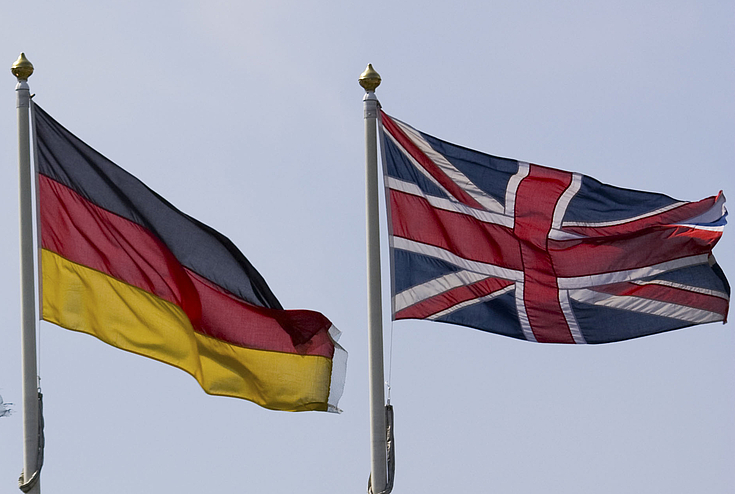
Defense and Security: Rewriting the UK-German Playbook
Beyond domestic political implications, Germany’s election outcome has a profound weight for European defense and security. These areas are ready for enhanced UK-German cooperation under Merz’s leadership. The CDU leader’s calls for Europe to shoulder greater responsibility for its own defense, signalling a shift away from simple reliance on the United States amidst growing transatlantic uncertainties, might give a new impetus to stronger bilateral defense ties between Germany and the UK. These have already been lifted to a new level with the 2024 Trinity House Agreement. However, its implementation might now become a matter of prioritised urgency.
Friedrich Merz has made no secret of his ambition to forge a more autonomous European defense framework, one that explicitly includes closer cooperation with non-EU nations like the UK. His open criticism of U.S. President Donald Trump’s perceived detachment from European concerns underscores this commitment. Merz has even suggesting Germany might seek shelter under the British and French nuclear umbrella as part of a broader European security strategy. Such a proposal could fundamentally reshape NATO’s dynamics.
For the UK, this presents an opportunity to play a pivotal role in shaping Europe’s defense architecture, leveraging its own advanced military capabilities. The Trinity House Agreement already provides a foundation for increased joint activities, such as developing next-generation precision strike weapons, improving interoperability between combat air systems, and protecting critical infrastructure like North Sea underwater cables. These initiatives not only bolster Europe’s collective security but also unlock economic opportunities through increased defense manufacturing collaboration.
However, Merz’s ambitions are not unchallenged. Germany’s military capabilities remain relatively underdeveloped compared to its European counterparts, and securing substantial defense investments will likely face domestic resistance.
Economic Synergy: Seizing New Opportunities
The election also opens the door to new avenues for UK-German economic collaboration, particularly important as both nations grapple with global economic headwinds and stagnation at home. Germany remains the UK’s second-largest trading partner within the EU, with bilateral trade reaching £145.7 billion in 2024. The CDU/CSU’s promise of kick-starting the economy and achieving growth rates of around 2% closely resembles the Labour government’s own central pledge of bringing about the highest economic growth rate for Britain within the G7 group.
Merz pragmatic stance and signalled desire to reset relations with Britain could facilitate negotiations on lowering trade barriers and harmonizing regulations in crucial areas like agriculture. For Prime Minister Starmer, this presents a chance to secure tangible economic wins that could increase Labour’s domestic popularity.

About the Author
Dr. Michael Martin Richter is the UK Country Director of the Hanns Seidel Foundation, based in London.