
Political Analysis
Ceuta, Spain and the Consequences for Europe
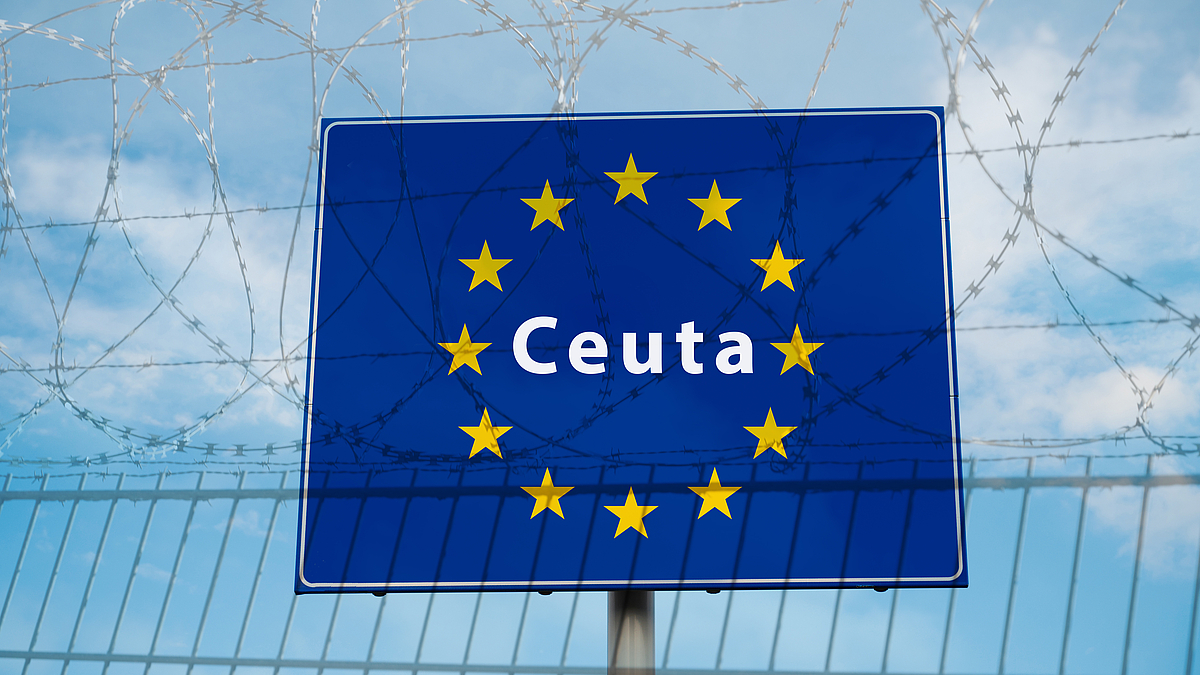
On July 30, a crowd of between 70.000 and 80.000 people overwhelmed personnel on either side on the border between Morocco and the Spanish exclave of Ceuta. According to different media outlets, the march was sparked by (fake) news on social media accounts about a Spanish court ruling, which allegedly implied that crossing into Spain by swimming could not be considered illegal.
While the situation remained unclear for most of the day, a majority of the newly arrived were almost immediately escorted back by Spanish police and security forces through the open gates to the Moroccan side of the border. The Spanish Prime Minister Pedro Sánchez called the massive inflow of migrants an “attack on Spanish sovereignty”. His Minister of the Interior, Fernando Grande-Marlaska, assured nervous television watchers that “all” migrants would have to leave Ceuta. The day after the mass crossing, Óscar Puente (Transport Minister and a close aide to the PM), published a triumphant tweet on X stating that the event showed that “yet another crisis [had been] resolved by Pedro Sánchez”. In his characteristic way, he unfoundedly accused “others” (most likely the conservative opposition) of not wanting the PM to succeed – and even to try to undermine his efforts.
Seldom has a government's helplessness been exposed so clearly
With this media cover, the Prime Minister took off for a four-week holiday. For the residents of Ceuta, reality on the ground proved to be quite different from what their national government had promised. With thousands of migrants still in the city and without refuge, life for its inhabitants grinded close to a standstill: shops closed due to the fear of plundering, beaches were occupied by makeshift shelters built by migrants, with public cleanliness and sanitary conditions declining swiftly, and -as a consequence- tourists cancelling trips to the exclave.
However, the 73-year-old president of the autonomous city of Ceuta (Juan Jesús Vivas from the conservative Partido Popular, in office since 2001) managed to maintain the country’s attention on Ceuta’s perils in the following days. His persistence paid off. While the national government initially appeared intent on repeating an established tactic tested during previous (natural) disasters, to point the finger at local administration, shun own responsibility while offering “support” to overwhelmed security, social and humanitarian services in Ceuta, both the magnitude of the event as repeatedly emphasized by Mr Vivas and Mr Sanchez’ first assessment as a breach of Spanish sovereignty rendered this approach unworkable.
In the following weeks, the rudderless cabinet (Mr Sánchez did not return to his duties until 24 August) had to backtrack on most of the positions defended at the outset of the crisis. While Ceutans were initially promised that virtually all migrants were to leave the city, it then gradually became clear that children and asylum-seekers would have to be taken care of. That means that a transfer of these groups to the Spanish peninsula (and, therefore, the Schengen area), previously categorically ruled out by the government, is likely to occur sometime in the future.
After three weeks, and in the face of attacks by residents on migrant camps and riots by migrants against security forces, the executive in Madrid finally declared a national emergency and appointed a single coordinator for Ceuta, a demand from Mr Vivas from the outset. The measure allows for both regional and national government authorities in Ceuta to be coordinated centrally under the oversight of Ángel Víctor Torres, the Spanish Minister for Territorial Policy. Even government-friendly media outlets could make no sense of the administration’s initial procrastination.

The government vs its security services
Additionally, Mr Sánchez’ coalition partner, the far-left Sumar movement, had started voicing criticism of the handling of the crisis, but not so much for its organizational shortcomings, as displayed, for example, by the chaotic images of food distribution carried out by NGOs. If the PM’s first statement regarding a violation of the Spanish sovereignty over Ceuta could have been interpreted as a critique against sluggish Moroccan border control agents (or even implied some kind of complicity), he himself and his ministers were swiftly trying to counter this impression.
During weeks, both Grande-Marlaska and his colleague for Foreign Affairs, José Manuel Albares, would heap praise on Morocco for its alleged assistance with the repatriation of migrants and for deterring new runs on the border. This position was maintained even when it became clear that the Moroccan cooperation regarding the return of underaged migrants to their families still shows room for improvement.
Inevitably, public debate turned to addressing the question whether the run on the border could have been prevented. Here, the government sought to pass the buck to its security services: Spanish intelligence would have failed to gather and pass any valuable information regarding the massive movements of people within the wider border region. The subsequent blame game left everyone worse off. Leaked intelligence reports seemed to show that the local government delegation indeed had been informed the night before the massive border crossing. Soon after that, images appeared that allegedly showed Moroccan security officials steering migrants into Spain. Only Defense minister Margarita Robles publicly defended the work of the Spanish intelligence agencies, while media close to the government seemed to have found further evidence to sustain their theory of a “deep state” working against Mr Sánchez’ progressive coalition. On September 28, the Government delegate in Ceuta stepped down, changing his version of events; now claiming that daily warnings had been sent to Madrid previously to July 30.
The government vs the lack of European “solidarity”
An additional international fault line emerged when the Italian Prime Minister Giorgia Meloni announced a temporary suspension of Schengen travel arrangements with Spain on July 31. Italy’s PM and her Foreign Minister Antonio Tajani told the press that uncontrolled illegal immigration would pose a threat to European security. Italy already had voiced concerns about the legalization of around half a million undocumented immigrants by the Sanchez’ government, a process initiated in April 2026. The move, though mainly motivated by domestic politics on the Italian side, granted some relief to the Spanish administration as well: the Mediterranean neighbors were accused of a lack of solidarity. Attention was thus momentarily shifted to a (foreign policy) domain where the Sánchez government excels, namely its self-proclaimed stance against a supposedly reactionary populist wave in the EU (and abroad). Spanish commentators referred to the case of migrants instrumentalized as a “hybrid threat” in the Polish-Belarus border region in summer 2021, when European partners stood unapologetically by the side of Poland.
Nevertheless, the Spanish government may have overplayed its hand and overstretched the patience of its EU partners in previous spats over Israel, China and spending on security and defense. A remarkable majority of 22 member states signed an open letter to European authorities demanding better control of EU borders and criticizing Spanish migration policies. Just a handful of EU members – although with the heavyweight France in their ranks– decided to not sign the note.
What does Marrocco have on Mr. Sánchez?
Ever since the Spanish government in 2022 has made public that the PM and several members of his cabinet had been spied upon with the help of the Israeli-made Pegasus software introduced into their mobile phones, speculation had been rife about what information the attackers could have obtained – and if that could condition Spanish government policies. The hacking was found to have taken place between 2020 and 2021, when a first border breach in Ceuta took place (although on a much smaller scale) and Marocco and Spain were in a diplomatic row regarding Marrocco’s long-standing rival Algeria. Conspiracy theories were fueled by PM Sánchez’ surprising U-turn on the question of the sovereignty over the Western Sahara, a former Spanish colony claimed by Marrocco in early 2022. The initial praise of the bilateral cooperation with its African neighbor and the delayed lukewarm critique at insufficient border control measures constitutes clear evidence, in the eyes of some observers, that Morocco may possess compromising information on Pedro Sánchez and his government.
Although Morocco sees Ceuta and Melilla (the other Spanish enclave within its territory) as relics of colonialism, it remains unclear what the immediate motivation for a hypothetical opening of the borders could have been. Some cite a Spanish-Algerian rapprochement as a probable cause. Be that as it may, any action taken may have backfired: Spaniards massively flocked to Ceuta-solidarity marches all over the mainland.
Besides the still unresolved situation of the several thousand migrants remaining in the Spanish autonomous city, the Ceuta crisis exposed the need for further European debate on border security as well as accompanying mechanisms for internal coordination and cooperation. It would be naïve to believe that the events of July 30, whether induced or not, could not be repeated – at any of Europe's external borders.

About the Author
Dr. Adriaan Kühn is a lecturer of Political Science and International Relations at University Francisco de Vitoria in Madrid, Spain. He also serves as UFV’s Director of the Robert Schuman Institute for European Studies.
Contact
