
Political Analysis
Can Regional Cooperation make Europe Safer? Security in the EU Strategy for the Danube Region
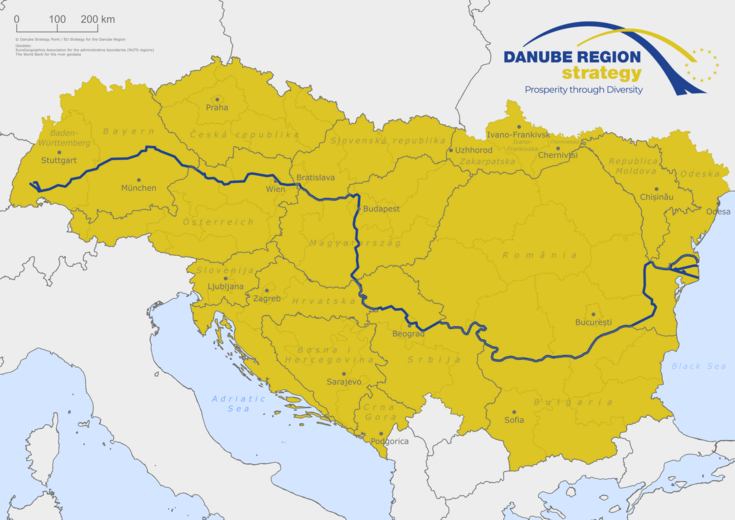
Map of the EU Strategy for the Danube Region @Danube Strategy Point
When security does not stop at borders
A smuggling network does not care where one country ends and another begins. Neither does a flood. A cyberattack can travel across Europe in seconds. Damage to an energy network can affect several countries at the same time.
This creates a fundamental problem for European security: many threats transcend national borders, requiring institutions working together across sectors and responsibilities.
In the Danube Region, this challenge is particularly evident. The Danube River connects fourteen countries from Central Europe to the Black Sea, making the region highly interconnected and vulnerable to cross-border risks that cannot be effectively addressed by a country or institution alone. To respond to shared challenges, the European Commission established the EU Strategy for the Danube Region (EUSDR) in 2011. It provides a framework for cooperation and knowledge exchange between public authorities, organisations, and other stakeholders. Its core aims are to achieve territorial cohesion and development by better connecting and strengthening the region, protecting the environment, and building prosperity [1]. Security is an important part of this picture.
The EUSDR, as a macro-regional strategy, brings together the fourteen countries Austria, Bosnia and Herzegovina, Bulgaria, Croatia, Czechia, the German states of Baden-Wuerttemberg and Bavaria, Hungary, Moldova, Montenegro, Romania, Serbia, Slovakia, Slovenia, and Ukraine [2]. The participating states are not all EU member states. Nine are EU members, while five are EU candidate countries. This is one of the strategy´s strengths: the region it covers extends beyond the EU´s external borders.
The EUSDR therefore serves as a platform where EU and non-EU states can work together on joint solutions. Its Priority Areas cover issues ranging from transport and environmental protection, to economic development and social welfare, to institutional capacity and security.
One of the most important areas is Priority Area 11 (PA11), which is dedicated to security. But what does “security” mean in practice within the EUSDR?
From organised crime to cyber threats
Within its PA11, the EUSDR focusses on some of the most pressing security challenges in the Danube Region: combatting serious and organised crime, cyber security, and enhancing effective border management and cross-border cooperation of law enforcement agencies [3]. By bringing together security authorities from all fourteen countries, the EUSDR plays a key role as a coordination platform.
National ministries work together with border police and customs agencies; cooperation also involves organisations such as AQUAPOL (Law Enforcement Network for Inland & Maritime Transport), the European security agencies Europol (European Union Agency for Law Enforcement Cooperation) and Frontex (European Border and Coast Guard Agency), as well as Interpol (International Criminal Police Organisation) and the regional initiative SELEC (Southeast European Law Enforcement Center).
These organisations are cooperating by sharing information, coordinating activities, developing common regulations and procedures, strengthening the capability of authorities to act across borders and ensuring that they know how to respond when a threat actually emerges.
From framework to action – the example of DARIF
While the EUSDR provides the framework for regional cooperation, projects such as DARIF (Setting up a Danube River Forum) turn these goals into concrete action [5].
Implemented already more than 10 years ago, between 2013 and 2015, its objective was straightforward: make the Danube River safer by increasing cooperation between police and law enforcement agencies in the countries along the river. The focus was set on coordinated actions, so-called “Joint Operations”. During those, authorities conducted patrols and controls along the river to detect cases of smuggling and trafficking, environmental crimes, breaches of transport laws, and to secure the Danube as a safe transport corridor. The cooperation between countries and institutions was a decisive part in implementing the project. By coordinating their actions, the participating countries were able to control large sections of the Danube simultaneously.
The Hungarian Ministry of the Interior, which led DARIF, has continued organising Joint Operations on the Danube every year since the project was completed. This might be the lesson of DARIF: successful regional cooperation can outlive the project where it was created.
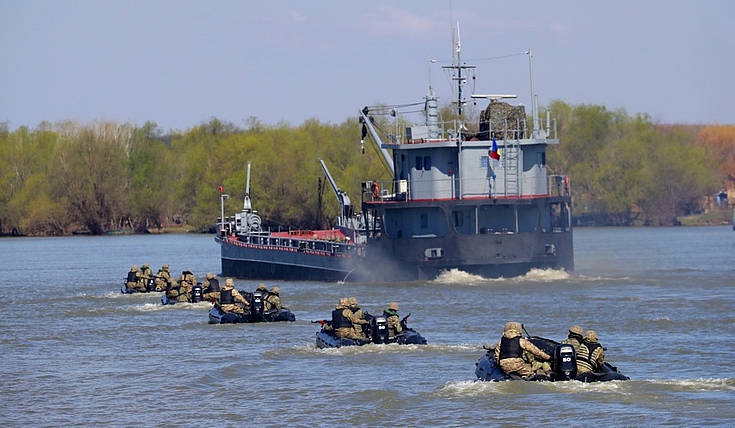
Romanian Navy light crafts escort a dredger ship during NATO exercise Sea Shield 2023 in the Danube Delta near Mahmudia harbor
@EPA-EFE/ Robe Ghement
The Danube: transport route, security corridor and geopolitical space
The significance of the Danube River goes beyond organised crime and law enforcement.
It connects Central Europe with the Black Sea and forms an important link between the heart of Europe and its south-eastern neighbours. As a transport route for goods and people, it plays an important economic and strategic role for Europe. Since Russia´s full-scale invasion of Ukraine, Danube ports have helped maintain Ukraine´s exports, reopen vital trade routes while bypassing Black Sea blockades, and support global food supplies [6].
As a gateway to Russia, China, and the Middle East, the river has a significant geopolitical dimension, too. Russia´s war against Ukraine has fundamentally changed Europe´s security environment. Alongside its conventional war against Ukraine, Russia increasingly employs hybrid means such as cyberattacks, disinformation, sabotage and interference with critical infrastructure across Europe. Against this backdrop, the countries of Central and South-Eastern Europe are increasingly dealing with military mobility, the security and resilience of critical infrastructure and people.
This raises a broader question:
What role can the EUSDR play within Europe´s security architecture?
The Danube River can play a decisive strategic role in military activities for the Eastern flank of the Union, as it is a “natural line of defence and a vector of mobility for the armed forces” [7]. And a deepened cooperation between the countries of the Danube Region, including EU accession countries and non-EU countries, will lead to a stronger Europe and heightened security on the Eastern flank.
This points to an important role that regional cooperation can play in strengthening European security. However, the EUSDR is not a security or defence strategy, nor is it meant to become one. Its strength lies elsewhere.

@EdNurg
Security beyond the military scope
Security is often only associated with “hard security” - meaning military capabilities, borders, and national security. These are essential elements of defending a country. The EUSDR takes on a broader view of security. Besides its focus on capacity building of police authorities and combatting crime, its activities contribute to disaster preparedness, environmental protection, infrastructure resilience, and regional development, which fall under “soft security”.
In this sense, it reflects the United Nation´s Development Programme´s concept of “human security”. The concept shifts the focus from states to people, defining seven dimensions of security: economic, food, health, environmental, personal, community, and political security [4]. These dimensions are all interconnected. For example, a cyberattack against critical infrastructure can become an economic, environmental, social, personal and political issue. A flood constitutes not only an environmental challenge, but can destroy homes and food supplies, damage infrastructure and interrupt transport, and become a challenge for public authorities.
Security is therefore not only about defending borders, but building resilience and stability with non-military approaches.
The EUSDR can complement existing European security structures by providing a platform for cooperation and resilience building. Its strengths lie in connecting countries and institutions. By including EU accession countries and non-EU neighbours, the EUSDR extends regional cooperation beyond EU external borders. At a time when the security landscape is becoming increasingly complex, the EUSDR demonstrates how macro-regional cooperation can complement national and EU policies. By creating partnerships, building trust, connecting civilian and governmental actors, strengthening institutional capacities, and promoting knowledge exchange.
Like all other macro-regional strategies, it was established with the prerequisites of the “3 No´s”: no new EU funding, no new EU legislation, and no new EU institutions [1]. This provides the strategy with both flexibility and local ownership. Instead of being tangled within bureaucratic structures, governments and communities are forced to optimise the use of existing resources and cooperate efficiently. By relying on existing administrative structures and a multi-level governance approach, the strategy includes actors from national, regional, and local levels - while working across borders – and allows the adaptation of activities to local needs.
But it also raises big challenges for the implementation of the EUSDR´s objectives.
The limitations to cooperation
Significant economic and social disparities continue to exist within and among EUSDR countries. The COVID-19 pandemic exposed and, in some cases, deepened these. Additionally, climate change, terrorism, digital developments, and the consequences of the ongoing war between Russia and Ukraine place pressure on the region.
Other difficulties lie in the conceptual structure of the EU Strategy. Funding remains a main challenge. To implement projects, resources need to be acquired from existing EU programmes, but these have undergone strict budget cuts. Additionally, to be able to access these funds, EUSDR priorities need to be closely aligned with EU funding programmes´ priorities. The lack of financial resources and the gap in the alignment are a continuous challenge.
Weak political commitment of participating states – both at the working and the highest political level, insufficient cooperation between EUSDR stakeholders and gaps between strategic ambitions and implementation raise the challenges already at hand [8].
The strategy can provide the framework for cooperation, but it needs to be backed by political will and adequate resources. Its success will depend on the commitment to turn the objectives into action.
Regional Cooperation through the EUSDR for a stronger Europe
Nonetheless, the EUSDR provides an added value to European cooperation. The strategy serves as a platform to connect countries, institutions, and people to work together across borders. It turns political objectives into practical cooperation and challenges into opportunities for joint action. By strengthening cooperation, building institutional capacity, sharing knowledge, and enhancing resilience, the EUSDR contributes to greater stability and security in the Danube Region. And regional cooperation not only strengthens security at the regional level but contributes to a safe and more resilient Europe as a whole.
References
[1] European Commission. (2010b, December 8). Communication from the Commission to the European Parliament, the Council, the European Economic and Social Committee and the Committee of the Regions: European Union Strategy for Danube Region (COM/2010/715 final). https://eur-lex.europa.eu/legal-content/EN/TXT/PDF/?uri=CELEX:52010DC0715&qid=1763994839106
[2] Directorate-General for EU Regional and Urban Policy. (2025b). EU Strategy for the Danube Region. European Commission. https://ec.europa.eu/regional_policy/policy/cooperation/macro-regional-strategies/danube_en
[3] European Commission. (2020b, April 6). Commission Staff Working Document: Action Plan replacing Staff Working Document SEC(2010) 1489 final accompanying the Communication from the Commission to the European Parliament, the Council, the European Economic and Social Committee and the Committee of the Regions: European Union Strategy for Danube Region (SWD/2020/59 final). https://eur-lex.europa.eu/legal-content/EN/TXT/PDF/?uri=CELEX:52020SC0059
[4] United Nations Development Programme. (1994). Human Development Report 1994. https://hdr.undp.org/content/human-development-report-1994
[5] Balog, G., Barnácz, I., Czuczor, Á., Herczeg, M. Kalmár, Á., Kozma, S., Mezö, G., Vas, G. & Vörös-Gyöngy, A. (2015). Setting up the Structure of a Danube River Forum: DARIF. Ministry of Interior of Hungary. bmprojektek.kormany.hu/download/b/37/f0000/DARIF%20publication%20-%20Results%20and%20Conclusions%20EN.pdf
[6] Association of Ukrainian Regions for the Danube Strategy. (2025, May 31). The Danube as a Strategic Security Artery: Key Takeaways from the Black Sea Security Forum in Odesa. https://www.danube-region.com.ua/en/the-danube-as-a-strategic-security-artery-key-takeaways-from-the-black-sea-security-forum-in-odesa/
[7] Cînjău, A. V., Moldoveanu, C. & Popescu-Necașu, T. (2025). The Strategic Role of the Danube in Developing an Integrated Maritime Security Strategy for Romania in the Black Sea. Proceedings of the 21st International Scientific Conference: Strategies XXI: “Technologies, Military Applications, Simulation and Resources”, 24-31. Retrieved October 2025, from https://www.academia.edu/download/124174720/Strategies_XXI_2025_Tehnologies_Military_Applications_Simulation_and_Resources.pdf#page=25
[8] D’Ambrogio, E. & van Lierop, C. (2022, February 28). Renewed EU Strategy for the Danube Region (EUSDR) (Briefing PE 729.277). European Parliamentary Research Service. https://www.europarl.europa.eu/RegData/etudes/BRIE/2022/729277/EPRS_BRI(2022)729277_EN.pdf

Lea Krolak
About the author
Lea Krolak is a project coordinator for Central and Eastern Europe at the Hanns Seidel Foundation. She holds a B.A. in International Relations. In her bachelor thesis, she examined the topic of security in the EU Strategy for the Danube Region.
Contact
