
Short Article
APEC summit – toward greater fragmentation in the Indo-Pacific?
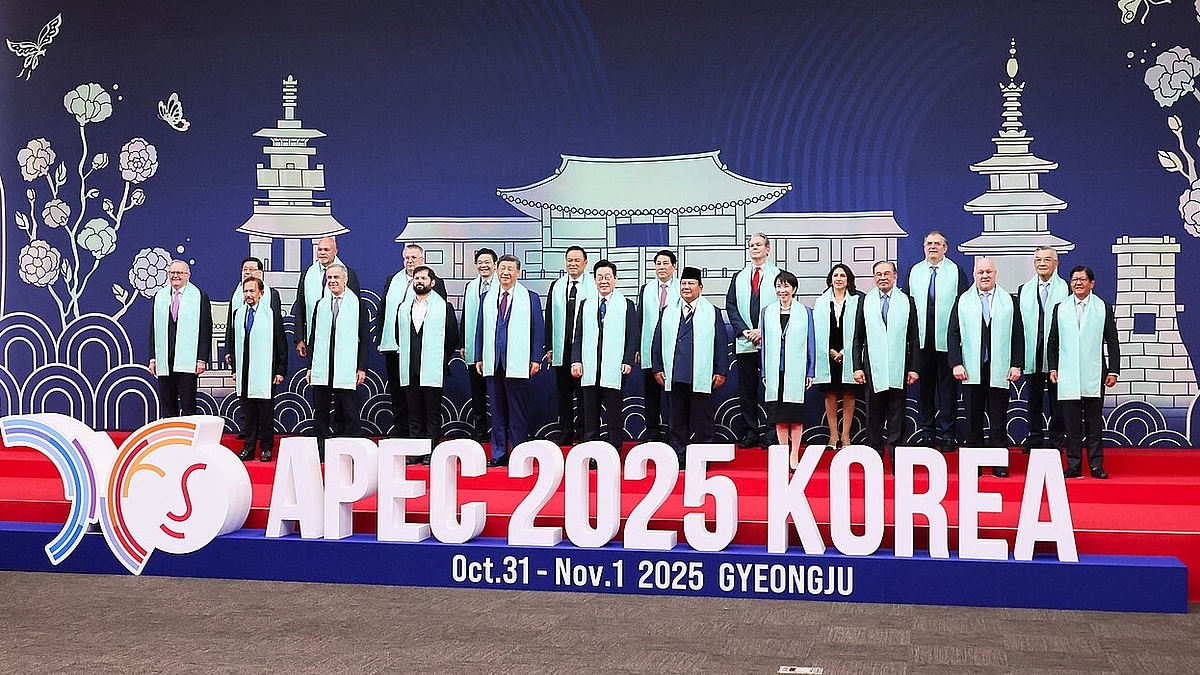
The APEC summit In Gyeongju in South Korea brought together delegations from 21 countries, including heads of state and government of 18 countries
Once upon a time, in the late 1980s, the rampant fear of a “fortress Europe” closing for international trading opportunities led to a counter-movement, the founding of the Asia Pacific Economic Cooperation, in 1989 in Canberra. Much less ambitious than the European Communities (and later European Union), APEC was founded to foster trade integration based on voluntary action and peer pressure, not on the same, rigid system (called “acquis communautaire”, the sum of all rules and regulations) like in Europe. APEC developed splendidly, and today in the 21 APEC member countries from East Asia and Australasia, North America, Central America and Latin America 60 percent of world output are produced, and a little less than half of world trade takes place. When in 2005 in November the APEC (Asia Pacific Economic Cooperation) summit took place for the first time in South Korea, in Busan, countries around the region were in anticipation of greater integration and unity. China had become a member of the World Trade Organization (WTO), and some years before, in the aftermath of the East Asian crisis, East Asian countries invented the ASEAN plus three (China, Japan, Korea) format to foster trade relations and integration.
How the times changed! When twenty years later the APEC countries again met in Korea, this time on November 1st in the old royal city Gyeongju of the Shilla Kingdom, from the time, when Korea was divided in several kingdoms, the hopes for greater unity and integration were largely dashed and the summit´s ambition was rather to reduce tensions than to follow new integration projects. The second presidency of Donald Trump in the USA, as well as the ascent of China and its much more assertive role in the Indo-Pacific largely overshadowed any joint agenda. And the host himself, Lee Jae Myong, the new president of South Korea, only recently had been elected in a snap election after the botched declaration of martial law and subsequent impeachment of his predecessor, Yoon Seok Yeol.
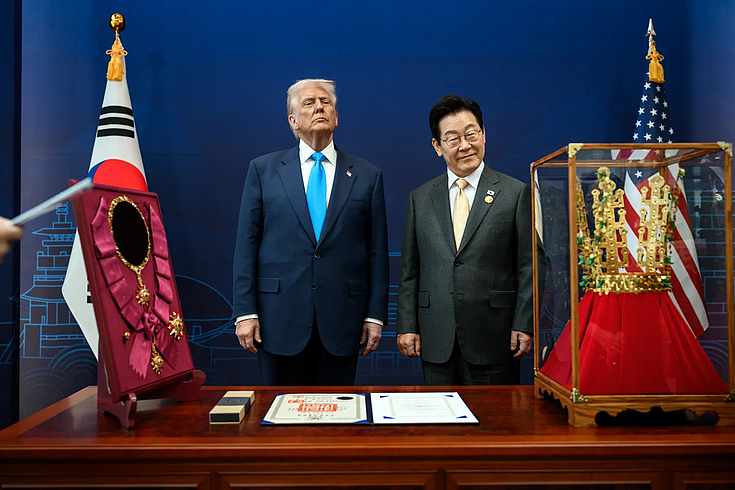
Bilateral Meeting between President Donald Trump of the USA and President Lee Jae Myong of South Korea. The South Korean present, a crown of the Shilla kingdom period (6th century AD) found great and sometimes ironic attention due to the simultaneous “no kings” demonstrations in the USA.
Lee Jae Myong – a competent host of the meeting
Lee Jae Myong, a left-of-center candidate with no great foreign policy experience, formerly known for his populist policies, all in all managed the summit surprisingly well and was rightly praised for his approach in summits with the bigwigs of the party, president Donald Trump of the USA, president Xi Jing Ping of the People´s Republic of China and Prime Minister Sanae Takaichi of Japan, plus a number of other meetings with heads of state, business leaders and important guests like the managing director of the International Monetary Fund, Kristalina Georgieva. However, the message of the leader´s meeting remained almost invisible, compared to the highly scrutinized bilateral summit meetings, and that says a lot of the current state of affairs in the Indo-Pacific.
throughout the year the APEC already held various meetings in Korea. Interesting and new was the first Ministerial Meeting on Digital and AI transformation in Incheon, where ministers from 21 member economies discussed ways to foster innovation, expand digital connectivity, and ensure the safe use of AI technologies. Technology cooperation is also the focus of the Digital Economy Steering Group (DESG) and policy frameworks such as the APEC Internet and Digital Economy Roadmap (AIDER). The voluntarism in enacting policy frameworks adds to the flexibility of APEC, but also limits its usefulness, in case countries do not comply. The APEC leaders meeting, the highest level of representation in APEC, met under the theme "Building a Sustainable Tomorrow: Connect, Innovate, Prosper," highlighting innovation-driven connectivity and responsible technological governance as cross-cutting priorities. While this, plus a number of side events like capacity-building workshops and technological dialogues, as well as the dialogue with businesses, most importantly in the APEC CEO summit, were important, the real focus was on the bilaterals.
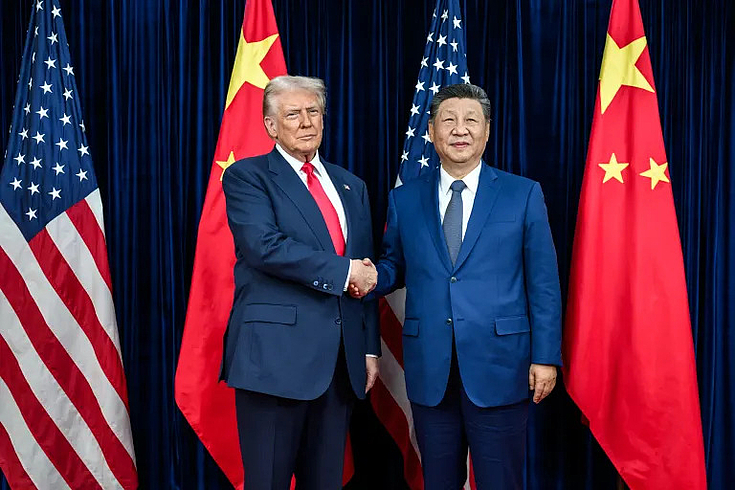
Bilateral meeting of President Donald Trump of the USA and President Xi Jing Ping of China. The bilaterals were probably the most important outcome of the APEC summit 2025.
The importance of bilateral meetings
Most important were the meetings of president Donald Trump with the host, president Lee Jae Myong of South Korea, and with president Xi Jing Ping of the People´s Republic of China. In both summits, president Trump showed his flexibility, not focusing on the topics which had for months dominated headlines and created strife, namely tariffs, demands for higher participation of South Korea in the costs of military deployments in South Korea and the economic sanctions against China. And both summits brought some positive environment for deals more acceptable for the trading partners of the USA. The South Korean side had also hoped that president Trump might meet with North Korean leader Kim Jong Un, and had blocked, for example, access of civilians to the Demilitarized Zone between South and North. This, however, did not take place, but there is a chance, it will happen in next spring. Next spring, also, probably a visit of Donald Trump to China is foreseen. Given the often hostile exchanges of both sides, this is good news.
The fragility of bilateral approaches was seen with another widely scrutinized meeting: Chinese president Xi Jing Ping also met with the new Japanese prime minister Sanae Takaichi, who just a week before had assumed her new job. During the summit, both were friendly and exchanged good wishes and hopes for cooperation. But only a week later, prime minister Takaichi in a debate in the National Diet of Japan called a potential crisis over Taiwan an “existential threat” for Japan, implying Japanese military reaction. This was followed by a wild outburst of the Chinese consul-general in Osaka, Xue Jian, who wrote on X on that "we have no choice but to cut off that dirty neck that has lunged at us without a moment's hesitation. Are you ready?” Later, this was retracted, but from that time on recriminations on both sides and a vile campaign in the official Xinhua News agency depicting Takaichi as a warmonger is ongoing.
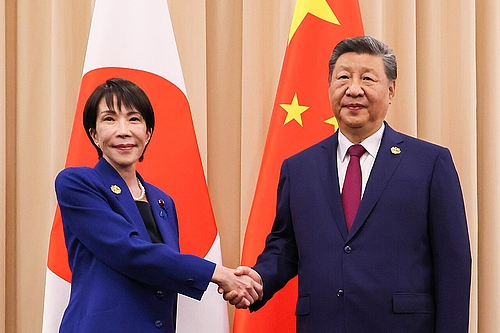
Still smiling – while the summit meeting of the new Japanese prime minister Sanae Takaichi and president Xi Jing Ping of China remained friendly, only a week later hostilities broke out regarding the relations of Taiwan and Japan.
Wither APEC?
The decline of the relative appeal of APEC vis-à-vis bilateral approaches is best shown by the fact that Donald Trump did not bother to stay for the final, and supposedly most important APEC meeting, the APEC leaders meeting, but only attended a dinner with the other leaders and let his Treasury secretary Scott Bessent represent the USA at the leaders meeting. The 2025 APEC summit ended without great surprises. The relative decline of the joint, APEC approach, might lead to a conclusion that APEC is obsolete. But in an increasingly fragmented world formats like these, where leaders can meet and exchange opinions, are not at all obsolete, even if the aspirations for ever more and more comprehensive integration have been dashed. Deal-making, negotiations and free bilateral or multilateral exchanges need such occasions. Even, if no formal deals were concluded, certainly the set for more negotiations has been staged. The presence of 18 out of 21 heads of state shows the continued importance of APEC. The non-participation of Russian president Vladimir Putin, and instead the participation of Russia´s deputy prime minister Alexey Overchuk, shows that multilateral engagement by states is not a case by case issue independent of world politics – Vladimir Putin could not come, since South Korea is state party to the International Criminal Court, which issued an arrest warrant for him. At the same time, Russia as a state was not banned and it is clear that Russia´s role is seen differently in APEC than in Europe.
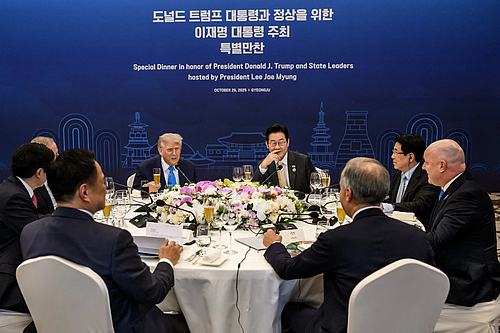
State leaders dinner on the eve of the summit: President Trump left after the dinner, leaving his treasury secretary Scott Bessent in charge.
For Europe, the development of APEC and the recent APEC summit hold some important lessons: First, while the rise of bilateral dealings is undeniable, APEC remains a powerful trade bloc in the world. Second, Europe has the chance to benchmark APEC to consider the advantages and disadvantages in more flexibility and more rigidity in trade policies and other community policies. Finally, APEC is also a reality check for revaluing the Euro-centric view of geopolitics. While for Europe, the European conflicts, and here in particular the Ukrainian battlefield, are of overwhelming interest, this is less so for other world regions. The newly published US National Security Strategy clearly has a pivot towards the US itself, second towards the Indo-Pacific and third toward the Middle East. The European theatre only ranks fourth. This might hurt European pride, but without seeing these realities, Europe´s own strategic hopes might easily be disappointed.

About the Author
Prof. Dr. Bernhard Seliger is representative of Hanns-Seidel-Foundation in Korea and specializes in economic institutions and economic development in Northeast Asia and the Korean Peninsula.
Kontakt
