
EU-US Relations after Midterms
“It Is an Illusion to Believe We Can Live Without Each Other”
AdobeStock
The United States elected the 120th United States Congress on 3 November: all 435 seats in the House of Representatives and 35 of the 100 seats in the Senate. While the elections are widely considered an electoral defeat for President Trump and the Republican Party, the results do not only define the future political landscape in the United States; the new US Congress will also shape the transatlantic partnership, either by constraining or supporting the current administration’s political agenda. At the same time, commentators have already raised concerns that a domestically restrained lame-duck President Trump will shift his focus back to foreign policy, potentially creating further frictions with the EU.
Over the past years, several flashpoints — from strategic moves in Greenland to ongoing debates over NATO commitments and a war against Iran, trade disputes, and climate and technological regulation — have tested longstanding assumptions about alliance reliability and shared political goals. Therefore, maintaining the transatlantic partnership requires continuous dialogue and cooperation at all levels.
Together with experts and decision-makers from both sides of the Atlantic explored the present and future trajectories of the EU-US relations. To what extent will the EU and the United States align in their economic and security interests? Will the transatlantic relationship remain a cornerstone of international security, prosperity and shared democratic values?

Discussed the future of EU-US relations: Christian Forstner, Dimitar Lilkov, Assita Kanko and Ron Nehring.
HSS Europe
EU needs to become more realistic
Assita Kanko, Member of the European Parliament from Belgium and Vice-Chair of the European Conservatives and Reformists (ECR), had recently visited Nashville and met with American counterparts. She reminded the audience that Europe needs to work with whoever is governing in Washington. "It is an illusion to believe that we can live without each other." Especially in the area of cybercrime, she sees a common interest in cooperating closely on digital platforms and Artificial Intelligence (AI) to protect women and children.
In the current geopolitical environment, the goal was for Europe and America not to become divided. For example, she would like to see stronger cooperation with American defence companies, since they provide products that Europe cannot produce on its own. Yet the partnership goes beyond trade, she said. Strategically, there was no other partner like the United States with whom to protect Western values. Therefore, she also wished the EU to become more realistic about the world we live in.
Return to conservative principles and free trade?
On the US midterms, Ron Nehring, a political strategist and former chair of the Republican Party of California when Arnold Schwarzenegger was governor, explained that external factors were part of the story of why Republican candidates suffered defeat. The war in Iran, with its effect on fuel prices, as well as tariffs, played a role in voter rejection, he said. In American history, however, the party holding the White House regularly loses the midterm elections. And one of the biggest internal problems was that Republican campaigns had become "nationalised", meaning that a currently unpopular national Republican identity overshadowed the identities of local candidates.
Looking ahead to the 2028 presidential elections, Nehring sees the field as wide open for candidates in his party. Europeans should "cheer on" the traditional Reaganite Republicans who believe in free trade and NATO. But that also required conservatives in Europe to return to their roots and to live up to those principles, too. For example, Europe had been a proponent of free trade in the car industry, but had been rather protectionist on agriculture, treating American farmers unfairly.
Foreign and trade policy may not change entirely with Democratic Party
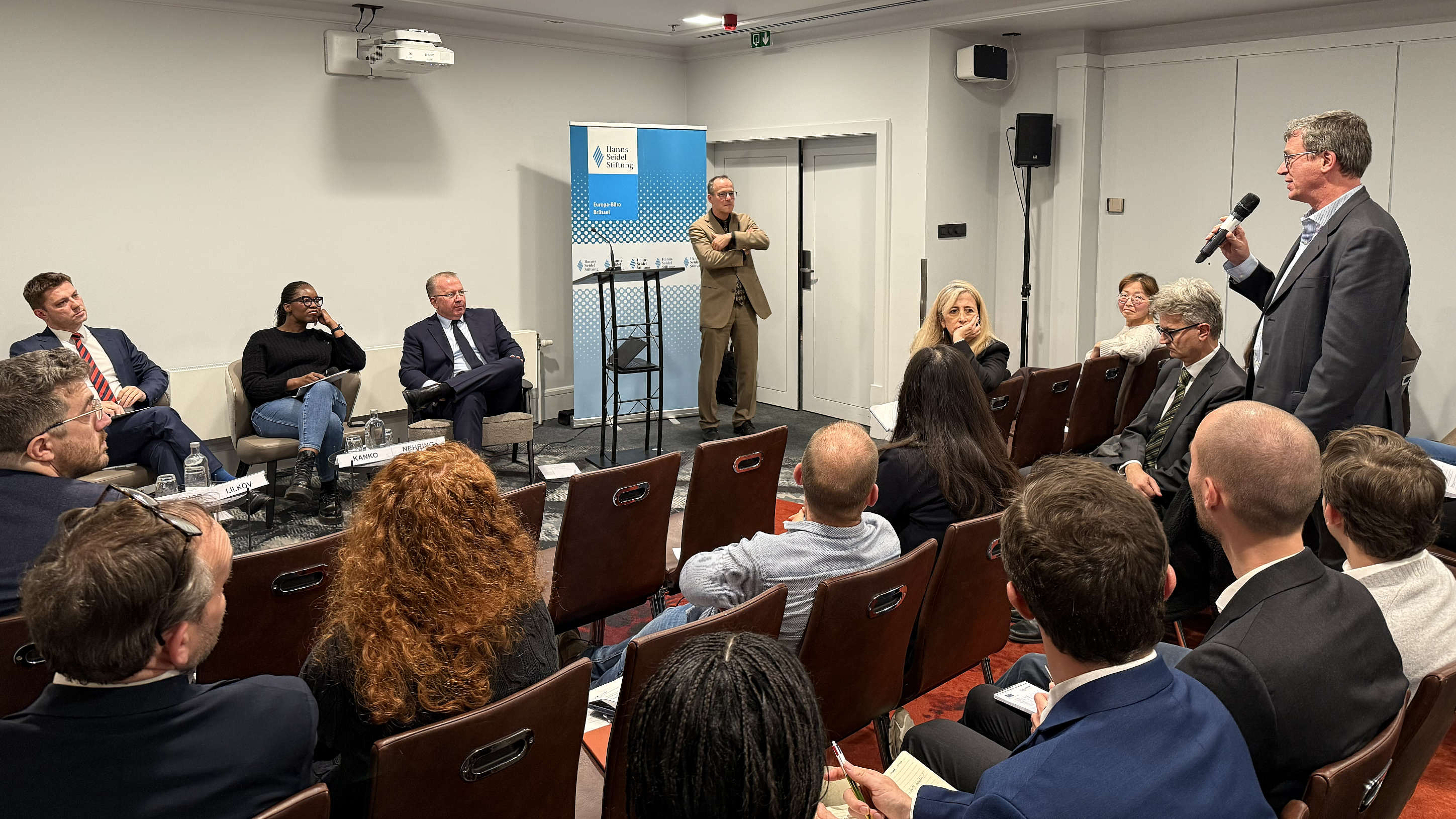
Audience question on the partnership between Europe and the United States.
HSS Europe
Dimitar Lilkov, Senior Researcher at the Wilfried Martens Centre for European Studies (WMCES), was more critical of the current dynamics between the US and the EU in general. Noting that Congress lacked a two-thirds majority to overrule the President on foreign policy, he pointed to the unreliability of the current administration when it comes to Russia and China. In addition, he criticised traditional Republicans for their lack of visible opposition to the MAGA movement.
At the same time, Lilkov warned that Brussels should not take for granted that the Democratic Party may become fully "pro-European" if it won further elections. He recalled that under President Biden, Washington had not coordinated the withdrawal from Afghanistan and had introduced protectionist policies such as the Inflation Reduction Act.
Similarly, he's currently following the Multilateral Alignment of Technology Controls on Hardware (MATCH) Act being discussed in Congress. "Domestic policies have extraterritorial implications, also for the revenues of European companies.”
Contact

Director

Policy Advisor